
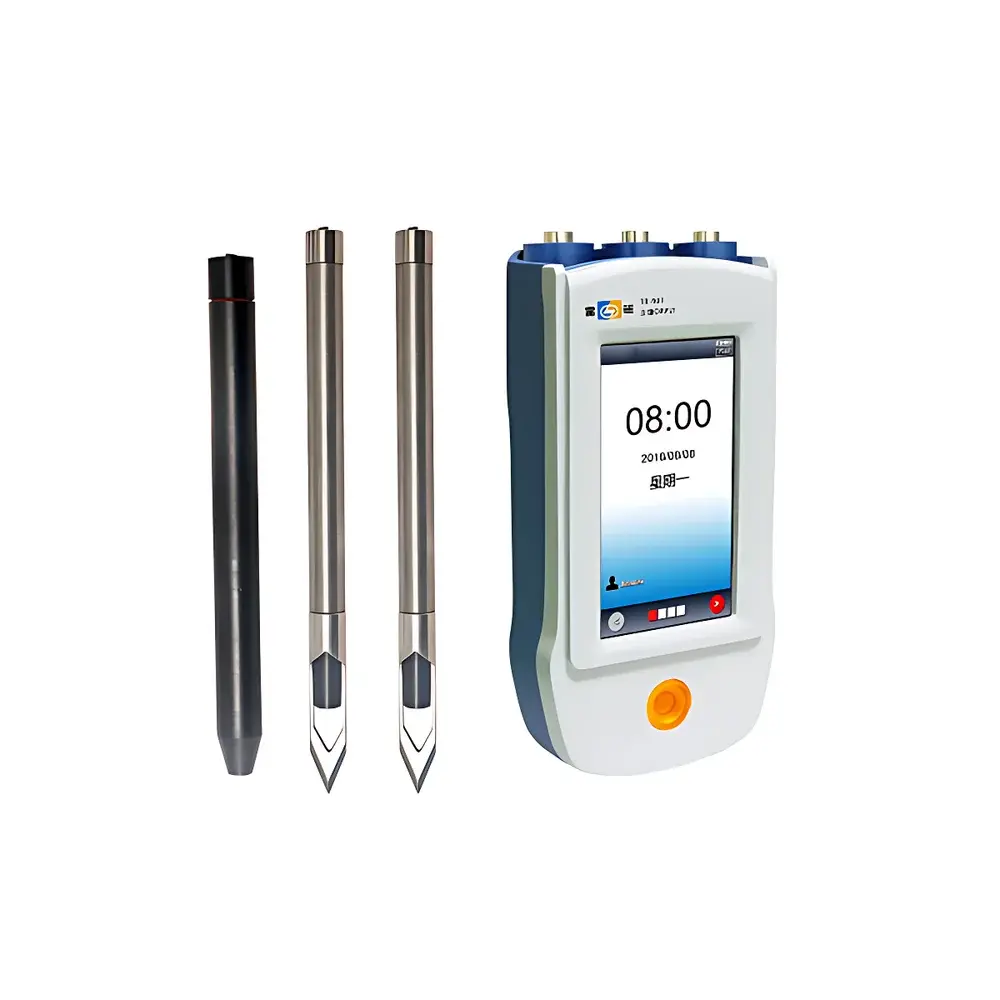
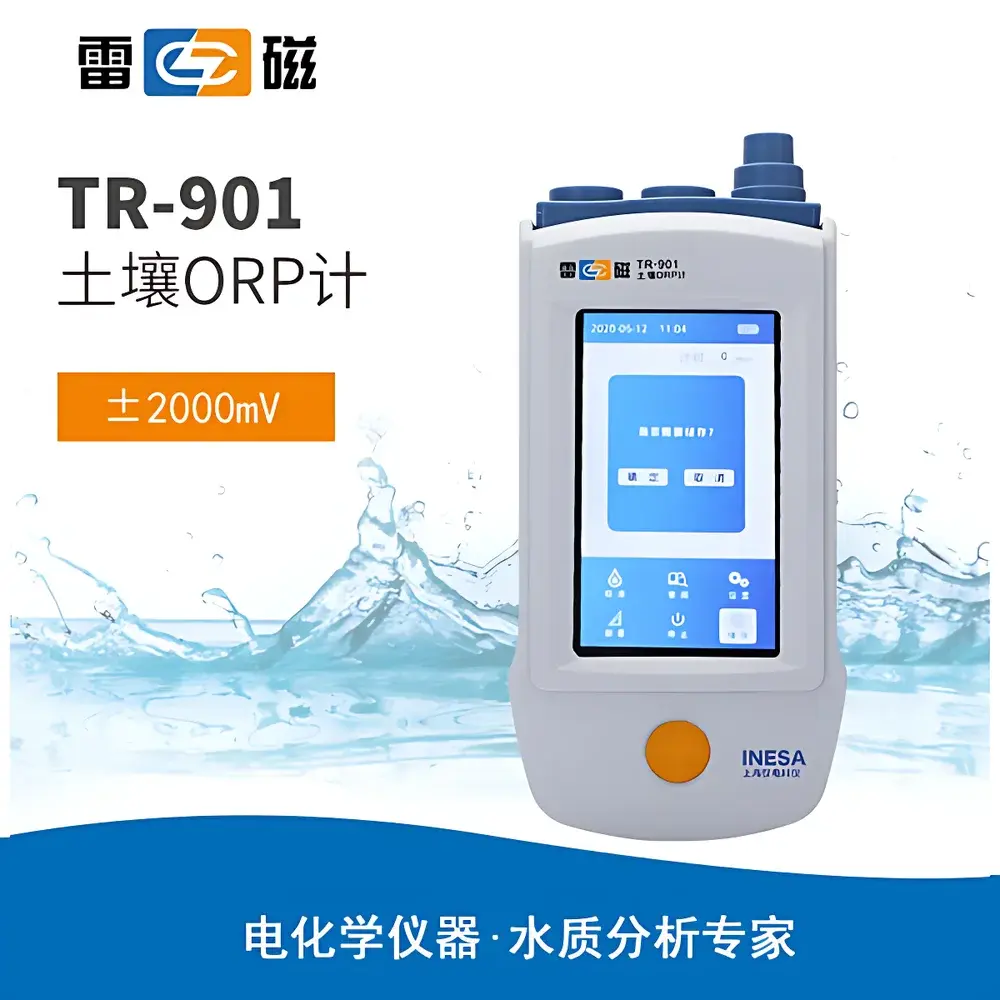
Leici TR-901 Soil ORP Meter
| Brand | Leici |
|---|---|
| Origin | Shanghai, China |
| Manufacturer Type | Direct Manufacturer |
| Regional Classification | Domestic (China) |
| Model | TR-901 |
| Instrument Type | Laboratory & Field-Portable ORP Meter |
| Measurement Range | ±2000 mV (ORP), 5.0–60.0 °C (Temperature) |
| Resolution | 1 mV (ORP), 0.1 °C (Temperature) |
| Basic Error | ±1 mV (within −1000 to +1000 mV), ±0.1% FS (outside that range) |
| Calibration | 1-point or 2-point ORP calibration |
| Temperature Compensation | Automatic and manual modes |
| Data Storage | 500 measurement sets |
| Protection Rating | IP65 |
| Power Supply | Rechargeable Li-ion battery, compatible with external mobile power banks |
| Display | Color touchscreen with guided navigation interface |
| Sampling Interval | Configurable in minutes |
| Additional Features | Auto-read lock, auto-backlight, auto-power-off, dual-channel ORP input |
Overview
The Leici TR-901 Soil ORP Meter is a dedicated field-portable and laboratory-grade instrument engineered for direct in-situ measurement of oxidation-reduction potential (ORP or Eh) in fresh or moist soil matrices. ORP serves as a critical integrative indicator of soil redox status—reflecting the thermodynamic tendency of electron transfer reactions—and strongly influences biogeochemical processes including nutrient speciation (e.g., Fe²⁺/Fe³⁺, Mn²⁺/Mn⁴⁺), contaminant mobility (e.g., Cr(VI) reduction, As(III) oxidation), microbial metabolism, and organic matter decomposition. The TR-901 implements potentiometric measurement based on the Nernst equation, utilizing a robust two-electrode configuration: a platinum or inert metal working electrode paired with a stable reference electrode (typically Ag/AgCl or calomel), both integrated into a stainless-steel hollow probe assembly designed for minimal soil disturbance during insertion. Its design complies strictly with HJ 746–2015, the official Chinese Environmental Protection Standard for Determination of Soil Oxidation-Reduction Potential by Potentiometric Method—a protocol aligned with internationally recognized principles found in ISO 11261 and ASTM D3841.
Key Features
- Dual-channel ORP input architecture ensures simultaneous acquisition from working and reference electrodes, meeting mandatory requirements of HJ 746–2015 for electrode potential stability verification and drift correction.
- Integrated stainless-steel hollow probe system enables rapid, low-intrusion insertion into undisturbed soil profiles—eliminating the need for slurry preparation or extraction, thereby preserving native redox microenvironments.
- High-resolution color touchscreen with context-aware, menu-driven navigation simplifies operation under variable field lighting and glove-compatible conditions.
- Intelligent auto-read function locks measurement once signal stability (±1 mV over 10 s) is achieved, delivering final reported values without post-hoc conversion or manual calculation.
- Comprehensive temperature compensation: automatic via built-in thermistor (5.0–60.0 °C range) with optional manual override for use with external calibrated probes.
- Configurable data logging interval (in minutes), enabling time-series monitoring of redox dynamics during incubation experiments or field diurnal surveys.
- IP65-rated enclosure provides dust-tight protection and resistance to low-pressure water jets—suitable for extended outdoor deployment in humid, muddy, or rain-exposed environments.
- Rechargeable lithium-ion battery supports >12 hours of continuous operation; USB-C port allows hot-swappable charging via portable power banks—critical for remote site work without AC infrastructure.
Sample Compatibility & Compliance
The TR-901 is validated for direct measurement in non-saturated, cohesive, and granular soils—including agricultural topsoil, wetland sediments, landfill cover materials, and contaminated brownfield matrices—provided moisture content exceeds field capacity to ensure sufficient electrolyte continuity. It is not intended for dry, highly resistive, or rocky substrates lacking ionic conduction pathways. All operational protocols, electrode handling procedures, and calibration routines conform to HJ 746–2015, which specifies electrode conditioning, soil-to-electrode contact validation, stabilization criteria (≥3 min), and reporting conventions (mV vs. standard hydrogen electrode, SHE). While not certified to ISO/IEC 17025, the instrument’s documented accuracy (±1 mV within ±1000 mV range), traceable calibration options, and audit-ready data export support GLP-aligned environmental monitoring programs.
Software & Data Management
Data are stored internally in non-volatile memory (500 full records), each containing timestamp, ORP value, temperature, user ID (optional), and stabilization duration. Export is supported via USB mass-storage mode to CSV files compatible with Excel, R, Python (pandas), or LIMS platforms. No proprietary software is required; raw files include header metadata compliant with FAIR (Findable, Accessible, Interoperable, Reusable) principles. Audit trail functionality includes automatic logging of calibration events, battery status warnings, and firmware version—supporting internal QA/QC documentation for regulatory submissions under China MEP guidelines or international environmental due diligence frameworks.
Applications
- Wetland biogeochemistry studies tracking seasonal redox zonation and denitrification thresholds.
- Phytoremediation site assessment—evaluating rhizosphere Eh shifts induced by metal-tolerant plant species.
- Landfill leachate plume characterization and long-term monitoring of anaerobic degradation fronts.
- Agricultural soil health diagnostics—correlating ORP with organic carbon mineralization rates and sulfate reduction activity.
- Regulatory compliance testing for contaminated land remediation projects governed by HJ 25.x series standards.
- University teaching labs conducting hands-on soil redox experiments with real-time visualization of electron transfer thermodynamics.
FAQ
Does the TR-901 require electrode refilling or liquid junction maintenance?
No—the reference electrode is sealed gel-filled (Ag/AgCl type), eliminating electrolyte replenishment. The ORP sensor uses solid-state platinum contact, ensuring maintenance-free operation across >500 field insertions.
Can the instrument be used in submerged sediments or flooded paddy soils?
Yes, provided the probe is fully inserted below the water table and the soil remains physically intact; however, measurements reflect the solid-phase redox interface—not aqueous phase Eh—per HJ 746–2015 methodology.
Is calibration traceable to national metrology institutes?
While the TR-901 itself is not NMI-certified, it accepts standard ORP buffer solutions (e.g., +228 mV Zobell’s, +470 mV Light’s) traceable to NIM (National Institute of Metrology, China) reference materials.
What happens if the measured ORP exceeds ±1000 mV?
The instrument maintains linearity up to ±2000 mV with full-range error specified as ±0.1% of full scale (FS), ensuring reliable quantification in strongly reducing (e.g., sulfidic mangrove soils) or oxidizing (e.g., pyrite-rich mine tailings) environments.
How is temperature drift compensated during prolonged field deployment?
The built-in thermistor continuously monitors probe tip temperature at 0.1 °C resolution; auto-compensation applies the Nernst slope adjustment (−59.16 mV/pH unit at 25 °C, scaled per actual T) in real time—critical for accurate Eh interpretation across diurnal thermal cycles.






