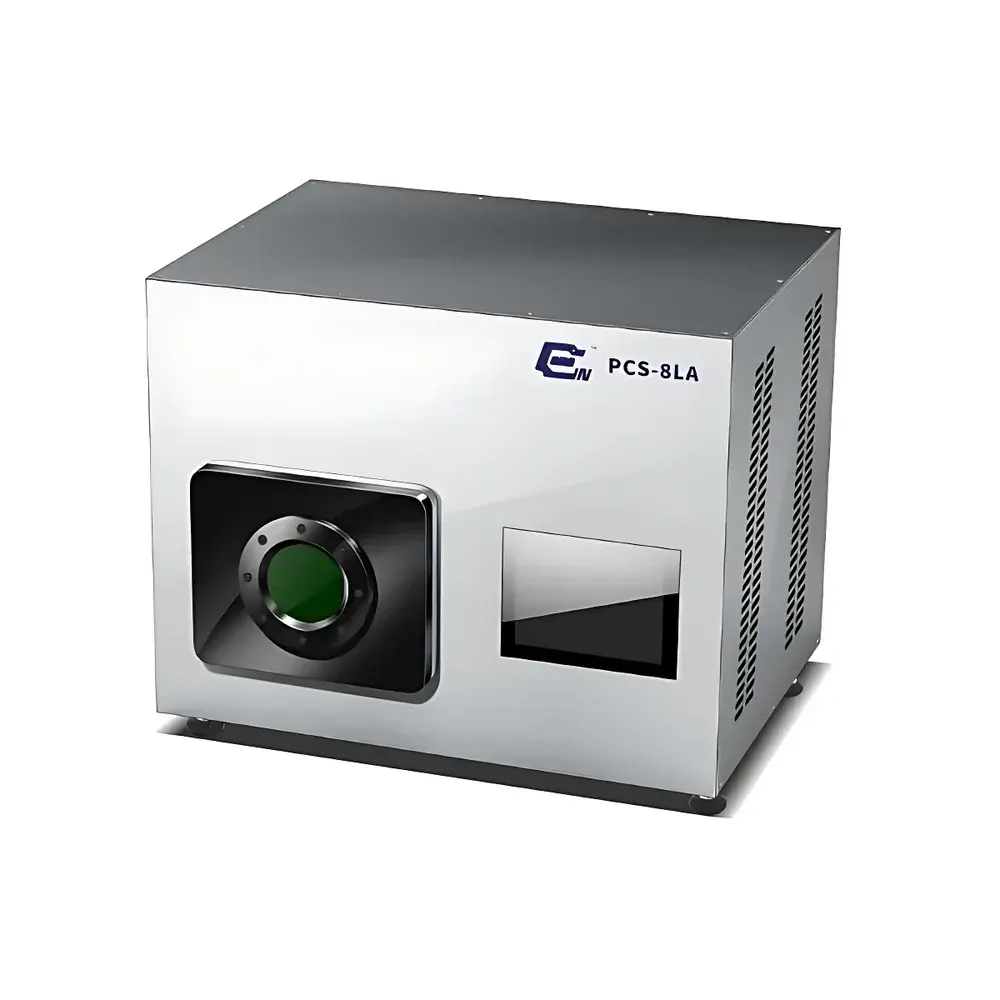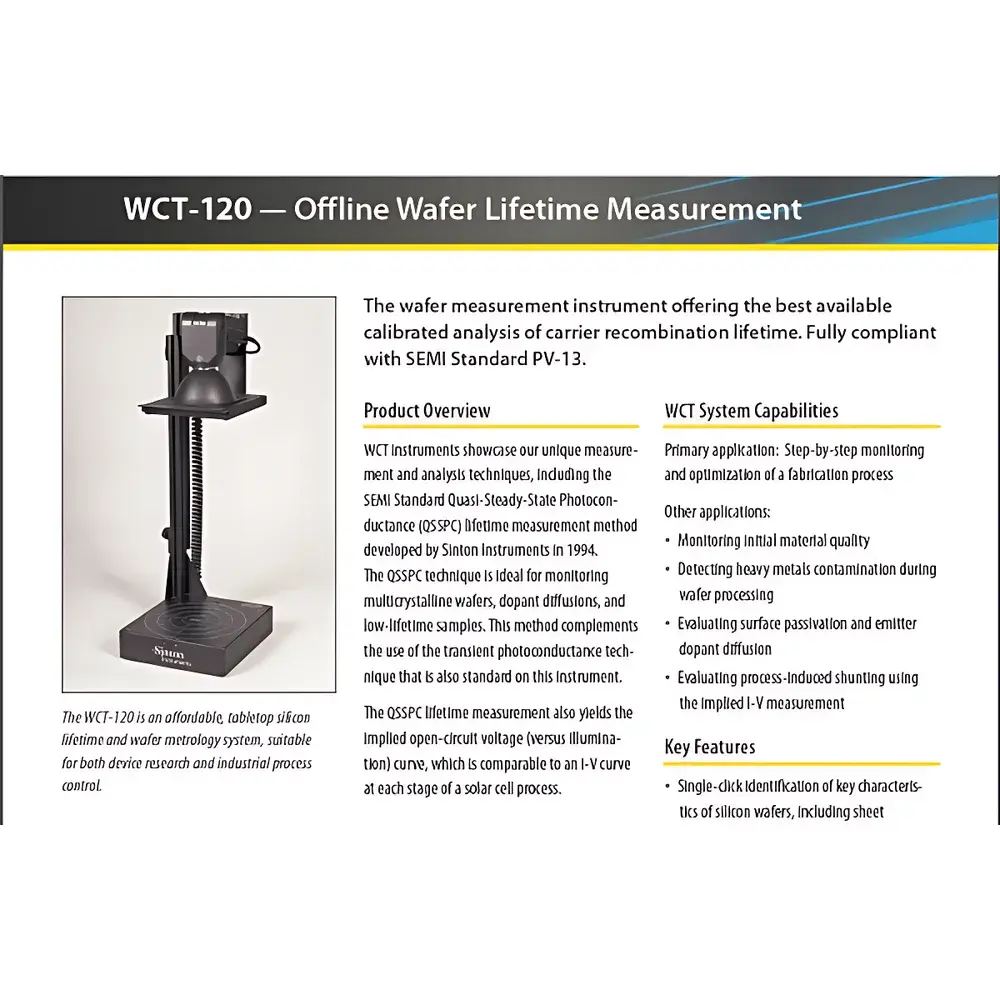
Sinton Instruments WCT-120MX + Suns-VocMX Minority Carrier Lifetime Tester
| Brand | Sinton Instruments |
|---|---|
| Origin | USA |
| Model | WCT-120MX + Suns-VocMX |
| Minority Carrier Lifetime Range | 0.1 µs – 15 ms |
| Penetration Depth | 3 mm |
| Maximum Sample Diameter | 230 mm |
| Resistivity Range | 0.15 – 300 Ω·cm |
| Compatible Material | Silicon wafers |
Overview
The Sinton Instruments WCT-120MX + Suns-VocMX is a dual-module, contactless characterization system engineered for high-precision, non-destructive evaluation of minority carrier recombination lifetime (τ), implied open-circuit voltage (iVoc), resistivity, trap density, and emitter saturation current density (J0) in silicon photovoltaic materials. The system operates on two complementary physical principles: the WCT-120MX employs eddy-current-based quasi-steady-state photoconductance (QSSPC) and transient photoconductance (TPC) measurement to extract τ(Δn) across an injection range of 1013–1016 cm−3, fully compliant with SEMI PV13-0211. The Suns-VocMX module applies calibrated flash illumination under open-circuit conditions to measure Voc(illumination) and reconstruct full implied I–V curves using a built-in two-diode model—enabling derivation of J01, J02, shunt resistance (Rsh), series resistance (Rs), effective lifetime (τeff), and maximum fill factor (FFmax). Together, they provide pre-cell process diagnostics critical for R&D, ingot-to-wafer qualification, and inline process control in solar cell manufacturing.
Key Features
- Contactless, non-invasive eddy-current sensing with 40 mm diameter sensor and 3 mm effective penetration depth—enabling bulk lifetime assessment without surface passivation or metallization
- Integrated QSSPC, transient, and generalized analysis modes for comprehensive recombination kinetics modeling across low-to-high injection regimes
- Calibrated white + IR flash source (>1000 nm) with programmable irradiance up to 50 suns (WCT-120MX) and 6 suns (Suns-VocMX), both traceable to NIST-traceable reference cells
- NI DAQ-based 12-bit acquisition at up to 5 MS/s sampling rate, ensuring high temporal resolution for fast-decay lifetime capture
- Simultaneous resistivity mapping (0.15–300 Ω·cm) and trap density estimation via photoconductance decay slope analysis
- Dual-module architecture allows sequential or synchronized operation—WCT-120MX characterizes bare wafers; Suns-VocMX evaluates processed wafers with formed junctions
- Temperature-stabilized sample stage (25 °C ± 0.5 °C) and ambient-controlled operating environment (18–25 °C) for metrological repeatability
Sample Compatibility & Compliance
The WCT-120MX + Suns-VocMX supports silicon wafers from 40 mm to 230 mm in diameter and thicknesses ranging from 10 µm to 2000 µm—including Czochralski (Cz), float-zone (FZ), and multicrystalline (mc-Si) substrates. It complies with SEMI PV13-0211 for contactless lifetime measurement and supports GLP-aligned data integrity through audit-trail-enabled software logging. All calibration procedures follow ISO/IEC 17025 traceability requirements, with documented uncertainty budgets for lifetime, resistivity, and Voc outputs. The system meets IEC 61215 and IEC 62788 material qualification prerequisites for PV production line deployment.
Software & Data Management
The integrated WCT software suite (v5.x) runs on Windows OS with National Instruments LabVIEW-based architecture. It provides real-time waveform visualization, automated τ(Δn) curve fitting using multi-exponential decay models, and export of ASCII-compatible datasets for third-party analysis (e.g., PC1D, Sentaurus). Raw data files include full metadata: timestamp, lamp energy, sample ID, temperature, and calibration coefficients. Software enforces 21 CFR Part 11 compliance via electronic signatures, role-based access control, and immutable audit trails for all parameter changes and measurement exports. Batch reporting supports CSV, PDF, and XML formats with customizable templates aligned to internal QA protocols.
Applications
- Raw silicon feedstock grading and impurity screening (e.g., Fe, Cu, Cr contamination via lifetime degradation kinetics)
- Diffusion process optimization—quantifying emitter recombination losses and junction quality through J0 and iVoc mapping
- In-line monitoring of surface passivation (SiNx, Al2O3) effectiveness via τ enhancement under controlled Δn
- Pre-cell yield prediction: correlation of τ(1015 cm−3) and iVoc with final cell efficiency (η) and FF
- Root-cause analysis of shunting defects using Rsh extraction and spatially resolved Suns-Voc scans
- Technology transfer validation between R&D labs and pilot lines—ensuring measurement equivalence across sites
FAQ
Does the WCT-120MX require surface passivation before measurement?
No. Its eddy-current method measures bulk photoconductance without electrical contact or surface treatment.
Can the system measure lifetime in textured or saw-damaged wafers?
Yes—penetration depth of 3 mm ensures robust signal from bulk material, independent of surface morphology.
Is calibration traceable to international standards?
Yes. Flash energy calibration uses NIST-traceable silicon reference diodes; lifetime calibration follows SEMI PV13-0211 Annex B protocols.
What is the minimum detectable lifetime resolution?
The system achieves <100 ns temporal resolution in transient mode, enabling reliable quantification down to 0.1 µs with SNR > 40 dB.
How does Suns-VocMX differentiate between J01 and J02?
Through constrained two-diode model fitting of Voc vs. illumination intensity data, with separate extraction of recombination currents from the emitter and base regions.
Can data be exported for statistical process control (SPC)?
Yes—CSV exports include all raw and derived parameters with timestamps, supporting integration into Minitab, JMP, or factory MES platforms.