
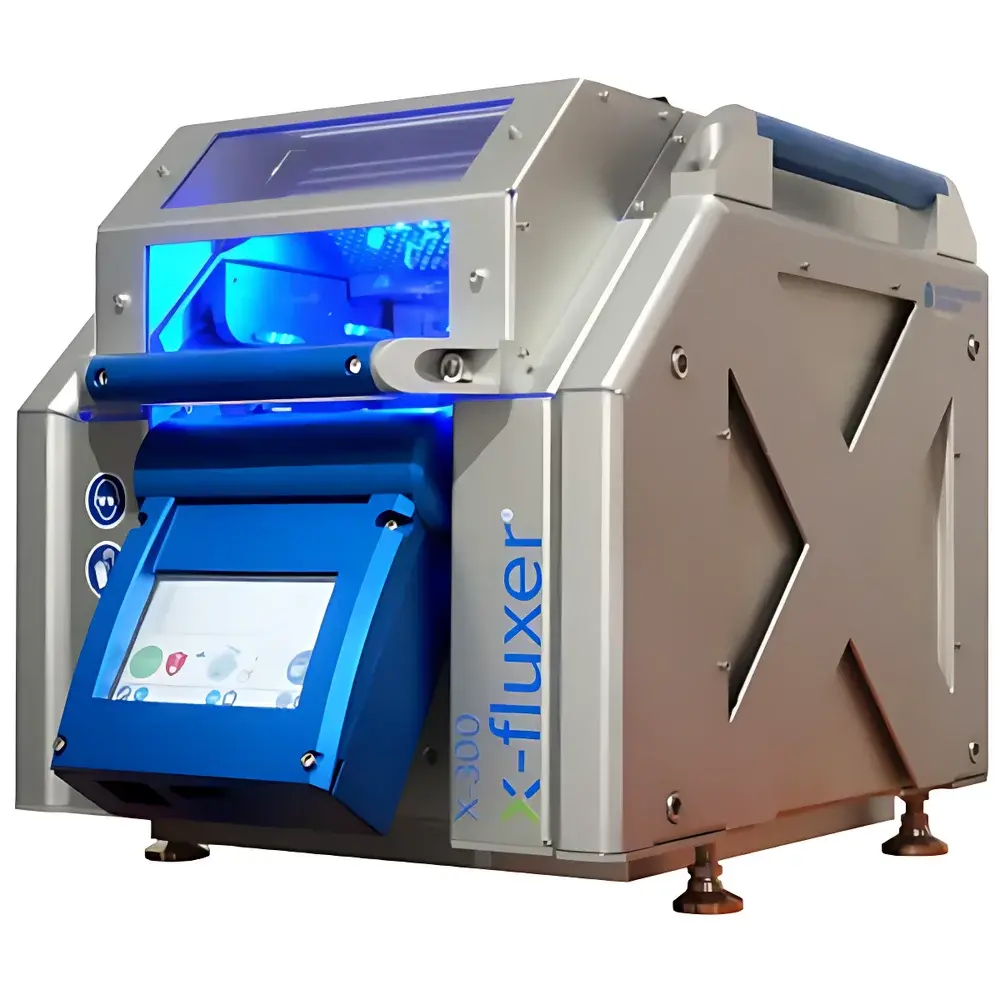
Katanax X300 Automated Electric Fusion Machine
| Brand | Katanax |
|---|---|
| Origin | Canada |
| Model | X300 |
| Dimensions (L×W×D) | 51×48×63 cm |
| Temperature Control Accuracy | ±1°C |
| Operating Temperature Range | 50–1200°C |
| Sample Throughput | 7–20 samples/hour |
Overview
The Katanax X300 Automated Electric Fusion Machine is a high-precision, fully programmable laboratory fusion system engineered for the preparation of homogeneous glass discs from inorganic powdered samples. It operates on resistive heating principles using proprietary black ceramic electronic composite heating elements—eliminating reliance on traditional silicon carbide or molybdenum disilicide rods. This architecture enables rapid thermal ramping (5–10 minutes to 1200°C), exceptional thermal stability (±1°C control accuracy), and long-term operational reliability without water cooling, forced air, gas supply, open flame, or high-frequency electromagnetic emissions. Designed for routine and method-development workflows in geochemical, metallurgical, cement, ceramics, and regulatory-compliant laboratories, the X300 delivers reproducible, bubble-free, crack-free, and crystallization-free fused beads under precisely controlled dynamic temperature profiles (DTP). Its all-electric, plug-and-play 220 V AC operation ensures deployment flexibility across global laboratory infrastructures.
Key Features
- Triple-channel configuration (field-upgradeable to single/dual channels) for parallel sample processing and method scalability
- Proprietary black ceramic composite heating elements with integrated ceramic shielding—resistant to corrosive volatiles (e.g., halogens, SOx, PxOy) and extending service life beyond 5,000 operating hours
- Four-layer composite ceramic fiber insulation—maintaining external surface temperature below 30°C at full operating temperature, minimizing energy loss and enhancing operator safety
- Halogen exhaust channel design—enabling real-time visual monitoring of crucible contents while preventing condensate corrosion of heating elements, crucible holders, and furnace walls
- 100% high-purity ceramic crucible holder and adjustable mold frame compatible with 30 mm, 32 mm, 35 mm, and 40 mm molds—eliminating metal alloy degradation under aggressive flux environments
- 7-inch industrial-grade LCD touchscreen with intuitive graphical interface, dual-user/admin access levels, USB-based method import, and built-in diagnostics
- No-phase SCR power regulation with UL94-rated PCB conformal coating and anodized aluminum chassis—certified to CE standards and compliant with industrial EMC and fire-safety requirements
Sample Compatibility & Compliance
The X300 accommodates diverse inorganic matrices including silicates, oxides, sulfides, fluorides, carbonates, metals, alloys, catalysts, slags, refractories, and pharmaceutical excipients. It supports common flux systems (e.g., lithium tetraborate, lithium metaborate, mixtures with oxidizing agents) and release agents (e.g., iodides, bromides) without compromising hardware integrity. All thermal protocols adhere to ASTM E2118 (Standard Practice for Fusion of Siliceous and Aluminosilicate Materials), ISO 8526 (Glass Disc Preparation for XRF Analysis), and USP guidelines for elemental impurity testing. The system’s audit-trail-capable software meets GLP/GMP data integrity expectations and supports 21 CFR Part 11 readiness when deployed with validated IT infrastructure.
Software & Data Management
The embedded firmware implements Dynamic Temperature Profiling (DTP)—a nine-step programmable sequence covering preheat, flux/sample mixing, rotation-assisted homogenization, holding, pouring, annealing, and cooldown. Preloaded methods cover geological standards (e.g., NIST SRMs), steel alloys (ASTM E1086), cement clinker (ASTM C114), and rare-earth oxides. Users may customize ramp rates, dwell times, oscillation amplitude/frequency, pour speed, and post-pour stabilization. Method files are stored locally with timestamped execution logs; raw thermal and motion parameters are exportable via USB in CSV format. Firmware updates and new method libraries are distributed through secure Katanax portal downloads—no third-party drivers or OS dependencies required.
Applications
The X300 serves as a core sample preparation platform for wavelength-dispersive (WDXRF) and energy-dispersive (EDXRF) spectrometry, inductively coupled plasma optical emission spectroscopy (ICP-OES), and inductively coupled plasma mass spectrometry (ICP-MS) sample introduction. It is routinely deployed in QA/QC labs for raw material certification in cement production, blast furnace feedstock analysis in integrated steelworks, compositional verification of advanced ceramics, regulatory screening of heavy metals in consumer goods, and geochemical mapping in exploration geology. Its robustness and repeatability make it suitable for ISO/IEC 17025-accredited testing facilities requiring documented method validation and inter-laboratory comparability.
FAQ
Does the X300 require external cooling or compressed air?
No—it operates passively with no water chiller, fan, or pneumatic connections.
Can I use my existing platinum-gold or graphite crucibles?
Yes—the ceramic crucible holder accepts standard 30–40 mm diameter crucibles with compatible height profiles.
Is method validation support available from Katanax?
Yes—application scientists provide protocol optimization, uncertainty budgeting, and interlaboratory study coordination upon request.
What safety certifications does the X300 hold?
CE marking per Machinery Directive 2006/42/EC and Low Voltage Directive 2014/35/EU; UL94 V-0 compliance for internal electronics.
How is data integrity ensured during regulatory audits?
All user actions, thermal events, and method executions are time-stamped and immutable within the local log file; optional network logging enables centralized archive integration.



