
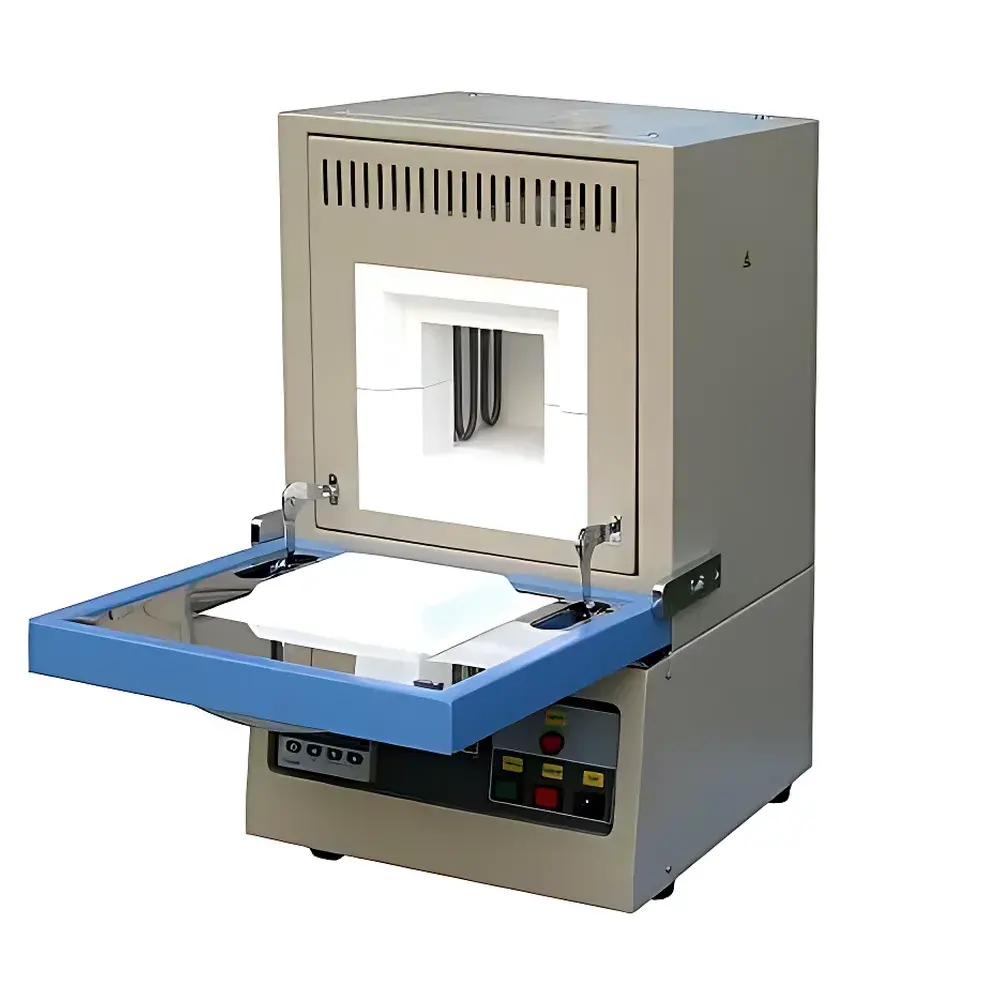
Hefei Kejing KSL-1700X-S Miniature High-Temperature Box Furnace
| Brand | Hefei Kejing |
|---|---|
| Model | KSL-1700X-S |
| Maximum Temperature | 1700 °C |
| Operating Temperature | Up to 1650 °C |
| Temperature Uniformity | ±1 °C |
| Heating Rate (to max temp) | 10 °C/min |
| Chamber Dimensions (W×D×H) | 120 mm × 120 mm × 120 mm |
| Heating Element | Molybdenum Disilicide (MoSi₂) Rods |
| Thermocouple Type | Type B (Platinum–Rhodium 30/6) |
| Control System | 30-Stage Programmable PID Controller (518P Series) |
| Rated Power | 2.5 kW |
| Voltage/Frequency | AC 220 V / 50 Hz |
| External Dimensions | 380 mm × 410 mm × 620 mm |
| Net Weight | 30 kg |
| Certification | CE |
Overview
The Hefei Kejing KSL-1700X-S Miniature High-Temperature Box Furnace is a compact, precision-engineered muffle furnace designed for laboratory-scale thermal processing requiring stable operation up to 1700 °C. Engineered for reproducibility and energy efficiency, it employs MoSi₂ heating elements — known for excellent oxidation resistance and long service life in air-atmosphere environments — and integrates a Type B platinum–rhodium thermocouple for high-accuracy temperature sensing above 1300 °C. Its downward-opening door configuration enables ergonomic sample loading and unloading, while the integrated gas inlet/outlet ports support controlled-atmosphere experiments under oxidizing (e.g., ambient air), inert (N₂, Ar), or reducing (H₂/N₂ mixtures) conditions — critical for sintering, annealing, ashing, and ceramic phase development. The furnace complies with IEC 61000-6-3 (EMC emission standards) and meets CE marking requirements for safety and electromagnetic compatibility within the European Economic Area.
Key Features
- Compact chamber volume (1.73 L) minimizes thermal mass and power consumption without compromising maximum operating temperature
- 30-stage programmable PID controller (518P series) enabling complex thermal profiles: ramp-hold-cool sequences with independent slope and dwell settings per segment
- High-stability Type B thermocouple (Pt30Rh–Pt6Rh) calibrated for accuracy across 0–1700 °C range; integrated cold-junction compensation ensures traceable measurement
- Four MoSi₂ heating rods arranged symmetrically for uniform radial and axial temperature distribution (±1 °C at 1650 °C, measured at center and corners)
- Refractory insulation system comprising multilayer alumina fiber boards and high-purity alumina bricks, providing low surface temperature (<60 °C at 1700 °C ambient) and rapid thermal recovery
- Downward-lifting door with high-temperature ceramic gasket seal and mechanical latch ensures repeatable closure force and minimal heat leakage during operation
Sample Compatibility & Compliance
The KSL-1700X-S accommodates standard crucibles including high-purity Al₂O₃ (99.7%), ZrO₂, and Pt-based vessels (up to 1650 °C). Its internal dimensions (120 mm cube) support standardized sample holders used in ASTM C1161 (flexural strength of ceramics) and ISO 2738 (sintered metal density testing). The furnace design adheres to EN 60519-12:2015 (safety requirements for industrial electroheating equipment), and its electrical architecture conforms to IEC 61000-4-5 surge immunity standards. All materials contacting the hot zone are RoHS-compliant and non-outgassing under vacuum or inert gas purge. Optional accessories — such as mobile refractory stands, custom door plugs, and graded insulation bricks — allow adaptation for GLP/GMP-aligned workflows requiring documented thermal validation (e.g., IQ/OQ protocols per ISO/IEC 17025).
Software & Data Management
While the standard 518P controller operates via front-panel keypad and LCD interface, optional RS485 Modbus RTU communication enables integration with LabVIEW™, MATLAB®, or SCADA systems for remote monitoring and data logging. Temperature setpoints, actual readings, and alarm status can be streamed at user-defined intervals (1–60 s), supporting 21 CFR Part 11-compliant electronic records when paired with validated third-party software. The controller stores up to 10 user-defined programs with password protection, and includes hardware-based overtemperature cutoff (independent of main control loop) set at 1750 °C to prevent thermal runaway.
Applications
- Sintering of advanced ceramics (Al₂O₃, SiC, YSZ) and metal oxides under controlled atmospheres
- Thermal gravimetric analysis (TGA) pre-treatment and residue quantification (e.g., ASTM E1131)
- Heat treatment of battery cathode precursors (LiCoO₂, NMC) and solid-state electrolyte synthesis
- Calibration of high-temperature reference materials (e.g., gold, palladium, and nickel fixed points per ITS-90)
- Pre-firing of sensor substrates and microelectromechanical systems (MEMS) packaging
- Research-scale glass melting and devitrification studies
FAQ
What atmosphere types are supported, and what gas flow rates are recommended?
The furnace supports static or dynamic atmospheres using N₂, Ar, O₂, or forming gas (5% H₂/95% N₂). For dynamic purging, recommended flow rates range from 50–200 mL/min (measured at STP) to maintain positive pressure without excessive cooling.
Is the furnace suitable for vacuum operation?
No — the standard configuration is not vacuum-rated. The door seal and insulation structure are optimized for atmospheric and positive-pressure inert/oxidizing environments only.
How often does the Type B thermocouple require recalibration?
Per ISO/IEC 17025 guidelines, annual calibration against a certified reference thermocouple (e.g., SPRT-based fixed-point cell) is recommended for applications requiring metrological traceability.
Can the furnace be integrated into an automated sample-handling system?
Yes — the RS485 interface supports Modbus commands for start/stop, setpoint adjustment, and real-time temperature readback, enabling synchronization with robotic arms or conveyor-linked batch processing.
What maintenance is required for MoSi₂ heating elements?
MoSi₂ rods exhibit minimal degradation below 1700 °C in air. Avoid thermal shock (rapid quenching) and contact with alkali-containing samples (e.g., Na₂CO₃), which accelerate volatilization. Visual inspection every 200 operating hours is advised.



