
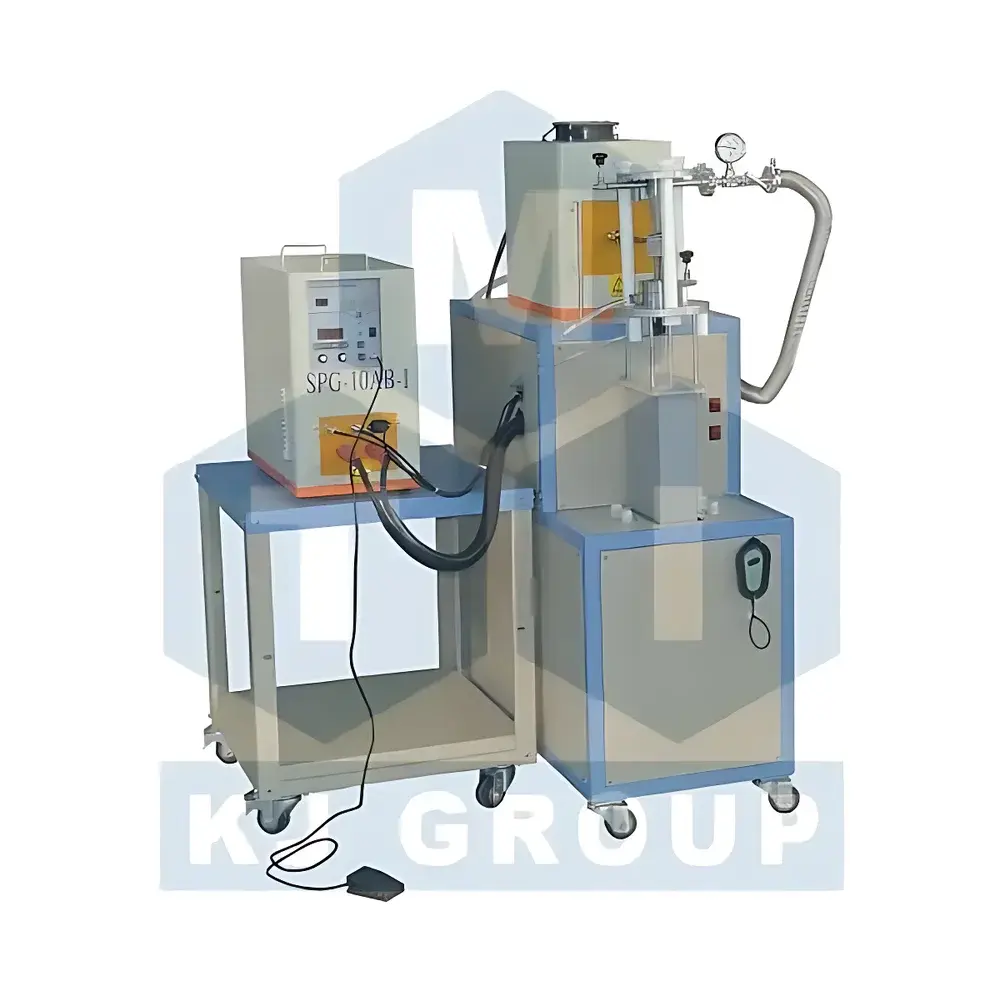
KJFMF-10 Compact Vacuum Suspended Induction Melting Furnace
| Brand | Hefei KJ (KJFMF Series) |
|---|---|
| Model | FMF-10 |
| Type | Horizontal Tube-Type Induction Melting System |
| Max Operating Temperature | 2,200 °C (material-dependent, graphite crucible not included) |
| Control Accuracy | ±1 °C |
| Max Input Power | 10 kW |
| RF Frequency Range | 80–250 kHz |
| Internal Chamber Dimensions | 32 mm (OD) × 28 mm (ID) × 180 mm (L) |
| Vacuum Level | ≤1×10⁻² torr (with included dual-stage rotary vane pump) |
| Optional High-Vacuum | ≤1×10⁻⁵ torr (with external turbomolecular pump) |
| Cooling Water Flow Rate | >40 L/min (crucible) |
| Sample Capacity | Up to 5 g (stainless steel reference) |
| Gas Compatibility | Inert atmosphere (Ar, N₂), flow rate ≤200 sccm (≤200 mL/min) |
| Max Allowable Internal Gauge Pressure | <0.02 MPa |
| Safety Compliance | CE-marked electrical architecture, IEC 61000-6-4 EMC compliance, UL-listed power interface (380 VAC, 3-phase, 50 Hz, 60 A circuit required) |
Overview
The KJFMF-10 is a compact, vertically integrated vacuum suspended induction melting system engineered for high-purity synthesis of magnetic alloys, refractory metals, and reactive intermetallic compounds in laboratory-scale R&D environments. Unlike conventional resistance-heated tube furnaces, the KJFMF-10 employs high-frequency electromagnetic induction (80–250 kHz) to generate eddy currents directly within electrically conductive samples—enabling rapid, contactless heating without crucible contamination. Its defining feature is the water-cooled copper crucible with optimized geometry (φ11 mm × 11 mm), which—under controlled inert gas flow—induces stable electromagnetic levitation (micro-suspension) of molten droplets. This eliminates solid–liquid interface reactions, suppresses heterogeneous nucleation, and minimizes oxide inclusion formation—critical for preparing single-phase metallic glasses, metastable alloys, and ultra-high-purity elemental standards. The system operates under dynamic vacuum or precisely regulated inert atmospheres (Ar/N₂), with real-time pressure monitoring and fail-safe interlocks to maintain internal gauge pressure below 0.02 MPa—ensuring quartz tube integrity and operator safety per ISO 10816-3 mechanical vibration thresholds and IEC 61508 functional safety principles.
Key Features
- Integrated 10 kW high-frequency induction generator with digital phase-locked loop (PLL) frequency tuning for optimal coupling efficiency across diverse alloy resistivities
- Electromagnetically levitated melting zone: copper crucible with internal micro-channel cooling (≥40 L/min flow) maintains thermal stability during sustained 2,200 °C operation
- Dual-stage vacuum architecture: built-in 2 L/s dual-vane rotary pump achieves ≤1×10⁻² torr; optional KF25-flanged turbomolecular pump upgrade enables UHV conditions (≤1×10⁻⁵ torr) for oxide-sensitive melts
- High-purity fused quartz reaction tube (32 mm OD × 28 mm ID × 180 mm L) with stainless-steel KF40 vacuum flanges and metal-sealed O-rings compliant with ASTM F2627 for low-outgassing performance
- Motorized crucible lift mechanism (±0.1 mm repeatability) enables precise positioning relative to induction coil focal zone and facilitates post-melt quenching control
- Independent control cabinet with PID temperature profiling, real-time pressure logging (0–0.1 MPa range), and hardware-enforced interlock logic preventing heater activation unless vacuum/gas pressure thresholds are met
Sample Compatibility & Compliance
The KJFMF-10 supports synthesis of ferromagnetic (Fe, Co, Ni-based), paramagnetic (Ti, Zr, Nb), and diamagnetic (Cu, Al, Mg) alloys—provided bulk electrical conductivity exceeds ~0.5 MS/m at melt temperature. It is routinely used for rapid prototyping of soft magnetic composites (e.g., Fe-Si-B-P-C), Heusler phases, and rare-earth permanent magnet precursors (Nd-Fe-B, Sm-Co). All wetted components comply with ASTM E1157 (high-purity quartz tubing specifications) and ISO 8502-3 (surface cleanliness validation). Vacuum system design conforms to ISO 27429 for leak-tightness verification (<1×10⁻⁸ mbar·L/s He leak rate). For GLP/GMP-regulated environments, optional audit-trail software logs all process parameters—including time-stamped pressure/temperature curves, gas flow events, and interlock triggers—in accordance with FDA 21 CFR Part 11 requirements.
Software & Data Management
The embedded controller provides local touchscreen operation with programmable ramp-soak profiles (up to 10 segments), real-time graphing of T/P/F (temperature/pressure/flow), and USB export of CSV-formatted datasets. Optional PC-based KJControl Suite adds remote monitoring via Ethernet, automated report generation (PDF/Excel), and integration with LabArchives ELN via REST API. All data files include embedded metadata: instrument serial number, operator ID, ambient lab temperature/humidity (via optional sensor input), and calibration certificate traceability to NIST SRM 1749a (thermocouple reference). Firmware updates follow IEC 62443-3-3 security protocols, with signed binary verification prior to installation.
Applications
- Preparation of oxygen-sensitive master alloys for arc-melting feedstock
- In-situ purification of transition metals (e.g., Ti, V) via volatile impurity volatilization under dynamic vacuum
- Levitation-assisted directional solidification studies for microstructure refinement
- Synthesis of amorphous/nanocrystalline ribbons via melt-spinning precursor preparation
- Thermophysical property measurement (density, surface tension) of molten metals using pendant drop analysis in situ
- Development of high-entropy alloy (HEA) compositions requiring homogeneous mixing without segregation
FAQ
What is the maximum recommended sample mass for stable levitation?
For consistent electromagnetic suspension, we recommend ≤5 g for stainless steel analogs; lower masses (1–3 g) are advised for low-density metals (Al, Mg) or high-resistivity alloys (Ni-based superalloys) to maintain coil coupling efficiency.
Can the system operate under reactive gases like H₂ or CO?
No. The quartz tube and copper crucible are incompatible with reducing or carburizing atmospheres above 800 °C. Only inert gases (Ar, N₂, He) are permitted per ASTM E2913 guidelines for quartz integrity.
Is water cooling mandatory for all operational modes?
Yes. Continuous deionized water flow (>40 L/min) through the crucible and >16 L/min through the induction coil is required during any heating cycle—even at sub-1000 °C—to prevent thermal deformation and maintain electromagnetic field uniformity.
How is vacuum integrity validated before each run?
The system performs an automated 5-minute hold test after pump-down: pressure rise must remain <5×10⁻⁴ torr/min. A failed test triggers audible alarm and disables heater enable signal until manual reset and leak check.
Does the warranty cover quartz tube replacement due to thermal shock?
Quartz tube breakage from pressure excursions (>0.02 MPa gauge) or rapid quenching falls outside standard warranty coverage. We recommend scheduled replacement every 50–100 melts for critical purity applications.
Related Products



