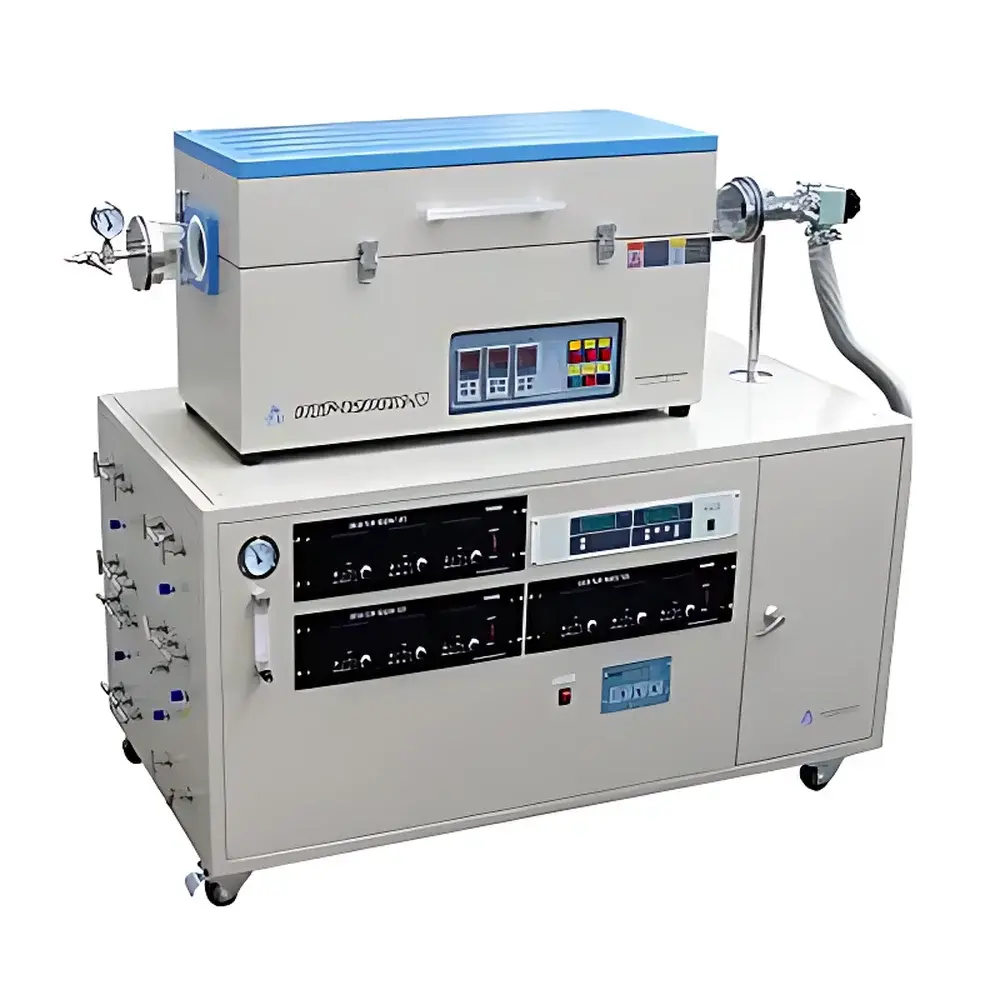
KEJING OTF-1200X-4-III-9HV Triple-Zone Split Tube Furnace with High-Vacuum CVD System
| Brand | KEJING |
|---|---|
| Origin | Anhui, China |
| Model | OTF-1200X-4-III-9HV |
| Max. Operating Temperature | 1200 °C (continuous at 1100 °C) |
| Heating Rate | ≤20 °C/min |
| Tube Dimensions | 100 mm OD × 92 mm ID × 1400 mm L (fused quartz) |
| Vacuum Level | 10⁻⁵ Torr (turbo-molecular pump) |
| Mass Flow Controllers | 9-channel digital MFCs (CS200 series |
| ranges | 0–1000, 0–200, and 0–10 sccm |
| Power Supply | 7 kW, AC 208–240 V, single-phase, 50/60 Hz |
| Temperature Uniformity | ±1 °C over 500 mm constant-temperature zone |
| Certification | CE |
Overview
The KEJING OTF-1200X-4-III-9HV is a fully integrated, CE-certified chemical vapor deposition (CVD) platform engineered for reproducible thin-film synthesis under controlled thermal, vacuum, and gas-phase conditions. It combines a triple-zone split tube furnace with a high-vacuum pumping system (10⁻⁵ Torr base pressure) and a nine-channel precision gas delivery architecture—enabling simultaneous introduction, mixing, and metering of up to nine reactive or carrier gases. The system operates on the fundamental principle of thermal CVD: gaseous precursors are introduced into a heated reaction zone where thermally activated surface reactions yield conformal, stoichiometric thin films on substrates—commonly used for depositing SiO₂, Si₃N₄, TiN, graphene, transition metal dichalcogenides (TMDs), and metal oxides. Its modular cart-mounted configuration ensures operational flexibility, while the fused quartz reaction tube provides broad spectral transparency and thermal shock resistance—critical for in situ optical monitoring and rapid thermal cycling protocols.
Key Features
- Triple independent heating zones (220 mm + 440 mm + 220 mm) with programmable 50-segment digital PID controllers—each featuring auto-tune, over-temperature cutoff, and thermocouple break protection.
- High-stability constant-temperature zone of 500 mm length with uniformity maintained within ±1 °C across the full working range (room temperature to 1100 °C).
- Integrated dual-stage vacuum system: a T2XZ-4C110 two-stage rotary vane pump (10⁻² Torr) coupled with a turbo-molecular pump (10⁻⁵ Torr), backed by a digital vacuum gauge and controller mounted on the mobile base cabinet.
- Nine CS200-series mass flow controllers (MFCs) with digital front-panel displays and manual dial adjustment—configured in three calibrated ranges (0–10, 0–200, and 0–1000 sccm) to accommodate both trace dopant gases and bulk carrier flows.
- Stainless steel 316 gas manifold with 21 external vacuum-rated needle valves, enabling independent control of inlet gases, purge lines, vacuum paths, and pump isolation—designed for leak-tight operation per ASTM E493 and ISO 10648-2 standards.
- Air-cooled double-layer steel enclosure with high-purity alumina fiber insulation—optimized for energy efficiency and thermal safety compliance (IEC 61000-6-3, EN 61000-6-4).
Sample Compatibility & Compliance
The system accommodates standard 4-inch wafers, ceramic substrates, quartz slides, and custom fixtures placed inside the 100 mm OD fused quartz tube. Substrate heating profiles are fully decoupled from furnace zone temperatures via optional radiant heating inserts or resistive heater tapes—supporting gradient-driven growth (e.g., van der Waals heterostructure stacking). All wetted components—including flanges, O-rings (dual high-temp silicone rated to 300 °C), porous alumina radiation shields, and SS316 piping—meet USP Class VI biocompatibility requirements for cleanroom-compatible materials handling. The system’s CE marking confirms conformity with the EU Machinery Directive 2006/42/EC, Electromagnetic Compatibility Directive 2014/30/EU, and Low Voltage Directive 2014/35/EU. Vacuum and gas control logic supports audit-ready operation under GLP and GMP frameworks when paired with optional 21 CFR Part 11-compliant software modules.
Software & Data Management
Multi-DMFC V1.02 control software (optional) enables centralized configuration of all nine MFCs, real-time flow logging, and synchronized ramp-soak programs with timestamped event tagging. The interface supports CSV export, alarm history archiving, and user-level access controls—facilitating traceability for QC documentation and process validation. Temperature profiles are logged via the built-in K-type thermocouples and exported through RS485/USB to third-party SCADA platforms. Firmware updates and calibration certificates are provided with each unit; raw sensor data streams are accessible via Modbus RTU protocol for integration into laboratory information management systems (LIMS) or MES environments.
Applications
This CVD platform is routinely deployed in academic and industrial R&D labs for: atomic-layer-controlled graphene growth on Cu/Ni foils; low-k dielectric deposition (SiCOH) for advanced node interconnects; high-k gate oxide formation (HfO₂, Al₂O₃) via metal-organic precursors; photovoltaic absorber layer synthesis (CIGS, CZTS); and scalable 2D material heterostructure fabrication. Its precise multi-gas mixing capability supports co-injection strategies for graded-composition films, while the high-vacuum environment minimizes particulate contamination and enables residual gas analysis (RGA)-compatible process optimization.
FAQ
What vacuum level is achievable with the standard configuration?
The integrated turbo-molecular pump achieves a base pressure of ≤1×10⁻⁵ Torr under clean, dry conditions—verified using the included Pirani/cold-cathode hybrid vacuum sensor.
Can the furnace operate under inert gas purging without vacuum?
Yes—the system supports continuous positive-pressure operation with N₂ or Ar at regulated flow rates (via dedicated floating rotameter), including dynamic purge cycles between heating segments.
Are replacement quartz tubes and O-rings available as consumables?
All critical consumables—including custom-cut fused quartz tubes (100 mm OD × 92 mm ID × 1400 mm), high-temp silicone O-rings, and Fe-Cr-Al heating elements—are stocked and orderable with part-number traceability.
Is remote monitoring supported?
With optional Multi-DMFC software and Ethernet-enabled controller add-ons, real-time temperature, pressure, and flow data can be accessed via secure HTTPS web interface or OPC UA server.
Does the system meet semiconductor industry cleanliness standards?
While not class-100 certified, its SS316 gas path, particle-trapped vacuum valves, and bake-out capable design align with SEMI F27-0204 recommendations for pre-deposition chamber conditioning and outgassing mitigation.