
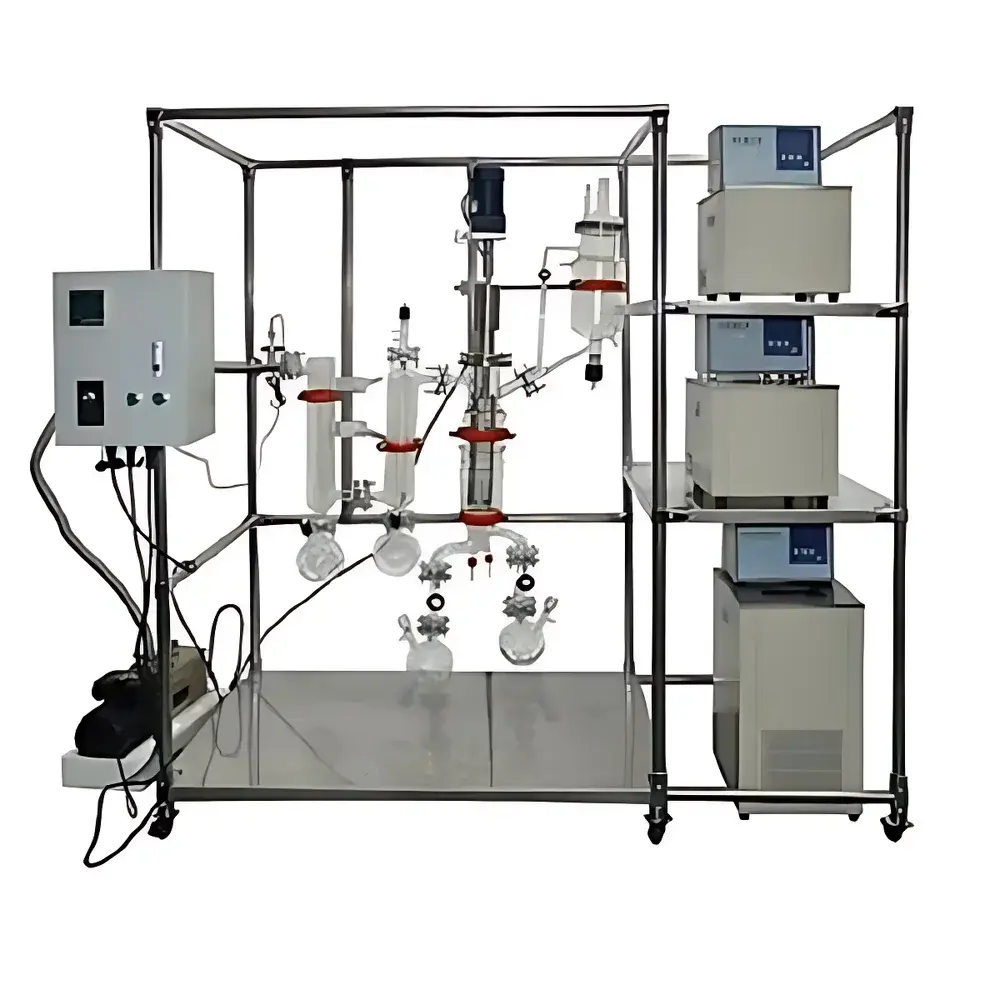
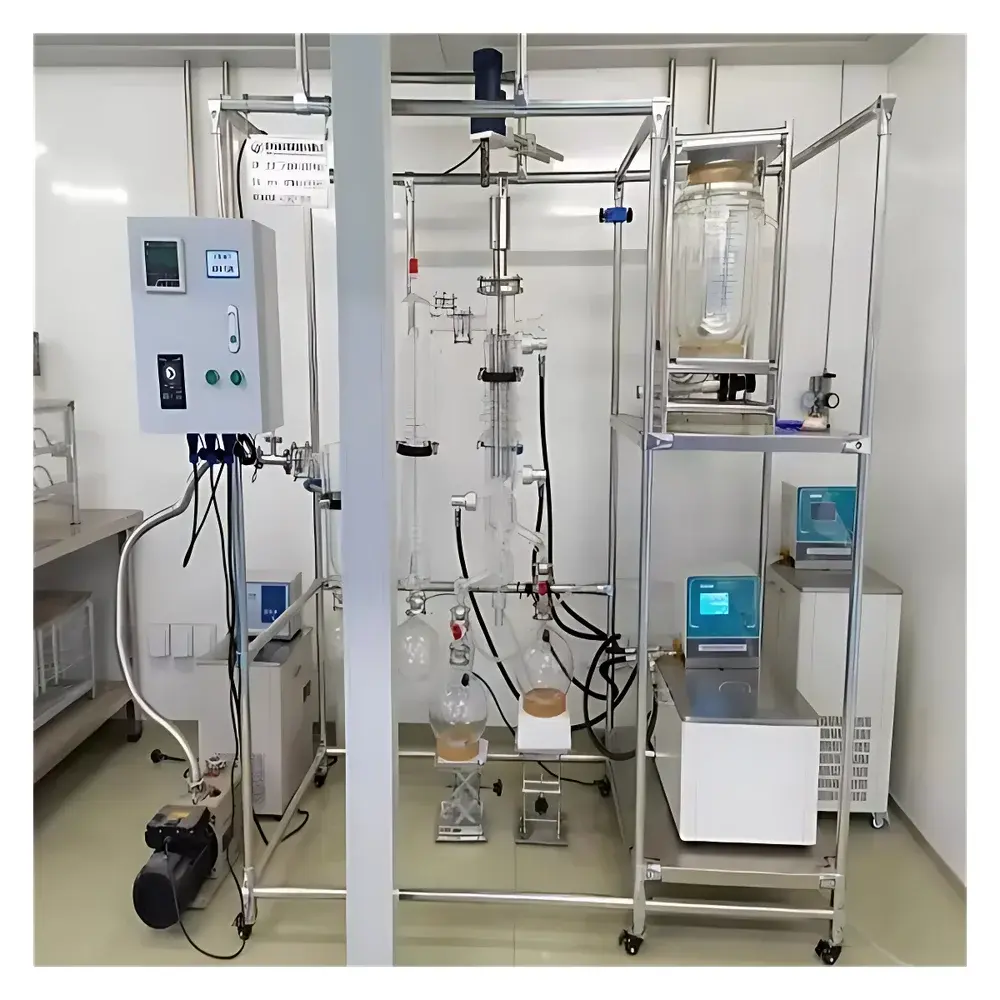
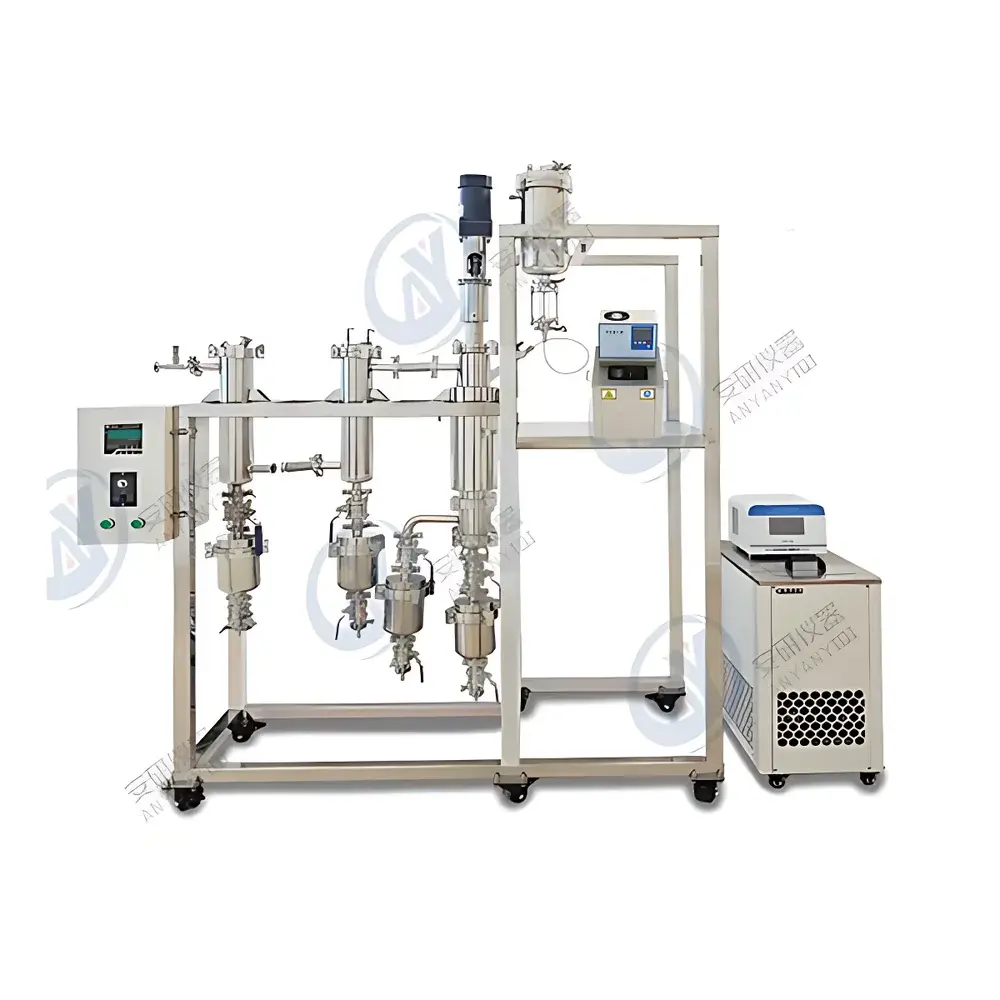
Anyan AYAN-B220 Wiped-Film Evaporator
| Brand | Anyan (Hangzhou Anyan Instrument Co., Ltd.) |
|---|---|
| Origin | Shanghai, China |
| Model | AYAN-B220 |
| Heating Surface Diameter | 220 mm |
| Evaporation Area | 0.5 m² |
| Condensation Area | 0.65 m² |
| Feed Volume Capacity | 5 L |
| Processing Flow Rate | 2.0–15.0 L/h |
| Motor Power | 200 W |
| Max Rotational Speed | ≤450 rpm |
| 刮板间� | �: 0.5–1.5 mm |
| Vacuum Capability | ≤1 Pa (absolute) |
| Heating Temperature Range | Ambient to 200 °C |
| Light Fraction Collection Bottle | 5 L |
| Heavy Fraction Collection Bottle | 5 L |
| Integrated Cold Trap | Yes |
| External Condenser | Yes |
| Cooling System | Yes |
Overview
The Anyan AYAN-B220 Wiped-Film Evaporator is a precision-engineered short-path thermal separation system designed for continuous, high-efficiency molecular distillation and thin-film evaporation under ultra-high vacuum conditions. It operates on the principle of forced-film formation via a rotating wiper assembly, enabling rapid heat transfer and minimal residence time—typically 5–15 seconds—thereby preserving thermolabile compounds, preventing thermal degradation, and minimizing fouling or polymerization. The unit features a vertically oriented cylindrical evaporator body with an internal heating jacket (steam or thermal oil compatible), a precisely balanced rotor-driven wiper system, and an integrated cold trap and external condensation train. Its geometry—220 mm internal diameter, 0.5 m² active heating surface, and 0.65 m² condensing area—is optimized for scalable lab-to-pilot transition in applications requiring precise volatility-based fractionation.
Key Features
- High-precision wiper mechanism maintaining consistent 0.5–1.5 mm clearance between blade and heated wall, ensuring uniform film thickness and laminar-to-turbulent transition for enhanced heat transfer.
- Ultra-high vacuum compatibility: system design supports sustained operation at ≤1 Pa absolute pressure, enabled by low-pressure-drop vapor path, integrated cryogenic cold trap, and externally mounted condenser.
- Thermally robust construction: stainless steel 316L evaporator body with double-jacketed heating zone; temperature controllable from ambient to 200 °C with ±1 °C stability.
- Modular collection system: dual 5 L borosilicate glass receivers—one for light fractions (distillate), one for heavy residues—with PTFE-sealed quick-connect ports and level monitoring capability.
- Low-inertia drive system: 200 W brushless DC motor with digital speed control (0–450 rpm), offering stable torque delivery across viscosity ranges without stalling or slip.
- Integrated vapor-liquid separation: centrifugal demister located above the evaporation zone minimizes entrainment, returning droplets to feed distribution for improved fraction purity and yield reproducibility.
Sample Compatibility & Compliance
The AYAN-B220 accommodates complex feedstocks including high-viscosity liquids (>10,000 cP), suspensions containing micron-scale solids, heat-sensitive actives (e.g., vitamins, polyphenols, peptides), and crystallizing or fouling-prone mixtures (e.g., fatty acid esters, resin prepolymers). Its mechanical design conforms to ASME BPE-2021 guidelines for hygienic equipment interfaces, and all wetted surfaces meet FDA CFR 21 Part 11-compliant material traceability requirements when configured with optional audit-trail-enabled controller. While not certified to ISO 9001 out-of-box, the system is fully compatible with GLP and GMP workflows when installed with calibrated temperature/vacuum sensors, validated cleaning protocols, and documented IQ/OQ procedures. It supports compliance with ASTM D2872 (vacuum distillation of bituminous materials) and USP (residual solvents) methodologies through adjustable residence time and programmable vacuum ramping.
Software & Data Management
The standard configuration includes a PID-based local control panel with real-time display of jacket temperature, rotor speed, vacuum level (capacitance manometer), and feed rate (when paired with peristaltic pump interface). Optional Ethernet-enabled PLC integration allows remote monitoring via Modbus TCP or OPC UA, enabling synchronization with LIMS or MES platforms. All process parameters—including timestamped vacuum profiles, thermal gradients, and speed logs—are exportable as CSV for 21 CFR Part 11-compliant electronic records when equipped with user-access-controlled authentication and electronic signature modules. No cloud storage or proprietary SaaS platform is embedded; data sovereignty remains fully on-site.
Applications
This evaporator serves critical unit operations across regulated and research-intensive sectors: purification of omega-3 concentrates and phospholipids (e.g., lecithin, phosphatidylserine) in nutraceutical manufacturing; solvent removal from polymer reaction intermediates (e.g., PBT prepolymer, epoxy novolacs); isolation of volatile aroma compounds from botanical extracts (e.g., citrus oils, rose otto); recovery of catalysts from homogeneous metal-catalyzed reactions; deodorization of edible oils and fish oil distillates; and concentration of heat-labile antibiotics (e.g., macrolides) without epimerization. It is routinely deployed in method development for ICH Q5C stability studies and supports DOE-based optimization of distillation cut points under varying vacuum ramps and feed rates.
FAQ
What is the maximum allowable feed viscosity for stable film formation?
Stable wiped-film operation has been verified up to 25,000 mPa·s at 60 °C using glycerol–water standards; higher viscosities require preheating to reduce inlet viscosity below 10,000 mPa·s.
Can the AYAN-B220 be used for complete solvent removal to dryness?
Yes—under controlled vacuum and temperature ramping, the system achieves final residue moisture content <0.5% w/w for non-volatile APIs and polymers, provided feed solids content does not exceed 35% w/w to avoid wiper jamming.
Is validation support available for pharmaceutical use?
Anyan provides DQ/IQ templates aligned with ASTM E2500 and ISPE Baseline Guide Vol. 5; OQ/PQ protocols must be developed onsite by qualified personnel per facility SOPs.
What maintenance intervals are recommended for the wiper assembly?
Wiper blades (PTFE-impregnated stainless steel) require inspection every 200 operational hours and replacement every 800 hours under continuous high-viscosity service.
Does the system support automated batch sequencing?
Not natively—but third-party SCADA integration via 4–20 mA analog I/O or Modbus RTU enables multi-step program execution, including vacuum ramping, temperature profiling, and fraction switching.



