
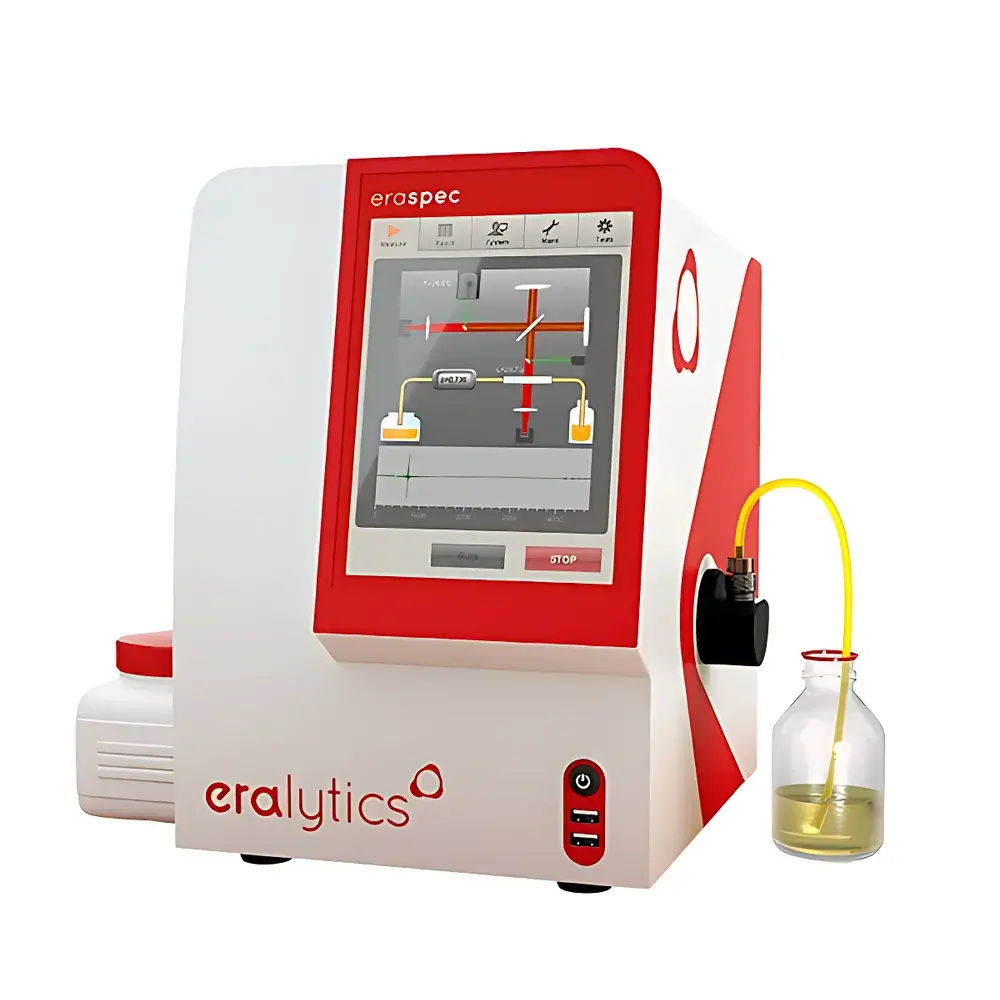
ERASPEC JET Mid-Infrared Aviation Turbine Fuel Analyzer
| Brand | ERALYTICS |
|---|---|
| Origin | Austria |
| Model | ERASPEC JET |
| Application | Gasoline Octane Number and Diesel Cetane Number Analysis |
| Portability | Portable |
| Measurement Principle | Fourier Transform Infrared (FTIR) Spectroscopy |
| Measurement Range | 0–170 (Octane/Cetane Scale) |
| Accuracy | ±0.01 |
| Measurement Time | 60 s |
| Sample Volume | 10 mL |
| Spectral Range | 4000–400 cm⁻¹ |
| Data Points | Up to 3000 per spectrum |
| Density Measurement Accuracy | ±0.0001 g/cm³ (integrated Anton Paar density module) |
| Dimensions | 220 × 320 × 280 mm |
| Weight | 8 kg |
| Power Supply | 85–263 VAC, 47–63 Hz, 70 W |
| DC Input | 12 V / 4 A (vehicle-compatible) |
| Storage Capacity | ≥2000 test records |
| Interfaces | 3× USB, 1× Ethernet, 1× RS232, LIMS-ready |
Overview
The ERASPEC JET is a field-deployable, mid-infrared (MIR) Fourier Transform Infrared (FTIR) spectrometer engineered specifically for the rapid, multi-parameter physicochemical analysis of aviation turbine fuel (Jet A/A-1), gasoline, and diesel. Unlike conventional benchtop analyzers requiring thermal stabilization or external calibration standards, the ERASPEC JET operates on a real-time background referencing principle—eliminating the need for pre-heating or cyclohexane-based baseline correction. Its core measurement capability leverages high-resolution spectral acquisition across the full 4000–400 cm⁻¹ range with up to 3000 data points per scan, enabling chemometric modeling of critical fuel properties including freezing point, flash point, kinematic viscosity, distillation profile (T10/T50/T90), density, aromatic content, and olefin concentration. Designed for compliance with ASTM D1655, D7467, D7706, and ISO 8217, the instrument delivers laboratory-grade reproducibility in under 60 seconds per sample using only 10 mL of unmodified fuel.
Key Features
- Military-grade ruggedized enclosure rated for mobile deployment—including vehicle-mounted operation via 12 V DC input
- Integrated Anton Paar density module delivering ±0.0001 g/cm³ precision, traceable to NIST-certified reference materials
- Full-spectrum FTIR acquisition (4000–400 cm⁻¹) with high-density sampling and built-in atmospheric compensation (H₂O/CO₂ subtraction)
- Automated liquid-handling system: single-step syringe-driven aspiration, flow-through cell conditioning, and solvent-free gas–liquid purge cleaning
- 6.5-inch high-brightness color touchscreen with fully localized Chinese GUI—no language barrier for operational staff or QA personnel
- Triple USB ports (data export to USB drive, printer interface, peripheral connectivity), plus Ethernet and RS232 for LIMS integration and remote diagnostics
- Onboard storage for ≥2000 test records with timestamping, operator ID tagging, and audit-trail metadata compliant with GLP/GMP documentation requirements
Sample Compatibility & Compliance
The ERASPEC JET accepts neat hydrocarbon samples without dilution, filtration, or temperature equilibration—ideal for field testing at airports, refueling depots, or pipeline terminals. It is validated for Jet A, Jet A-1, JP-5, JP-8, automotive gasoline (including ethanol-blended E10/E15), and ultra-low-sulfur diesel (ULSD). All predictive models are developed and verified against primary reference methods: ASTM D2386 (freezing point), D93 (flash point), D445 (kinematic viscosity), D86/D1078 (distillation), D1298 (density), D1319 (hydrocarbon types), and D6887 (cetane number by IR). Instrument firmware supports FDA 21 CFR Part 11-compliant electronic signatures and audit trails when connected to validated LIMS environments.
Software & Data Management
Embedded firmware runs a deterministic real-time OS ensuring consistent measurement timing and spectral fidelity. The analyzer includes ERALYTICS’ proprietary ChemCal™ chemometric engine, which applies PLS (Partial Least Squares) regression calibrated against >15,000 reference measurements from global fuel databases. Raw interferograms and processed spectra are exportable in ASTM E131-compliant JCAMP-DX format. USB mass storage mode enables direct transfer of CSV-formatted reports—including uncertainty estimates per parameter—to external PCs or cloud-synced QA repositories. Optional software modules support automated report generation (PDF/XLS), trend analysis across batches, and deviation alerts based on user-defined specification limits (e.g., ASTM D1655 Table 1 tolerances).
Applications
- Routine quality assurance of aviation turbine fuel prior to aircraft refueling—ensuring compliance with freezing point ≤ −47 °C (Jet A-1) and flash point ≥ 38 °C
- Detection and quantification of diesel contamination in jet fuel (as low as 0.5% v/v) via spectral residual analysis and hydrocarbon group fingerprinting
- On-site verification of gasoline octane rating (RON/MON) and diesel cetane number to prevent misfueling or blending errors
- Monitoring refinery output stability during grade transitions or feedstock changes using time-series spectral clustering
- Supporting root-cause investigations during nonconformance events—e.g., unexpected viscosity drift linked to polymer formation or additive depletion
- Enabling predictive maintenance of fuel handling infrastructure by correlating aromatic content shifts with tank corrosion rates
FAQ
Does the ERASPEC JET require daily calibration with certified reference fuels?
No. It uses an internal dynamic background referencing system that continuously corrects for optical drift and environmental fluctuations—eliminating routine standardization while maintaining traceability to ASTM reference methods.
Can the instrument be used inside an aircraft hangar or fuel truck cab?
Yes. Its IP54-rated housing, shock-absorbing chassis, and 12 V DC operation make it suitable for use in non-laboratory environments, provided ambient temperature remains between 5 °C and 40 °C and relative humidity stays below 80% RH (non-condensing).
Is method validation support available for regulatory submissions?
ERALYTICS provides full IQ/OQ documentation packages, ASTM correlation reports, and third-party verification letters from independent fuel testing laboratories accredited to ISO/IEC 17025.
How is data integrity ensured during offline field use?
All measurements are cryptographically timestamped and signed with a device-specific key; exported files include SHA-256 checksums and embedded metadata required for 21 CFR Part 11 compliance when uploaded to validated systems.





