
SPEX SamplePrep 6875D CryoMill High-Throughput Liquid Nitrogen Cryogenic Grinder
| Brand | SPEX SamplePrep |
|---|---|
| Origin | USA |
| Model | CG-500 |
| Instrument Type | Cryogenic Grinder |
| Sample Applicability | Frozen & Temperature-Sensitive Materials |
| Final Particle Size | <0.01 mm |
| Maximum Feed Size | <5 cm |
| Batch Capacity | 0.1–200 g |
| Cooling Medium | Liquid Nitrogen (LN₂) |
| Precooling Time | 4.5 min to −196 °C |
| Grinding Time | Adjustable, typically 2 min |
| Electromagnetic Impact Frequency | 5–15 Hz |
| Power | 700 W |
| Voltage | 230 V / 50 Hz |
| Dimensions | 50.8 × 53.34 × 64.77 cm |
| Weight | 35 kg |
Overview
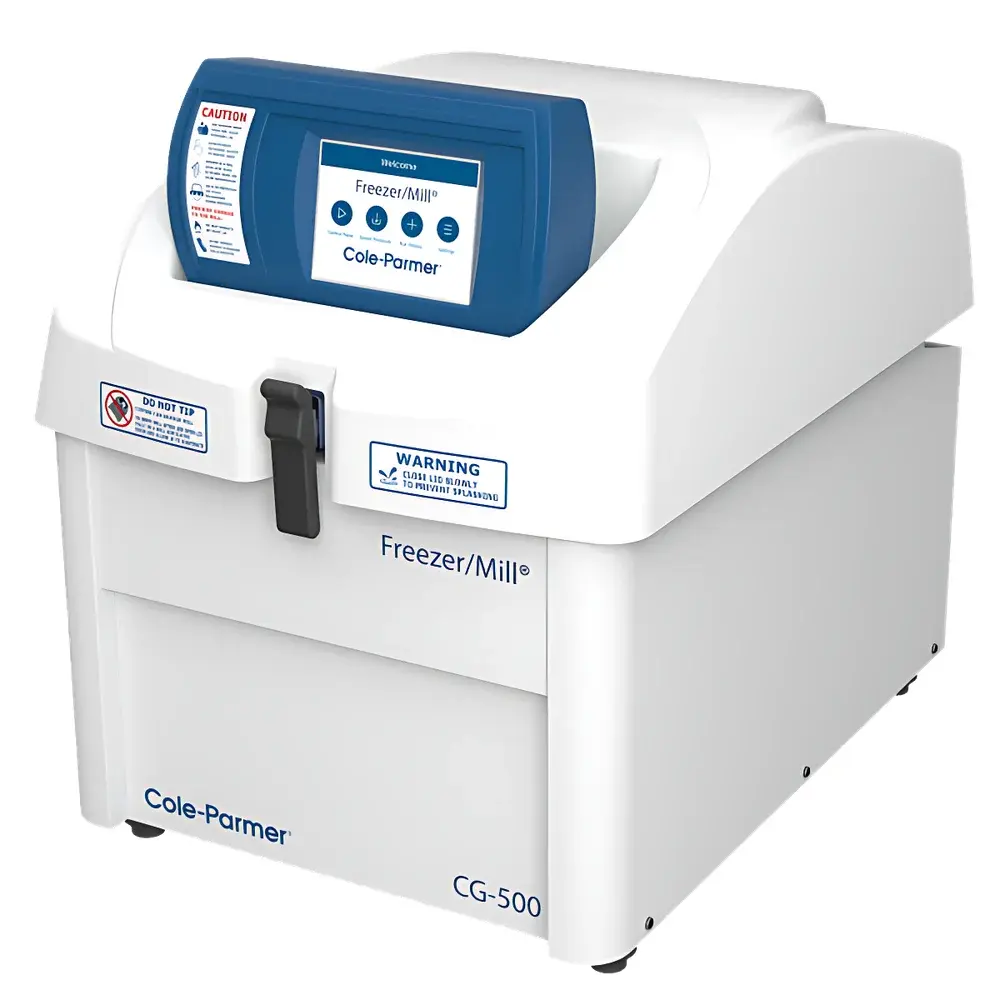
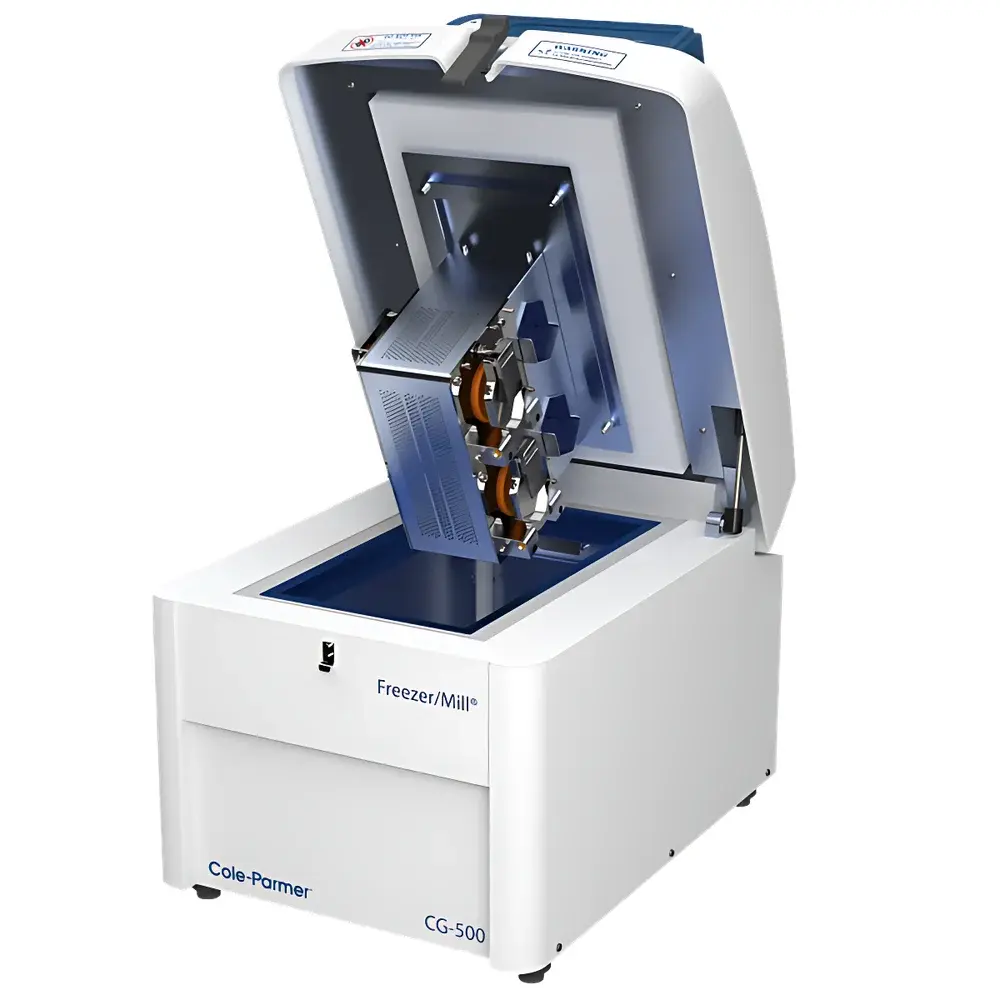
The SPEX SamplePrep 6875D CryoMill is an advanced high-throughput cryogenic grinder engineered for reproducible, contamination-free comminution of thermolabile, elastic, fibrous, or otherwise difficult-to-process materials. It operates on the principle of electromagnetic impact grinding under sustained liquid nitrogen immersion—maintaining samples at −196 °C throughout the entire process. Unlike conventional ball mills or blade grinders that generate frictional heat, the 6875D employs a patented Freezer/Mill® oscillating impact mechanism: a stainless-steel or Cr-free impactor is magnetically driven within a sealed, cryogen-cooled chamber to deliver high-energy, repetitive collisions against the sample. This ensures rapid embrittlement and fragmentation without thermal degradation, preserving molecular integrity—including nucleic acids, proteins, polymers, volatile organics, and crystalline phases. Designed for laboratories requiring rigorous sample integrity—such as forensic DNA labs, pharmaceutical QA/QC, geochemical XRD preparation, and regulatory-compliant RoHS/WEEE testing—the 6875D delivers deterministic particle size reduction to <10 µm while eliminating cross-contamination risks through fully isolated, user-selectable grinding vessels.
Key Features
- Patented electromagnetic impact technology with adjustable frequency (5–15 Hz), enabling precise control over kinetic energy input and minimizing mechanical wear.
- Dual independent 200 mL grinding chambers with integrated precooling reservoirs—each capable of autonomous operation or synchronized processing.
- Automated liquid nitrogen management system with level sensing: halts operation and triggers refill upon low-LN₂ detection to protect coil integrity and ensure thermal stability.
- Intuitive color touchscreen interface supporting programmable protocols—including precool time (up to 10 min), grinding duration (0.1–10 min), cycle count, and impact frequency—with onboard storage for 20 user-defined methods.
- Modular grinding vessel architecture: eight interchangeable configurations available (e.g., 24 × micro-vials, 8 × small jars, 2 × medium, or 2 × large jars), each compatible with stainless steel, polycarbonate, or Cr-free stainless components to meet material compatibility and regulatory requirements (e.g., RoHS, USP , FDA 21 CFR Part 11-ready data logging via optional software).
- CE-certified design with safety interlocks, sealed chamber integrity verification, and fail-safe shutdown logic—fully compliant with IEC 61000-6-2/6-4 EMC standards and EN 61010-1 for laboratory equipment safety.
Sample Compatibility & Compliance
The 6875D accommodates diverse sample classes without compositional compromise: biological tissues (bone, teeth, muscle, hair, plant matter), polymers (PET, PVC, epoxy resins), elastomers, pharmaceutical tablets, geological matrices (clays, shales, lunar regolith simulants), and consumer product materials (toys, textiles, electronics housings). Its cryogenic workflow inherently satisfies ASTM D7263-07 (standard test method for particle size analysis of soils by cryogenic grinding), ISO 13320:2020 (laser diffraction particle sizing—preparation guidance), and USP (cryogenic sample preparation for biopharmaceutical characterization). For regulated environments, the instrument supports GLP/GMP-aligned workflows when paired with validated software: audit trails, electronic signatures, and secure protocol archiving are achievable via USB-exported logs and external LIMS integration. All vessel materials comply with FDA 21 CFR §177.1520 (polycarbonate) and §177.1380 (stainless steel), and Cr-free options meet EU Directive 2011/65/EU (RoHS II) restrictions on hexavalent chromium.
Software & Data Management
The embedded control firmware provides real-time parameter monitoring (LN₂ level, chamber temperature estimate, impact cycle count, elapsed time) and stores full execution metadata—including date/time stamp, operator ID (via optional login module), selected program ID, and final status flag (success/warning/error). Protocols are exportable in CSV format via USB for traceability and retrospective analysis. When connected to laboratory networks, the 6875D enables remote diagnostics through encrypted firmware updates and fault-code lookup via SPEX’s certified service portal. Optional compliance software packages extend functionality to include 21 CFR Part 11–compliant electronic records, role-based access control, and automated report generation aligned with ISO/IEC 17025 accreditation requirements for testing laboratories.
Applications
This instrument serves as a foundational tool across multiple analytical disciplines. In molecular biology, it enables high-yield, low-degradation extraction of genomic DNA from calcified or keratinized tissues—critical for forensic identification (e.g., post-disaster victim recovery, historical remains authentication such as Ötzi the Iceman and Tsar Nicholas II), ancient DNA studies, and clinical biopsy preprocessing. In polymer science, it facilitates homogenization of filled composites prior to FTIR, DSC, or elemental analysis—preserving additive distribution and preventing thermal decomposition of flame retardants or plasticizers. Environmental labs use it for RoHS-compliant Pb/phthalate extraction from plastics; geochemists employ it to prepare unaltered clay fractions for XRD without lattice distortion; and pharmaceutical developers rely on it for uniform micronization of active pharmaceutical ingredients (APIs) sensitive to shear-induced racemization. Additional validated use cases include volatile organic compound (VOC) retention in coal/oil shale analysis, sterile bone powder synthesis for orthopedic research, and trace metal homogenization in food safety testing per FDA BAM Chapter 4.
FAQ
What types of samples are incompatible with the 6875D?
Samples containing significant free water content (e.g., unfrozen aqueous suspensions) or highly reactive metals (e.g., sodium, potassium) are not suitable due to LN₂ contact hazards and potential vessel rupture.
Can the 6875D be used for quantitative residue analysis?
Yes—when operated with validated vessel cleaning protocols and Cr-free components, it meets EPA Method 3550C requirements for pesticide residue homogenization and ASTM D5231-22 for microplastic isolation from environmental matrices.
Is method validation support available from SPEX?
SPEX provides application notes, IQ/OQ documentation templates, and third-party validation assistance through authorized service partners accredited to ISO/IEC 17025.
How does the 6875D compare to planetary ball mills for cryogenic applications?
Unlike planetary mills—which introduce variable shear stress, localized heating, and bearing-dependent motion—the 6875D’s electromagnetic impact design ensures consistent kinetic energy delivery, zero lubricant exposure, and no moving parts beyond the impactor, resulting in superior reproducibility (RSD 12,000 hours).
Are grinding vessels autoclavable?
Polycarbonate vessels are not autoclavable; stainless steel and Cr-free stainless vessels may be sterilized via dry heat (160 °C, 2 h) or ethylene oxide—validated per ISO 14937.



