Renishaw RX10 Rotary Axis Calibration System
| Brand | Renishaw |
|---|---|
| Origin | United Kingdom |
| Model | RX10 |
| Compatible Laser Systems | XL-80 or ML10 Laser Interferometer |
| Angular Accuracy | ≤1 arcsecond (standard), optional 0.5 arcsecond |
| Measurement Cycle Time | ≤25 minutes per full axis check |
| Mounting Orientation | Horizontal, vertical, or inverted |
| Built-in Calibration Routine | Yes |
| Automation Level | Fully motorized axis locking, unlocking, and rotation with auto-alignment and real-time tracking |
Overview
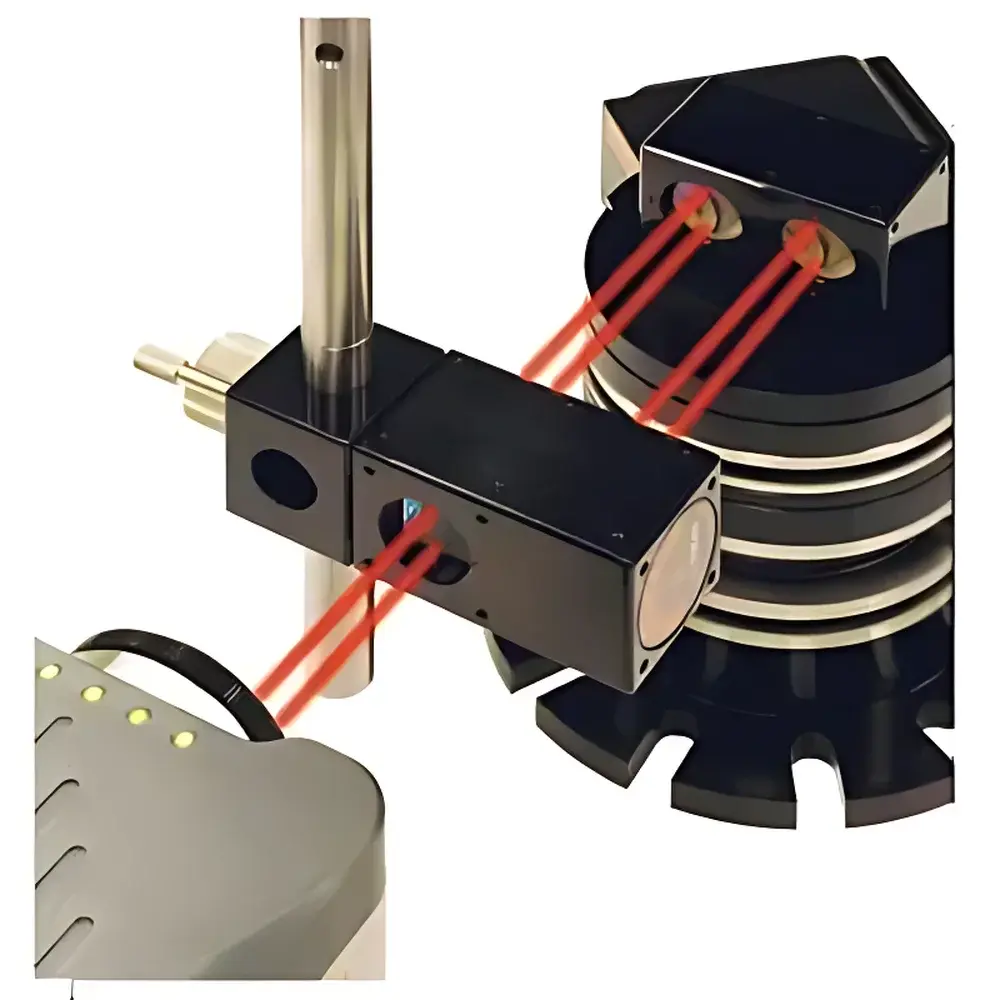
The Renishaw RX10 Rotary Axis Calibration System is a high-precision, automated metrology solution engineered for the quantitative verification and correction of angular positioning errors in rotary axes—particularly those found in coordinate measuring machines (CMMs), multi-axis machine tools, and precision motion platforms. Operating on the principle of laser interferometric angular measurement, the RX10 integrates seamlessly with Renishaw’s XL-80 or ML10 laser interferometers and complementary angular optics (e.g., angular retroreflector kits) to deliver traceable, NIST- and UKAS-aligned angular displacement data. Unlike traditional methods relying on autocollimators and polygon prisms—which require manual alignment, iterative setup, and operator-dependent interpretation—the RX10 implements closed-loop servo control of the rotary stage under test, enabling autonomous, repeatable, and operator-independent calibration sequences. Its core architecture is built around deterministic optical path geometry, thermal drift compensation via integrated environmental sensors (temperature, pressure, humidity), and real-time feedback from interferometric fringe counting, ensuring compliance with ISO 230-4 (Test Code for Positioning Accuracy of Numerical Control Axes) and ISO 10791-6 (Testing of Machining Centres — Accuracy of Positioning of Rotary Axes).
Key Features
- Fully automated rotary axis characterization: Motorized clamping, release, and incremental rotation eliminate manual intervention and reduce human-induced variability.
- Sub-arcsecond angular resolution: Standard system achieves ≤1 arcsecond total measurement uncertainty (k=2); optional configurations support ≤0.5 arcsecond performance for ultra-high-accuracy applications such as aerospace component inspection or synchrotron beamline alignment.
- Multi-orientation deployment: Designed for operation in horizontal, vertical, and inverted mounting configurations—enabling calibration of A-, B-, and C-axes across diverse machine tool architectures without reconfiguration overhead.
- Integrated self-calibration routines: Onboard algorithms automatically compensate for centering offset, squareness error, and eccentricity using reference-based iterative convergence, reducing dependency on external master artifacts.
- Environmental compensation: Real-time atmospheric parameter acquisition (via RS232-connected sensors) enables dynamic refractive index correction per ISO 10791-6 Annex B and VDI/VDE 2617 Part 8 guidelines.
- Interoperability with industry-standard laser interferometers: Native compatibility with XL-80 and ML10 systems ensures seamless integration into existing Renishaw metrology ecosystems and facilitates cross-platform data traceability.
Sample Compatibility & Compliance
The RX10 is compatible with any rotary axis exhibiting mechanical repeatability ≥±1 arcsecond and angular travel range ≥360°, including CNC rotary tables, tilting spindles, indexing heads, and robotic wrist joints. It supports both continuous and indexed motion profiles and accommodates shaft diameters from 50 mm to 500 mm via modular collet and adapter kits. All measurement protocols adhere to international standards including ISO 230-4, ISO 10791-6, ASME B5.54, and VDI/VDE 2617 Part 6. The system’s firmware and data logs are structured to support GLP/GMP audit trails, and raw interferometric data files (ASCII-based .dat format) are timestamped, versioned, and exportable for third-party validation or regulatory submission.
Software & Data Management
RX10 operation is managed through Renishaw’s CARTO software suite (v5.0+), which provides guided workflow execution, real-time angular deviation plotting (including sine/cosine error decomposition), harmonic error analysis (up to 12th order), and automated report generation compliant with ISO/IEC 17025 requirements. Data exports include CSV, PDF, and XML formats—with embedded metadata covering environmental conditions, instrument serial numbers, calibration certificate references, and uncertainty budgets. CARTO supports 21 CFR Part 11-compliant user access control, electronic signatures, and audit logging when deployed in regulated environments (e.g., medical device manufacturing or pharmaceutical equipment qualification).
Applications
- Verification and compensation of geometric errors in 5-axis machining centres prior to production ramp-up.
- Periodic performance validation of CMM rotary indexers used in automotive powertrain inspection.
- Commissioning support for ultra-precision diamond turning machines requiring sub-arcsecond angular fidelity.
- Traceable calibration of rotary stages in national metrology institutes and accredited calibration laboratories.
- Root-cause analysis of volumetric error in multi-axis systems through combined linear and angular error mapping.
FAQ
What laser interferometer models are compatible with the RX10?
The RX10 is validated for use exclusively with Renishaw XL-80 and ML10 laser interferometers, paired with angular optics kits (e.g., AxiSet Angle Kit or custom angular retroreflector assemblies).
Does the RX10 require external environmental sensors?
Yes—accurate angular compensation requires real-time input of air temperature, barometric pressure, and relative humidity. The system interfaces with Renishaw’s ENV20 environmental sensor via RS232.
Can the RX10 calibrate axes rotating beyond 360° continuously?
Yes—it supports unlimited revolution measurement with absolute angular position tracking via interferometric fringe counting and onboard encoder fusion.
Is firmware update capability available remotely?
Firmware updates are performed locally via USB connection and CARTO software; no remote update functionality is provided to maintain system integrity and cybersecurity compliance.
How is measurement uncertainty quantified for RX10 reports?
Uncertainty budgets follow the GUM (JCGM 100:2008) framework and include contributions from laser wavelength stability, optical alignment repeatability, environmental compensation residuals, and mechanical hysteresis—documented per ISO/IEC 17025 clause 7.6.