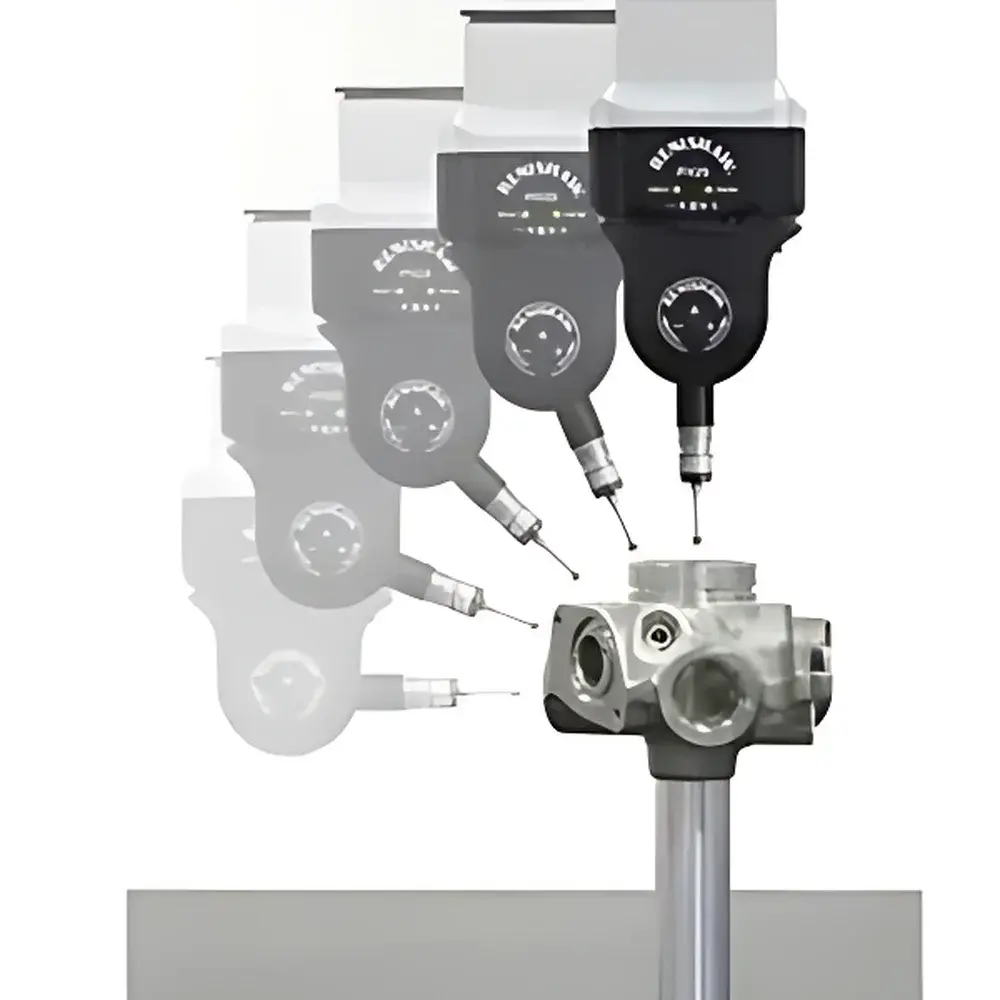
Renishaw PH20 Five-Axis Automatic Probe Head for Coordinate Measuring Machines
| Brand | Renishaw |
|---|---|
| Origin | United Kingdom |
| Model | PH20 |
| Type | Motorized 5-Axis Touch-Trigger Probe Head |
| Power Requirement | None (Passive, No Air Supply Required) |
| Compatibility | Retrofitable to Existing CMMs with TP20-style Interface |
| Calibration Method | Inferred Calibration (Single-Point Vector Determination) |
| Mounting Options | Direct Spindle Mount or Via Adaptor Kits (e.g., ISO 40/50, HSK, CAT) |
| Software Integration | Native Support in MODUS, PC-DMIS, QUINDOS, and OpenDMIS |
Overview
The Renishaw PH20 is a motorized five-axis touch-trigger probe head engineered for high-precision coordinate measuring machines (CMMs). Unlike conventional indexing probe heads that require discrete angular steps and repeated physical repositioning, the PH20 employs a true continuous five-axis kinematic architecture—two motorized axes (A and B) enabling simultaneous, real-time orientation control of the probe tip during measurement. This design implements Renishaw’s proprietary “probe-on-the-fly” methodology, where the probe head actively reorients *during* motion, eliminating the need for intermediate stops and significantly reducing cycle time. The system operates on a passive mechanical principle—no compressed air, no pneumatic actuators—relying instead on precision stepper motors and high-torque harmonic drives to deliver repeatable angular positioning within ±0.5 arcsec typical bidirectional repeatability. Its compact form factor (Ø89 mm × 106 mm height) and low mass (≤1.2 kg) minimize inertial loading on CMM kinematic structures, preserving dynamic accuracy across rapid vector changes.
Key Features
- True five-axis continuous motion: Simultaneous A- and B-axis articulation enables optimal probe approach vectors without retraction or indexing delays.
- Inferred calibration technology: A single master calibration determines both probe head orientation and stylus tip location relative to the machine coordinate system; subsequent angles inherit full metrological traceability without iterative recalibration.
- Retrofit-ready architecture: Designed for seamless integration onto legacy CMMs equipped with TP20-compatible interfaces (e.g., M3, M4, or M8 mounting threads), including models from Zeiss, Mitutoyo, Hexagon, and Nikon.
- Air-free operation: Eliminates dependency on shop air supply, reducing infrastructure complexity and improving long-term reliability in temperature-controlled metrology labs.
- Backward software compatibility: Executes existing automated probe head programs written for indexed systems (e.g., PH10M, PH10MQ) without modification—enabling immediate productivity gains post-installation.
- Modular stylus compatibility: Fully supports Renishaw’s TP20 series interchangeable modules (TP20-1 through TP20-5), allowing rapid stylus exchange while maintaining calibrated offsets.
Sample Compatibility & Compliance
The PH20 is intended for use in controlled laboratory and production metrology environments where dimensional verification of machined components, castings, sheet metal parts, and assembled subassemblies conforms to ISO 10360 (CMM acceptance and reverification tests) and ASME B89.4.1. It meets electromagnetic compatibility requirements per EN 61326-1 and carries CE marking under the EU Machinery Directive 2006/42/EC. While not intrinsically rated for hazardous locations, its solid-state construction and absence of pneumatic lines enhance suitability for cleanroom-class applications (ISO Class 5–7). When deployed with certified styli and calibrated against NIST-traceable artefacts (e.g., sphere stacks, step gauges), measurement uncertainty budgets align with ISO/IEC 17025-compliant quality management systems.
Software & Data Management
The PH20 integrates natively with industry-standard CMM software platforms—including Renishaw MODUS™, Hexagon PC-DMIS®, Zeiss CALYPSO®, and Mitutoyo MeasurLink®—via standardized I++ DME or UCC SDK protocols. All axis positions, trigger events, and stylus offset corrections are timestamped and logged with full audit trail capability. When configured within a GLP/GMP-regulated environment, the system supports 21 CFR Part 11-compliant electronic signatures and user-access-level controls when paired with validated software versions. Raw probe data is exported in standard formats (CSV, XML, DMIS 4.3) for downstream SPC analysis using Minitab, JMP, or custom Python-based statistical validation pipelines.
Applications
- High-mix, low-volume aerospace component inspection (e.g., turbine blades, structural brackets) requiring complex surface vectoring.
- Automotive powertrain validation, including cylinder head port geometry, valve seat concentricity, and camshaft lobe profiling.
- Medical device metrology for orthopedic implants and surgical instrument assemblies where GD&T callouts demand tight position and orientation tolerances.
- Tooling and fixture verification in mold & die shops, particularly for multi-cavity injection molds requiring cavity-to-cavity consistency analysis.
- Reverse engineering workflows where dense point-cloud capture via rapid vector scanning supplements optical digitizer data.
FAQ
Does the PH20 require compressed air or external power beyond the CMM controller?
No. The PH20 draws only low-voltage DC power (typically 24 V) from the CMM’s probe interface and contains no pneumatic components.
Can I use my existing TP20 styli and extension bars with the PH20?
Yes—full mechanical and electrical compatibility is maintained with all TP20-series modules, extensions, and adapters.
Is inferred calibration accepted by ISO 17025-accredited laboratories?
Yes, provided the calibration procedure is documented, traceable to national standards, and validated per ISO/IEC 17025 Clause 6.4.3 for measurement equipment verification.
What is the maximum recommended stylus length for stable triggering performance?
For optimal dynamic performance and repeatability, stylus lengths exceeding 50 mm should be evaluated case-by-case; Renishaw recommends ≤30 mm for high-speed vector scanning applications.
Does PH20 support analog scanning or only touch-trigger mode?
The PH20 is a dedicated touch-trigger probe head. For analog scanning, Renishaw’s REVO-2 or SP25M systems are engineered alternatives.