
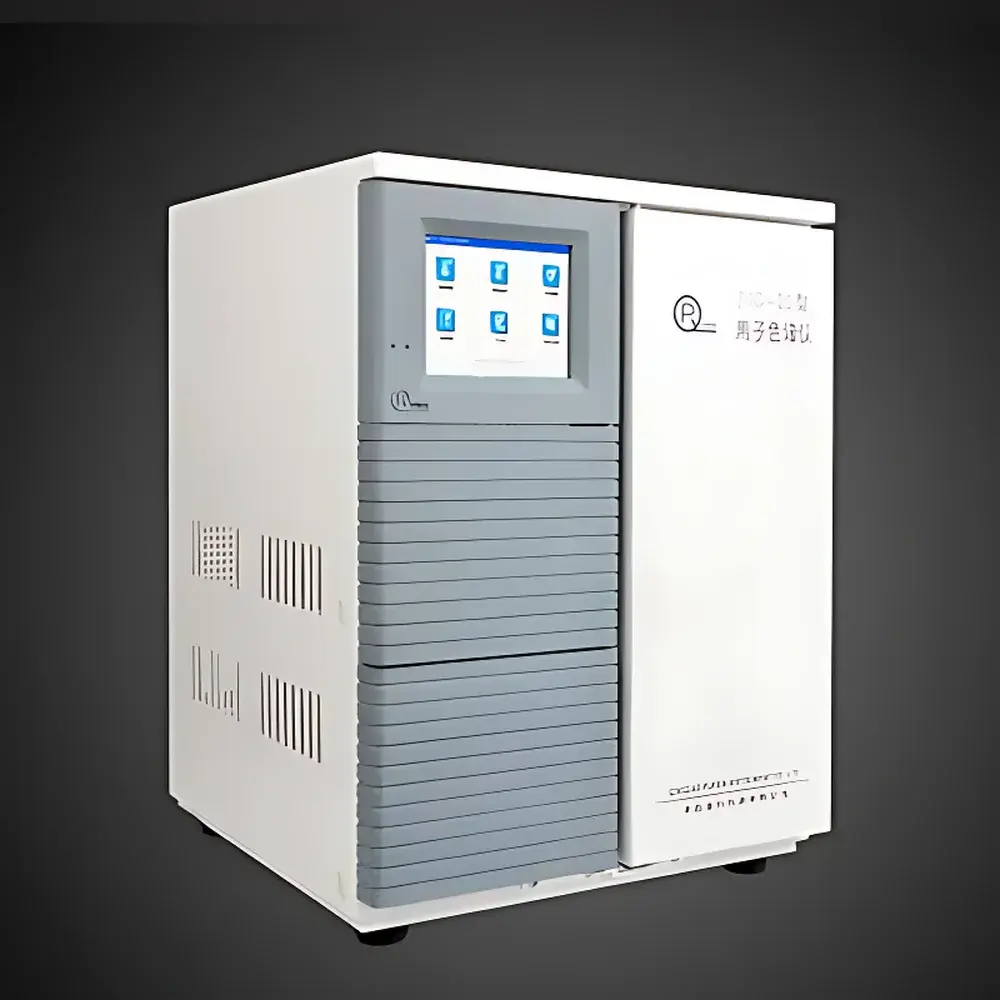
PUREN PIC-20 Ion Chromatograph
| Brand | PUREN |
|---|---|
| Model | PIC-20 |
| Origin | Shandong, China |
| Manufacturer Type | Direct Manufacturer |
| Instrument Class | Laboratory Benchtop Ion Chromatograph |
| Application Scope | General-Purpose Anion/Cation Analysis |
| Maximum Pump Pressure | 0–36.0 MPa |
| Flow Rate Range | 0.001–9.999 mL/min |
| Eluent Flow Rate | 0.7–1.5 mL/min |
| Max Operating Pressure | 10 MPa (1500 psi) |
| Operating Temperature Range | 5–65 °C |
| Temperature Reproducibility | ±0.1 °C |
| Eluent Concentration Range | 1.92–4.8 mM |
| Detector Configuration | Dual Conductivity Detectors + Optional Amperometric Detector |
| Column Oven | Integrated Peltier-heated Column/Suppressor Compartment (Patent No. ZL200820019630.3) |
| Data Storage | Local SSD + Cloud Synchronization |
| Connectivity | USB 2.0, Wi-Fi, Mobile App Remote Control (iOS/Android) |
| Compliance | Designed for ISO/IEC 17025 environments |
Overview
The PUREN PIC-20 Ion Chromatograph is a dual-channel, benchtop analytical system engineered for high-precision, simultaneous separation and quantification of inorganic anions and cations in complex aqueous matrices. It operates on the principle of suppressed conductivity detection—where analyte ions are separated on ion-exchange columns, followed by chemical or electrochemical suppression to reduce background conductivity and enhance sensitivity. The instrument integrates a dual high-pressure reciprocating piston pump system, PEEK fluidic pathways compatible with pH 0–14 eluents (including strong acids, bases, and 100% organic solvents), and a patented integrated column/suppressor thermostatic compartment (Patent ZL200820019630.3) ensuring thermal stability critical for retention time reproducibility and baseline fidelity. Its modular detector architecture supports concurrent conductivity detection (dual-channel) and optional amperometric detection—enabling trace-level analysis of redox-active species such as iodide, cyanide, sulfide, and heavy metal cations without hardware reconfiguration.
Key Features
- Dual independent high-pressure binary pumps with intelligent flow-pulse compensation algorithms, delivering flow stability ≤0.1% RSD across 0.001–9.999 mL/min range.
- PEEK-based inert flow path—resistant to corrosion from aggressive eluents (e.g., KOH, methanesulfonic acid) and fully compatible with acetonitrile, methanol, and other organic modifiers.
- Electrolytic continuous-regeneration micro-membrane suppressor (CR-ICE type), operating continuously without consumables, achieving background conductance <0.3 µS and noise <0.5 nS, with stable baseline within <5 min after startup.
- Integrated Peltier-controlled column oven (5–65 °C, ±0.1 °C reproducibility) housing both separation column and suppressor—eliminating inter-component thermal gradients that degrade resolution and peak symmetry.
- True standalone operation via 7-inch capacitive touchscreen with native chromatographic UI: real-time chromatogram zoom/pan, method recall, manual injection control, and status diagnostics—all without PC dependency.
- Modular detector bay supporting up to three detection modes: dual conductivity (simultaneous anion/cation channels), amperometric (DC, pulsed, integrated, and differential pulse), and optional UV/VIS—configurable at time of order or via field-upgrade kits.
Sample Compatibility & Compliance
The PIC-20 is validated for routine analysis of environmental, clinical, pharmaceutical, and industrial water samples—including drinking water (EPA Method 300.1, ISO 10304-1), wastewater (ISO 14911), food extracts, pharmaceutical excipients (USP ), and semiconductor process chemicals. Its PEEK fluidic system enables direct injection of high-salinity, acidic, or alkaline samples without post-column dilution or neutralization. All hardware and firmware are designed to support GLP/GMP-aligned workflows: electronic signatures, user role-based access (admin/operator/auditor), full audit trail of method changes and data modifications, and exportable raw data in open formats (.cdf, .csv). When deployed with the full-featured PAS workstation and enabled cloud sync, the system meets foundational requirements for FDA 21 CFR Part 11 compliance—including secure login, immutable data archiving, and time-stamped operator actions.
Software & Data Management
The PIC-20 runs PUREN’s PAS-IC Workstation v4.x—a Windows-based application certified for Windows 10/11 (64-bit) with native USB 2.0 digital acquisition at 100 Hz sampling rate. It provides full instrument control (pump gradient, oven temp, detector gain, valve sequencing), real-time spectral overlay, automatic baseline correction (including negative peak recognition), and ISO/IEC 17025-compliant reporting templates. Data integrity is reinforced via dual storage: local SSD (with RAID-1 mirroring option) and encrypted cloud backup (AES-256), enabling remote access to raw chromatograms, calibration curves, and audit logs via web portal or dedicated iOS/Android app. The mobile interface allows live status monitoring, alarm push notifications, and secure retrieval of processed reports—even when off-site.
Applications
- Environmental monitoring: Quantification of F⁻, Cl⁻, NO₂⁻, Br⁻, NO₃⁻, PO₄³⁻, SO₄²⁻, ClO₂⁻, ClO₃⁻, BrO₃⁻, and cations (Li⁺, Na⁺, NH₄⁺, K⁺, Mg²⁺, Ca²⁺, Sr²⁺, Ba²⁺) in surface water, groundwater, and effluent per EPA 300.0/300.1 and ISO 10304 series.
- Pharmaceutical quality control: Testing of residual counterions (e.g., Na⁺, Cl⁻) in APIs and excipients; sulfate and chloride impurities in injectables per USP .
- Food & beverage safety: Nitrate/nitrite in cured meats, bromide in flour additives, iodide in dairy, and perchlorate in bottled water.
- Power generation: Monitoring of chloride and sulfate ingress in boiler feedwater and nuclear coolant loops.
- Electronics manufacturing: Ultra-trace anion analysis (e.g., F⁻, Cl⁻, SO₄²⁻) in ultrapure water used in wafer cleaning processes (SEMI F57).
FAQ
What eluents are compatible with the PIC-20’s PEEK flow path?
The system accepts potassium hydroxide (KOH), methanesulfonic acid (MSA), carbonic acid, and sodium carbonate/bicarbonate buffers—plus any mixture containing ≤100% acetonitrile or methanol. No stainless-steel contact points exist in the high-pressure stream.
Can the PIC-20 perform simultaneous anion and cation analysis without hardware switching?
Yes. Its dual-pump, dual-detector architecture allows concurrent isocratic or gradient elution on separate anion- and cation-specific columns, with independent conductivity detection and real-time data fusion in PAS-IC software.
Is the suppressor truly maintenance-free?
The CR-ICE suppressor requires no chemical regenerants or periodic replacement membranes. It operates continuously using electrolytic water splitting for regeneration and maintains consistent performance for ≥2,000 injections under typical environmental testing conditions.
How is data integrity ensured for regulated laboratories?
With optional configuration, the PAS-IC Workstation enforces electronic signatures, password-protected method locking, automated audit trail generation (per 21 CFR Part 11 Annex 11), and tamper-evident raw data packaging—fully exportable for third-party review.
What level of technical support does PUREN provide internationally?
PUREN offers factory-certified remote diagnostics, English-language application support, and on-site service through authorized regional partners in EU, North America, and APAC—with documented SLAs for response time and spare parts availability.




