
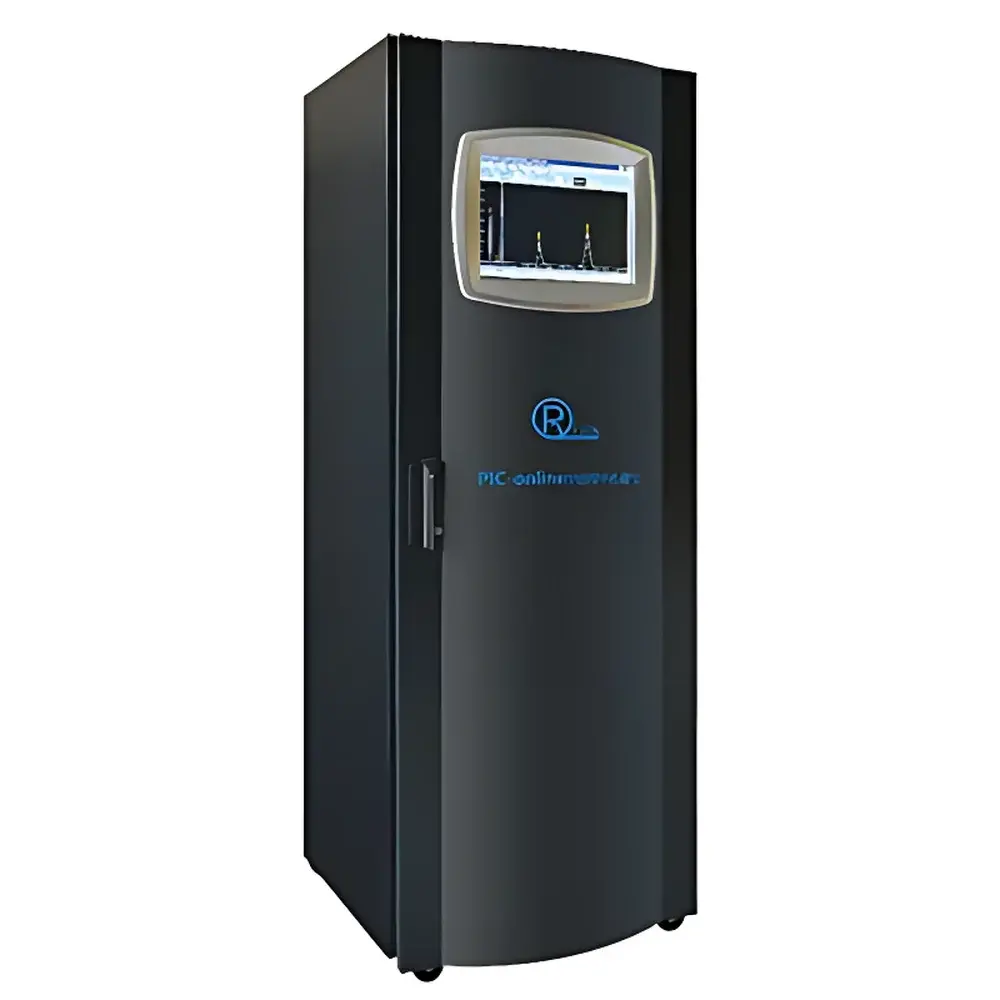
PUREN PIC-online Online Ion Chromatograph
| Brand | PUREN |
|---|---|
| Origin | Shandong, China |
| Manufacturer Type | OEM Manufacturer |
| Instrument Type | Online Analyzer |
| Application | General-Purpose Environmental & Industrial Process Monitoring |
| Pump Pressure Rating | 0–42.0 MPa (Stainless Steel) / 0–35 MPa (PEEK) |
| Flow Rate Range | 0.001–9.999 mL/min (0.001 mL/min increments) |
| Eluent Flow Rate | 0.7–1.5 mL/min |
| Max Operating Pressure | 10 MPa (1500 psi) |
| Temperature Range | 5–65 °C |
| Temperature Reproducibility | ±0.1 °C |
| Eluent Concentration Range | 1.92–4.8 mM |
Overview
The PUREN PIC-online Online Ion Chromatograph is an engineered solution for unattended, real-time ionic species monitoring in environmental and industrial water streams. Based on high-performance suppressed conductivity detection and modular dual-pump gradient elution architecture, it delivers continuous, trace-level quantification of anions, cations, and transition metal ions without manual intervention. Designed specifically for integration into automated water quality monitoring stations—including drinking water source protection zones, surface/groundwater networks, nuclear power plant cooling circuits, petrochemical effluent lines, and municipal water distribution systems—the PIC-online operates under strict regulatory data integrity requirements. Its core measurement principle relies on ion-exchange chromatography coupled with post-column chemical suppression and conductivity detection, enabling sub-ppb to ppm-level sensitivity across multi-ion matrices. The system complies with fundamental analytical performance criteria outlined in ISO 10304-1 (determination of dissolved anions), ASTM D4327 (standard test method for anions in water by IC), and supports alignment with EPA Method 300.0 and USP for purified water testing when configured with appropriate columns and detectors.
Key Features
- Triple-channel parallel analysis capability: Simultaneous detection of anions, cations, and heavy metals using configurable detector modules (conductivity, amperometric, or UV).
- Intelligent sample preconditioning: Auto-range concentration prediction, programmable on-line dilution for over-range samples, and solid-phase extraction (SPE)-based preconcentration for trace analytes—eliminating flat-top peaks and non-detect events.
- Self-calibrating workflow: Integrated syringe pump and mixing chamber generate 5–10 precise calibration points via quantitative loop injection; fully automated standard curve generation and interpolation without operator input (patented: ZL201410282068.3, ZL201410282025.5).
- Internal standardization protocol: Each injected sample includes a chemically inert internal standard for retention time alignment and signal normalization—critical for long-term drift compensation in unattended operation.
- Robust thermal management: Column oven and detector compartment maintain temperature stability within ±0.1 °C across 5–65 °C ambient range, ensuring retention time reproducibility and baseline consistency over extended deployments.
- Modular detector compatibility: Supports single/dual conductivity cells, pulsed amperometric detection (PAD), and dual-wavelength UV-VIS detection—configurable per application requirements and regulatory mandates.
Sample Compatibility & Compliance
The PIC-online accepts aqueous liquid samples directly—no organic solvent compatibility required. It is validated for use with natural waters (river, lake, groundwater), treated drinking water, ultrapure process water, and low-conductivity industrial effluents. All wetted components are constructed from PEEK, PTFE, or 316 stainless steel to prevent leaching and corrosion. The system meets essential design and documentation standards for regulated environments: full audit trail support for GLP/GMP-compliant laboratories, electronic signature readiness per FDA 21 CFR Part 11 (when deployed with compliant LIMS integration), and traceable calibration records stored locally and synchronized to cloud infrastructure. Instrument certification includes Manufacturing Metrology License (China NIM), confirming conformance with JJG 823–2014 (Ion Chromatograph Verification Regulation).
Software & Data Management
Controlled via PUREN IC-Studio v4.x software, the PIC-online provides browser-based remote access, real-time chromatogram visualization, and event-driven alarm notifications via email or SMS. All raw chromatographic data—including peak tables, calibration curves, instrument logs, and system status reports—are automatically timestamped and archived in native .icd format. Local storage capacity exceeds 10 years of continuous 24/7 acquisition at default sampling intervals. Dual redundancy is enforced: primary storage resides on embedded industrial SSD; secondary backup occurs automatically to secure TLS-encrypted cloud repositories (AWS S3-compatible). Data export options include CSV, PDF analytical reports, and XML-formatted results compatible with national environmental monitoring platforms (e.g., China’s National Surface Water Quality Monitoring System). Software supports customizable report templates aligned with local regulatory submission formats (e.g., HJ/T 91–2019 in China, EU WFD Annex V reporting).
Applications
- Drinking water source surveillance: Continuous monitoring of NO₃⁻, SO₄²⁻, Cl⁻, F⁻, PO₄³⁻, NH₄⁺, Na⁺, K⁺, Ca²⁺, Mg²⁺, and heavy metals (e.g., Cr⁶⁺, As³⁺) at reservoirs and intake stations.
- Nuclear facility coolant loop analysis: Detection of chloride-induced stress corrosion precursors and borate/pH buffer species.
- Petrochemical wastewater compliance: Quantification of sulfite, thiocyanate, and halide species in refinery discharge streams.
- Pharmaceutical water system validation: On-line verification of ionic purity per USP , EP 2.2.38, and JP 2.05.
- Smart city water infrastructure: Integration with SCADA systems for early warning of contamination events through anomaly detection algorithms embedded in IC-Studio.
FAQ
Does the PIC-online support remote diagnostics and firmware updates?
Yes—via secure HTTPS interface, authorized technicians can perform health checks, log analysis, and over-the-air firmware upgrades without onsite visits.
Can the system operate without continuous tap water supply?
Yes—integrated eluent generator option eliminates reliance on bottled eluents; for non-generator configurations, scheduled eluent replacement every 7–14 days suffices for stable operation.
Is method transfer possible from lab-based IC systems?
Yes—retention time indexing and column compatibility allow direct migration of validated methods from Thermo Fisher, Metrohm, or Shimadzu benchtop IC platforms.
What cybersecurity measures are implemented?
Role-based access control (RBAC), TLS 1.2+ encryption for all data transmissions, disabled default credentials, and optional hardware security module (HSM) integration for certificate-based authentication.
How is data integrity verified during cloud synchronization?
SHA-256 hash validation is performed before and after upload; mismatch triggers automatic retransmission and alerts the system administrator.




