
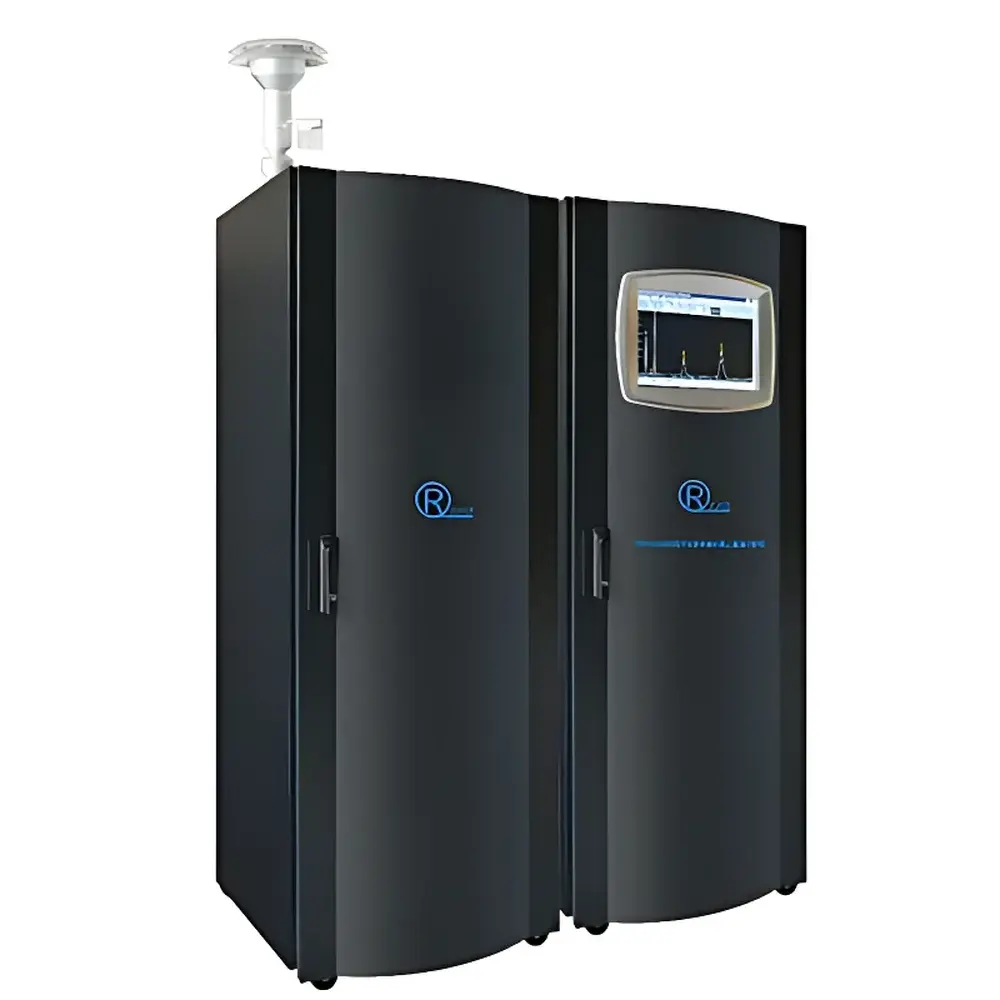
PUREN PAGM Online Atmospheric Aerosol Analyzer
| Brand | PUREN |
|---|---|
| Model | PAGM |
| Instrument Type | Online Ion Chromatograph with Integrated Aerosol Sampling & Pre-treatment System |
| Origin | Shandong, China |
| Manufacturer | PUREN Instrument Co., Ltd. |
| Pump Pressure Rating | 36 MPa |
| Flow Rate Range | 0–9.999 mL/min |
| Eluent Flow Rate | 1.0 mL/min |
| Max Operating Pressure | 15 MPa |
| Operating Temperature Range | 14–35 °C |
| Temperature Reproducibility | ±0.01 °C |
| Eluent Concentration Range | 1.0–5.0 mM |
Overview
The PUREN PAGM Online Atmospheric Aerosol Analyzer is a fully integrated, research-grade analytical platform engineered for continuous, real-time speciation and quantification of water-soluble ionic species—including anions (e.g., Cl⁻, NO₃⁻, SO₄²⁻, MSA), cations (e.g., Na⁺, NH₄⁺, K⁺, Ca²⁺, Mg²⁺), and transition metal ions (e.g., Fe²⁺/³⁺, Mn²⁺, Zn²⁺)—in both gaseous and particulate phases of ambient air. It combines a high-efficiency atmospheric sampling and aqueous extraction system with a triple-channel online ion chromatograph (IC) to deliver synchronized, time-resolved data at sub-hour resolution. The system operates on the principle of selective size-fractionated aerosol collection (PM₁.₀, PM₂.₅, PM₁₀) via cyclonic or impactor-based inlets, followed by parallel gas dissolution (using vertical wet flat-plate or concentric-tube diffusion scrubbers) and particle leaching. Extracted analytes are delivered to the IC modules without manual intervention, enabling unattended 24/7 operation under field conditions. Designed for regulatory compliance and scientific rigor, the PAGM meets foundational requirements for long-term environmental monitoring in accordance with ISO 16000-25 (indoor air), EPA TO-15/TO-17 analog workflows, and EU Directive 2008/50/EC for ambient air quality assessment.
Key Features
- Modular, size-selective aerosol inlet options: Interchangeable PM₁₀, PM₂.₅, and PM₁.₀ impactors or cyclones—certified per ISO 25548-1 and EN 12341.
- Low-loss gas sampling: Wet flat-plate and concentric-tube diffusion scrubbers achieve >95% SO₂ absorption efficiency with minimal particle loss (<2% at 0.3 µm).
- Two-stage particle capture: Thermophoretic condensation + inertial impaction ensures >90% recovery of water-soluble ions across the 0.01–10 µm aerodynamic diameter range.
- Precision volumetric dosing: Dual optical fiber liquid-level sensors enable ±0.5% volume accuracy for both gas scrubber effluent and particle leachate—critical for stoichiometric quantification and cross-platform calibration (e.g., with online TOC or ICP-MS).
- Integrated bubble removal: Mechanical degassing module eliminates macro-bubbles prior to IC injection—preventing column overpressure, baseline drift, and detector saturation.
- Simultaneous dual-path sample introduction: Independent fluidic pathways for gas-phase and aerosol-phase extracts eliminate cross-contamination and support concurrent anion/cation/metal analysis.
- Four-position automated injection manifold: Enables true continuous sampling—no data gaps during injection cycles; supports ≥144 analyses per day at 10-min intervals.
- Self-diagnostic calibration: Onboard blank-flush module performs daily system integrity checks using ultra-pure water; validates absence of residual ions or carryover.
- Adaptable internal standardization: Programmable IS injection (e.g., Br⁻, Li⁺, Sc³⁺) with dynamic concentration adjustment—optimized for haze episodes or low-concentration marine background conditions.
- Standalone IC capability: The chromatographic module can be decoupled for benchtop use with external sample introduction—supporting method development, QA/QC validation, and non-aerosol applications (e.g., water, soil leachates).
Sample Compatibility & Compliance
The PAGM accommodates diverse atmospheric matrices across urban, industrial, coastal, polar, and clean-background environments. Its sampling architecture complies with gravimetric and compositional reference methods defined in ISO 21507 (aerosol sampling), ASTM D7238 (ion chromatography of airborne particles), and US EPA Method IO-3.6 (anion analysis). All wet chemistry components—including tubing, valves, and reaction chambers—are constructed from PFA, PEEK, and quartz to prevent metal leaching and adsorption artifacts. The system supports GLP-compliant audit trails via timestamped raw chromatograms, instrument logs, and environmental metadata (flow, temperature, pressure). Data export formats include CSV, NetCDF, and XML—compatible with national air quality databases (e.g., China’s CNEMC, US EPA AQS, EEA AirBase) and third-party visualization tools (e.g., R shiny, Python Pandas, Tableau).
Software & Data Management
Control and data acquisition are managed through a ruggedized industrial PC (IPC) running Windows IoT Enterprise, featuring a localized English GUI with intuitive workflow navigation. The embedded software suite provides real-time chromatogram visualization, peak integration with retention time locking, multi-point calibration curve generation (linear/nonlinear), and automatic interference correction (e.g., carbonate suppression, matrix-matched standards). All analytical events—including auto-zeroing, blank subtraction, IS recovery calculation, and QC flagging—are logged with digital signatures. Remote access is enabled via secure LAN/WAN connection supporting TLS 1.2 encryption; users may monitor status, download reports, or trigger diagnostics from any web browser. Hourly summary reports (PDF/Excel) include statistical metrics (RSD%, recovery %, LOD/LOQ), trend plots, and exceedance alerts. Database storage supports ≥12 months of high-frequency data (per-second sensor readings + per-analysis chromatographic results) with configurable backup to NAS or cloud endpoints.
Applications
- Continuous monitoring at national/regional air quality stations—especially for secondary inorganic aerosol (SIA) formation studies (NH₄NO₃, (NH₄)₂SO₄).
- Source apportionment of industrial plumes (e.g., coal-fired power plants, smelters, chemical manufacturing) via time-resolved ion ratios (e.g., nss-SO₄²⁻/Na⁺, Cl⁻/Na⁺).
- Marine boundary layer chemistry—validated onboard the R/V Xuelong (Antarctic cruise, 2015–2016) for methanesulfonate (MSA) and non-sea-salt sulfate quantification.
- Ultra-clean environment surveillance in semiconductor fabrication facilities—detecting trace halides and metals that compromise wafer yield.
- Process control in flue gas desulfurization (FGD) systems—monitoring SO₂ oxidation products and chloride breakthrough.
- Field-deployable research platforms—integrated with TOC, ICP-OES, or GC-MS for comprehensive carbon/metal/organic speciation.
FAQ
What aerosol size fractions does the PAGM support?
The system accepts interchangeable PM₁₀, PM₂.₅, and PM₁.₀ inlets compliant with ISO/CEN size-selective definitions.
Can the PAGM operate unattended for extended periods?
Yes—designed for >30 days of continuous operation without consumable replacement (e.g., membranes, filters, or scrubber solutions).
Is the system compatible with FDA 21 CFR Part 11 requirements?
While not certified as Part 11–compliant out-of-the-box, the audit trail, electronic signature, and data integrity features meet foundational technical controls required for regulated environments.
How is calibration verified during long-term deployment?
Automated internal standard injection (with recovery tracking) and scheduled blank flushes provide daily verification of system performance and carryover control.
Does the PAGM support custom eluent gradients or column chemistries?
Yes—the IC module accepts standard 4-mm or 2-mm bore columns and supports user-defined gradient profiles and eluent compositions within the specified 1.0–5.0 mM range.






