
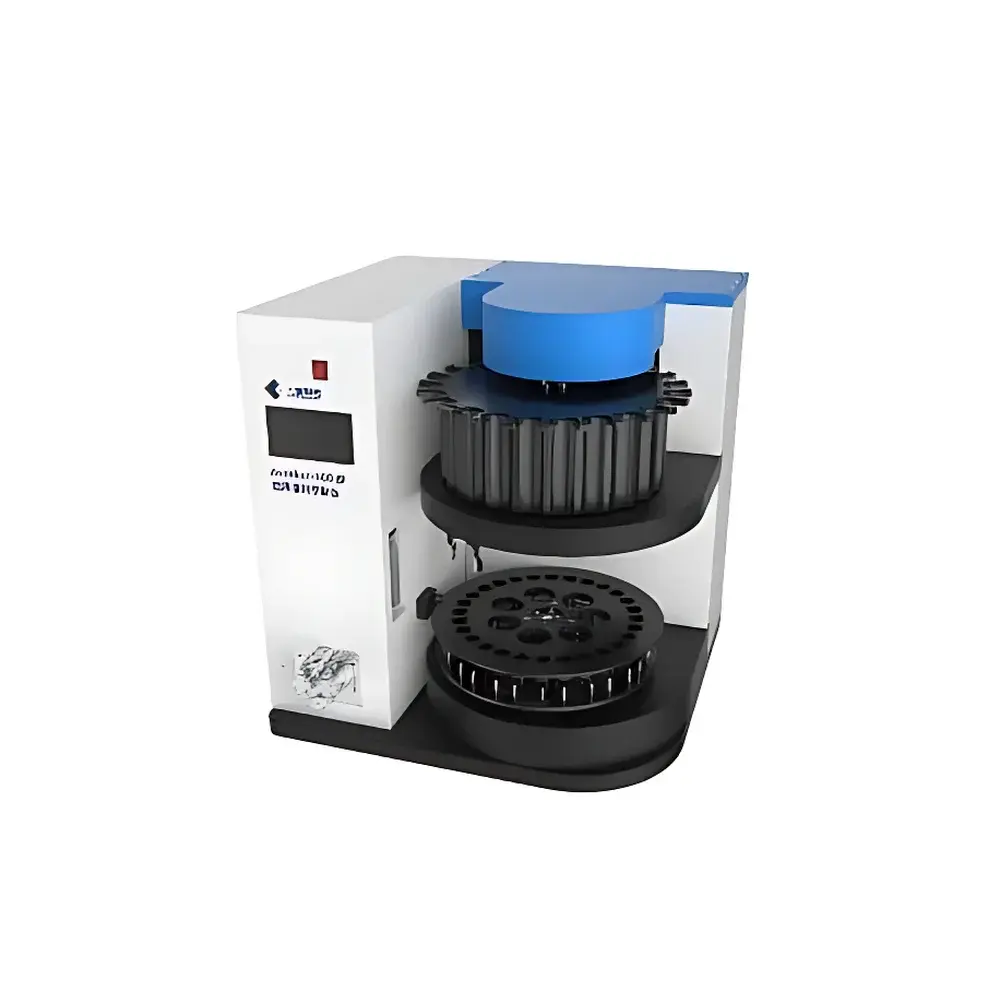
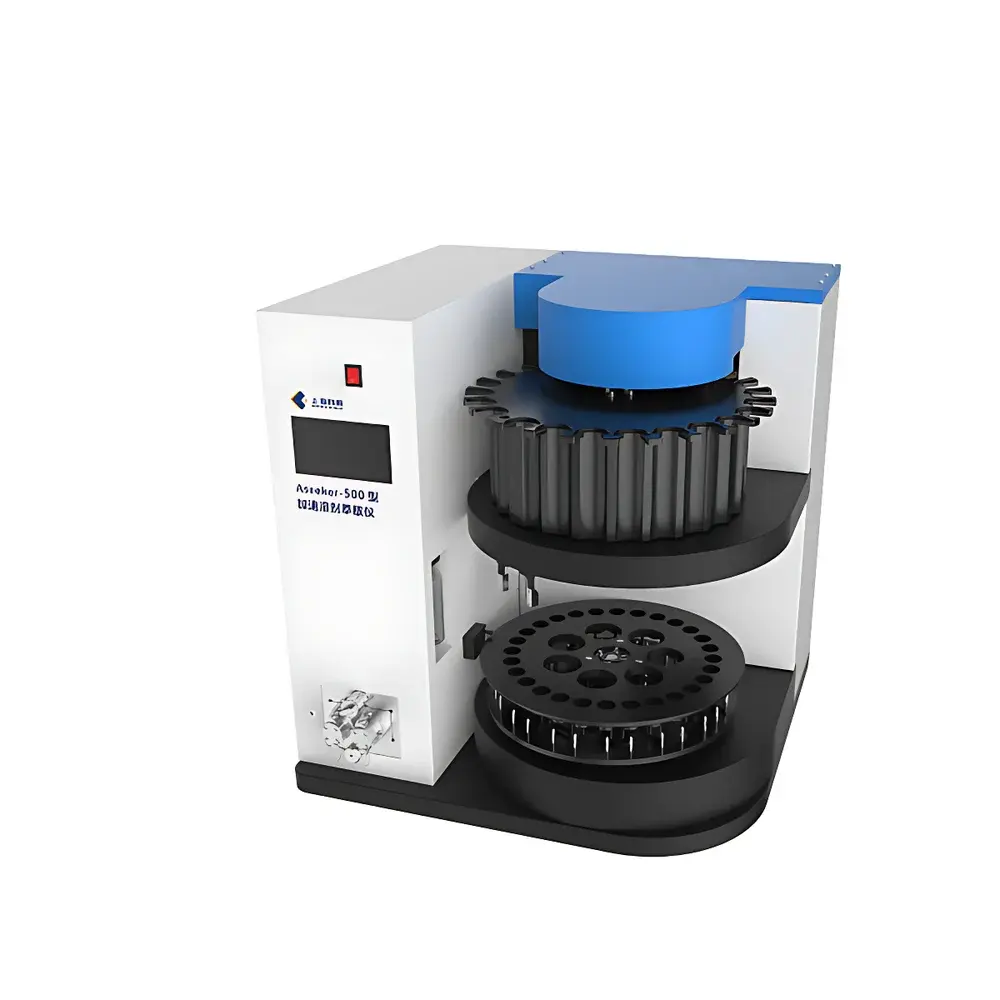
KEZHE Aseeker-500 Accelerated Solvent Extractor
| Brand | KEZHE SHANGHAI |
|---|---|
| Origin | Shanghai, China |
| Manufacturer Type | Direct Manufacturer |
| Origin Category | Domestic (China) |
| Model | Aseeker-500 |
| Instrument Type | Solid-Liquid Extraction System |
| Temperature Range | Ambient to 200 °C (±0.5 °C) |
| Pressure Range | 10 MPa (±0.5 MPa) |
| Extraction Cell Volume | Standard 34 mL (optional: 1, 5, 10, 22, 66, 100 mL) |
| Extraction Time per Sample | 20 min |
| Instrument Dimensions | 800 mm × 738 mm × 685 mm |
| Sample Capacity | 24 extraction cells |
| Collection Vials | Standard 19 × 250 mL or up to 28 × 60 mL + 5 × 250 mL with adapter |
| Pump Flow Rate | 0.1–50 mL/min |
| Power Consumption | ≤1.2 kW |
| Input Voltage | 100–240 VAC ±10 %, 50–60 Hz |
| Solvent Mixing Capability | Up to 4 solvents |
| Cleaning Stations | 2 |
| Weight | 70 kg |
| Contact Materials | PEEK, PTFE, 316L stainless steel, ceramic |
| Safety Features | Electronic over-pressure/over-temperature protection, leak detection with automatic shutdown and sequence bypass, external air supply pressure monitoring, infrared liquid-level sensing at collection vials |
Overview
The KEZHE Aseeker-500 Accelerated Solvent Extractor is an automated solid-liquid extraction system engineered for high-throughput, reproducible recovery of analytes from solid and semi-solid matrices under elevated temperature and pressure conditions. Based on the principle of accelerated solvent extraction (ASE®), the instrument utilizes pressurized organic or aqueous-organic solvents to enhance solubility, mass transfer kinetics, and extraction efficiency—significantly reducing extraction time compared to traditional Soxhlet or ultrasonic methods. Operating at temperatures up to 200 °C and pressures up to 10 MPa, the Aseeker-500 maintains thermodynamic stability while preventing solvent boiling, enabling rapid desorption of target compounds—including pesticides, PAHs, PCBs, pharmaceutical residues, lipids, and semi-volatile organic compounds (SVOCs)—from complex environmental, food, agricultural, and pharmaceutical samples.
Key Features
- Automated cell recognition system: Detects installed extraction cell volume (1–100 mL) without manual configuration, ensuring protocol integrity across variable sample loads.
- Integrated leak detection and response: Real-time solvent leak monitoring triggers immediate system halt; during multi-cell sequences, only affected cells are skipped—uncompromised processing continues for remaining positions.
- Intelligent collection management: Infrared liquid-level sensors detect fill level in vials; workflow pauses automatically upon reaching threshold, prompting operator intervention before resuming.
- Unattended operation: Supports fully automated processing of up to 24 samples consecutively—ideal for laboratories requiring overnight or shift-independent workflows.
- Fixed-pressure operation mode: Simplifies method development by decoupling pressure control from user input, improving inter-run consistency and reducing operator error.
- Dual-collection vial support: Standard 250 mL vials (19-position tray) or expanded 60 mL vial configuration (28 positions + 5 × 250 mL) with auto-detection of adapter installation—no software reconfiguration required.
- Robust fluidic architecture: Dual-piston high-precision pump delivers stable flow rates from 0.1 to 50 mL/min; solvent mixing module supports gradient or sequential delivery of up to four solvents.
- Thermal and mechanical safety: Electronic over-pressure and over-temperature cutoffs comply with IEC 61010-1 requirements; all wetted materials (PEEK, PTFE, 316L SS, ceramic) ensure chemical compatibility and minimize leaching.
Sample Compatibility & Compliance
The Aseeker-500 is validated for use with a broad range of solid and semi-solid matrices including soils, sediments, sludge, plant tissues, animal feed, edible oils, dairy powders, herbal extracts, and pharmaceutical tablets. Its operational parameters align with regulatory method requirements including U.S. EPA Method 3545A (SW-846), Chinese National Standard GB 23200.9–2016 (Pesticide Residues in Food), and HJ 834–2017 (Determination of Semi-Volatile Organic Compounds in Soil and Sediment by GC-MS). The system supports GLP-compliant data traceability when integrated with validated LIMS or chromatography data systems. All critical process parameters—including temperature, pressure, flow rate, cell volume, and collection vial assignment—are logged with timestamps and user attribution, facilitating audit readiness under FDA 21 CFR Part 11 and ISO/IEC 17025 frameworks.
Software & Data Management
The Aseeker-500 features an embedded 10.1-inch capacitive touchscreen interface running a deterministic real-time OS. Method creation includes stepwise definition of heat-up ramp, static extraction time, flush volume, purge duration, and solvent selection—all assignable per cell position. Sequence logs retain full execution metadata: start/end times, actual vs. setpoint temperature/pressure profiles, leak events, vial fill status, and hardware fault codes. Export options include CSV and PDF reports compatible with laboratory informatics platforms. No proprietary drivers or cloud dependencies are required; local network connectivity enables remote monitoring via standard HTTP/HTTPS protocols. Firmware updates are performed offline via USB, preserving data sovereignty and network isolation in regulated environments.
Applications
- Environmental analysis: Extraction of organochlorine pesticides, PAHs, phthalates, flame retardants, and dioxin precursors from soil, sediment, and biota samples prior to GC-MS or LC-MS/MS analysis.
- Food safety testing: Quantification of mycotoxins, veterinary drug residues, and fat-soluble contaminants in cereals, nuts, meat, and dairy products per EU Commission Regulation (EC) No 401/2006 and AOAC guidelines.
- Pharmaceutical quality control: Recovery of residual solvents, excipient impurities, and active pharmaceutical ingredient (API) degradation products from solid dosage forms.
- Agricultural research: High-yield lipid and pigment extraction from seeds, leaves, and roots for nutritional profiling and metabolomic studies.
- Industrial hygiene: Isolation of polycyclic aromatic hydrocarbons (PAHs) and heavy metal chelates from workplace dust and filter media.
FAQ
What regulatory methods does the Aseeker-500 support?
The instrument is designed to meet the operational specifications of U.S. EPA Method 3545A, GB 23200.9–2016, and HJ 834–2017, among other internationally recognized ASE-based protocols.
Can the system handle multiple solvent types within a single run?
Yes—the integrated solvent mixer allows up to four solvents to be selected and delivered in defined ratios or sequential steps per extraction cycle.
Is method transfer from other ASE platforms straightforward?
Method parameters (temperature, pressure, static time, flush volume) are directly translatable; cell geometry differences may require minor flow calibration—but no hardware modification is needed.
How is data integrity ensured during unattended operation?
All process variables are timestamped and stored locally with checksum-verified logging; optional integration with third-party audit-trail modules satisfies 21 CFR Part 11 electronic record requirements.
What maintenance intervals are recommended for routine operation?
Daily visual inspection of seals and tubing; quarterly calibration of temperature and pressure sensors using NIST-traceable references; annual verification of pump linearity and leak detection sensitivity per manufacturer’s service protocol.



