
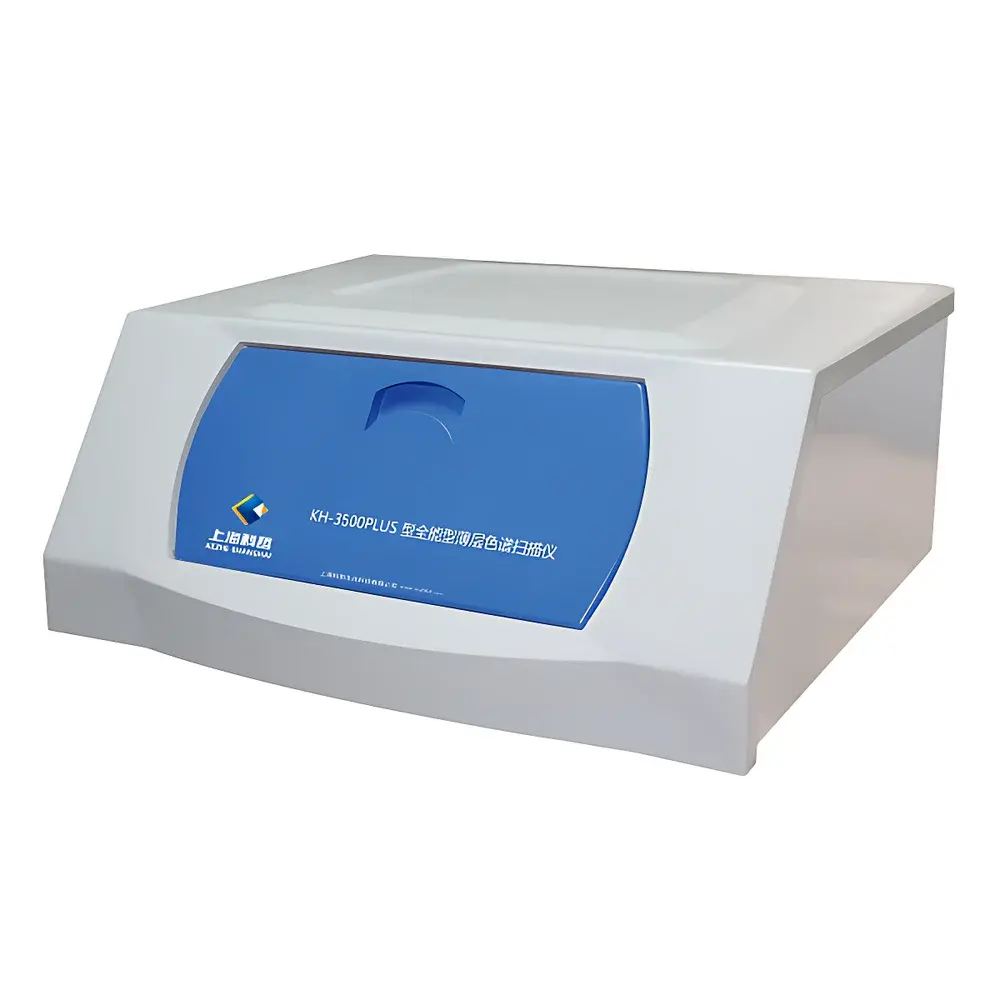
Kezhe KH-3500Plus II Full-Function Thin-Layer Chromatography (TLC) Scanner
| Brand | Kezhe / KEZHE SHANGHAI |
|---|---|
| Origin | Shanghai, China |
| Manufacturer Type | Original Equipment Manufacturer (OEM) |
| Product Category | Domestic |
| Model | KH-3500Plus II |
| Instrument Type | TLC Densitometer & Imaging System |
| Measurement Modes | Reflectance Absorption, Reflectance Fluorescence, Transmission Absorption, Transmission Fluorescence, Chemiluminescence |
| Wavelength Range | 190–1000 nm |
| Light Sources | Tungsten-Halogen Lamp, Deuterium Lamp, Mercury Lamp (Auto-Switching) |
| Monochromator | Holographic Grating (1200 lines/mm) with Nitrogen Purge Option |
| Spectral Bandwidth | 5 nm / 10 nm / 20 nm (Selectable |
| Wavelength Accuracy | ±0.5 nm |
| Wavelength Repeatability | <0.1 nm |
| Minimum Spatial Resolution | 10–25 µm |
| Imaging Wavelengths | 254 nm, 365 nm, White Light (Fully Automated Control) |
| Sample Stage Capacity | 200 mm × 200 mm TLC Plate (Customizable to 300 mm × 200 mm) |
| Scan Speed | 0–120 mm/s |
Overview
The Kezhe KH-3500Plus II is a fully integrated, computer-controlled thin-layer chromatography (TLC) densitometer and imaging platform engineered for quantitative, reproducible, and regulatory-compliant analysis across pharmaceutical, natural product, and quality control laboratories. Unlike conventional single-function scanners, the KH-3500Plus II implements dual-detection architecture—simultaneous optical densitometry and high-fidelity digital imaging—enabling correlation of spectral quantitation with spatial visualization. Its measurement principle is based on controlled monochromatic light irradiation (190–1000 nm), followed by detection of reflected or transmitted absorbance/fluorescence signals using a high-gain photomultiplier tube (PMT) and 24-bit analog-to-digital conversion. The system supports all major TLC detection modalities: reflectance absorption, reflectance fluorescence, transmission absorption, transmission fluorescence, and chemiluminescence—making it uniquely suited for method development, fingerprint profiling, and stability-indicating assays per ICH Q5C and USP <206> guidelines.
Key Features
- Automated two-dimensional scanning capability (X- and Y-axis programmable movement) for precise trajectory tracking and correction—exclusive to this platform in the global TLC instrumentation market.
- Adjustable slit aperture (0–8 mm length × 0–4 mm width, continuously variable and software-controlled) enabling optimization of signal-to-noise ratio and spatial resolution (down to 10 µm).
- Triple light source configuration (tungsten-halogen, deuterium, mercury) with automatic lamp selection and nitrogen-purged monochromator for UV-VIS-NIR spectral fidelity and long-term wavelength stability.
- Dual-detection chamber with integrated 254 nm, 365 nm, and white-light illumination for real-time plate inspection, image-guided scanning, and post-run documentation—fully compliant with Chinese Pharmacopoeia (2015 Ed.) Section 3.5 and EU Ph. Eur. 2.2.27.
- 24-bit A/D converter with 8-channel acquisition and 30,000 data points per second throughput ensures high dynamic range and low quantification uncertainty in trace-level analysis.
- Pre-installed Tstar-3500Plus II workstation software with embedded 21 CFR Part 11 compliance modules—including electronic signatures, audit trail logging, user role-based access control, and 3Q (IQ/OQ/PQ) documentation templates.
- Native integration with peripheral TLC automation modules: SP-30E strip sample applicator, TK-20E automated development chamber, TS-20E quantitative spray derivatizer, TY-10 immersion derivatization unit, and TD-II preparative plate coater.
Sample Compatibility & Compliance
The KH-3500Plus II accommodates standard 200 mm × 200 mm silica gel, alumina, or cellulose TLC plates—and accepts custom 300 mm × 200 mm formats for extended separation zones. Its universal detection modes support diverse analytes: small-molecule APIs, herbal markers (e.g., ginsenosides, berberine), peptides, lipids, and degradation products. All hardware and firmware comply with ISO/IEC 17025:2017 general requirements for testing laboratories. Software validation adheres to FDA 21 CFR Part 11, EU Annex 11, and WHO TRS 992 Annex 6 for regulated environments. Method libraries include pre-validated protocols aligned with Chinese Pharmacopoeia (2020 Edition), USP <621>, and EP 2.2.27, supporting GLP/GMP audits without third-party revalidation.
Software & Data Management
Tstar-3500Plus II is a modular, Windows-based application suite delivering end-to-end workflow control—from method design and instrument orchestration to statistical reporting. Core modules include: (1) Densitometric Quantitation Engine (single/dual-wavelength, spectral scan, multi-point calibration with linear/quadratic regression); (2) GoodLook-1000 Image Analysis Suite (automated spot detection, Rf calculation, similarity indexing, cluster analysis per PCA/HCA algorithms); (3) Fingerprint Profiling Toolkit (cross-batch comparison, marker alignment, relative peak area normalization); (4) Automated Development & Derivatization Scheduler (humidity, saturation time, development distance, post-development drying, spray volume/timing, immersion temperature/duration). Raw data are stored in vendor-neutral .csv and .tiff formats; audit trails record every parameter change, user action, and hardware event with timestamp, operator ID, and reason-for-change fields—fully traceable for regulatory submissions.
Applications
- Pharmaceutical QC/QA: Identity testing, assay uniformity, impurity profiling, and stability-indicating method validation per ICH Q2(R2).
- Traditional Medicine Research: Multi-component fingerprinting of herbal extracts, batch-to-batch consistency assessment, and marker compound quantification under Chinese Pharmacopoeia standards.
- Food & Environmental Safety: Pesticide residue screening, mycotoxin detection (aflatoxins, ochratoxin A), and adulterant identification in complex matrices.
- Academic & Method Development Labs: High-throughput TLC method scouting, spectral library generation, and coupling with hyphenated techniques (e.g., TLC–MS interface preparation).
- Regulatory Submissions: Generation of compliant images, densitograms, and statistical reports required for NDAs, ANDAs, and CMC sections per FDA and NMPA guidelines.
FAQ
Does the KH-3500Plus II support 21 CFR Part 11 compliance out-of-the-box?
Yes—the Tstar-3500Plus II software includes built-in electronic signature workflows, immutable audit trails, and role-based permission management validated per FDA guidance.
Can the system perform both densitometric scanning and digital imaging simultaneously?
Yes—dual-detector architecture enables concurrent spectral data acquisition and high-resolution UV/visible imaging without sequential mode switching.
Is nitrogen purging mandatory for UV measurements below 220 nm?
Nitrogen purging is optional but recommended for measurements at 190–210 nm to eliminate atmospheric oxygen absorption artifacts.
What level of automation is supported for TLC plate development?
TK-20E integration provides full environmental control: pre-equilibration humidity, saturation time, mobile phase composition, development distance, post-development drying, and solvent exhaust sequencing.
Are pharmacopeial methods pre-loaded in the software?
Yes—validated method templates for Chinese Pharmacopoeia (2020), USP <621>, and EP 2.2.27 are included, with editable parameters for lab-specific adaptation.




