
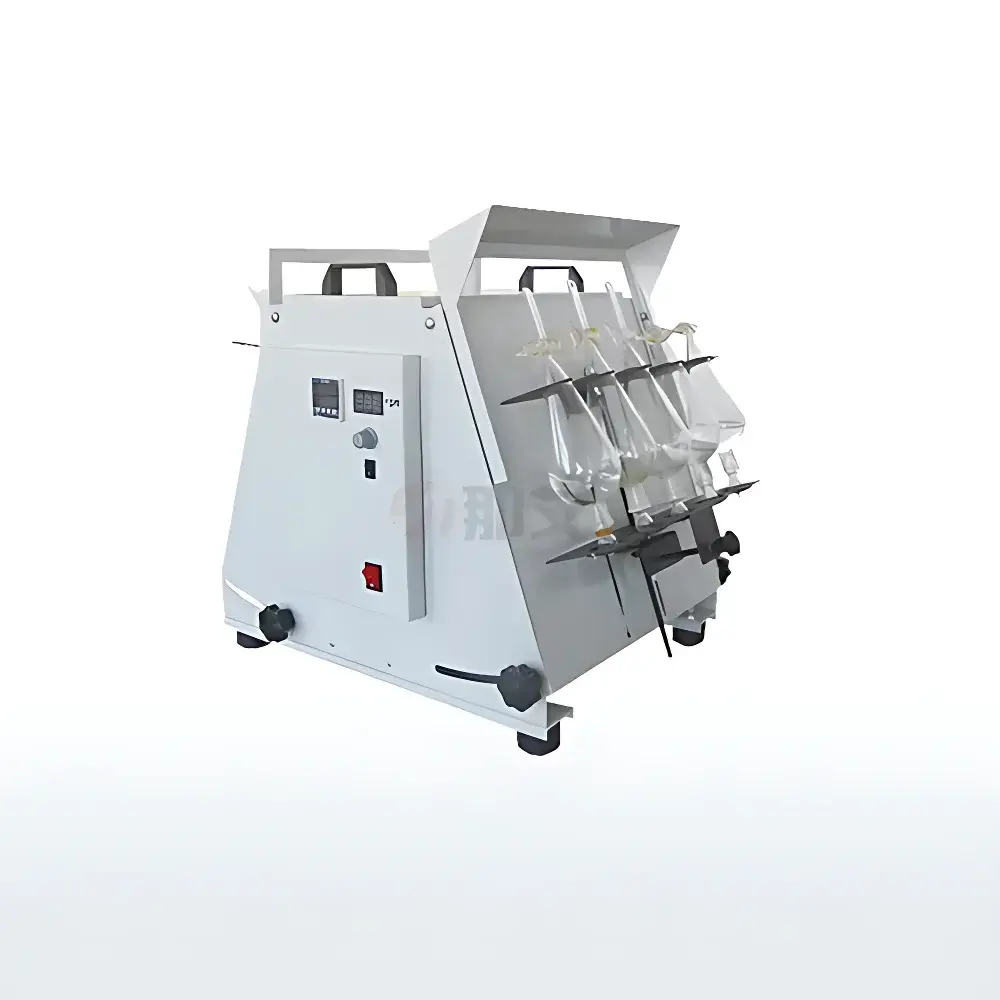
NAI-LF6 Vertical & Tilt Oscillating Separatory Funnel Shaker
| Brand | NAI Instruments |
|---|---|
| Origin | Shanghai, China |
| Model | NAI-LF6 |
| Sample Capacity | 6 units |
| Oscillation Mode | Vertical or Adjustable Tilt (0–22°) |
| Oscillation Frequency | 10–300 cycles/min |
| Stroke Amplitude | 40 mm |
| Display | Large LCD with Digital Timer |
| Motor Type | Low-Noise DC Motor (≤55 dB) |
| Rated Power | 350 W |
| Clamp Compatibility | Standard clamps for 50–1000 mL funnels |
| Standard Configuration | Host unit + 6 standard funnels clamps |
| Compliance | Designed for GLP-compliant laboratory environments |
Overview
The NAI-LF6 Vertical & Tilt Oscillating Separatory Funnel Shaker is an engineered solution for liquid–liquid extraction and sample purification in analytical laboratories. Based on controlled mechanical oscillation principles—specifically sinusoidal reciprocating motion with adjustable amplitude and frequency—it facilitates reproducible phase separation kinetics in separatory funnels. Unlike orbital or rotary shakers, the NAI-LF6 employs a vertically aligned drive mechanism that minimizes vortex formation while maximizing interfacial contact time between immiscible phases. Its dual-mode operation (vertical or tilt oscillation) allows users to optimize extraction efficiency across diverse solvent systems—including chloroform/water, ethyl acetate/buffer, and hexane/acidic aqueous layers—commonly encountered in environmental, pharmaceutical, and food safety testing workflows.
Key Features
- Dual oscillation modes: switchable between vertical and tilt (0–22°) configurations to accommodate varying density differentials and emulsion tendencies
- Precise digital control: 10–300 cycles/min frequency range with ±2 cycles/min repeatability; timer up to 99 hours 59 minutes with auto-stop function
- 40 mm stroke amplitude ensures consistent energy transfer without excessive shear stress on glassware
- Low-noise DC motor (≤55 dB at 1 m distance) enables continuous operation in shared lab spaces without acoustic interference
- Tool-free, vertically sliding clamp assembly permits rapid loading/unloading of funnels ranging from 50 mL to 3000 mL (with optional large clamps)
- Rugged steel frame with anti-slip rubber feet and reinforced mounting points ensures stability during high-frequency operation
- LCD interface displays real-time frequency, elapsed time, and remaining time—no external software required for basic operation
Sample Compatibility & Compliance
The NAI-LF6 supports standardized glass separatory funnels compliant with ASTM E180–22 (Standard Practice for Laboratory Distillation) and ISO 5667-3 (Water quality — Sampling — Part 3: Guidance on preservation and handling of water samples). Its clamp geometry accommodates both conical and pear-shaped funnels meeting DIN 12500 and USP <661> dimensional tolerances. The device is suitable for use in laboratories operating under GLP (Good Laboratory Practice) frameworks, where traceable operation logs and instrument calibration records are required. While the shaker itself does not generate electronic records, its digital timer and stable mechanical output support audit-ready process documentation when integrated into SOPs for EPA Method 3510C (Liquid–Liquid Extraction), ISO 17294-2 (Water quality — Elemental analysis by ICP-MS), or pharmacopeial heavy metal testing protocols.
Software & Data Management
The NAI-LF6 operates as a standalone hardware platform with no proprietary software dependency. All operational parameters are set and monitored via the front-panel LCD interface. For laboratories requiring electronic data capture, the device can be integrated into LIMS or ELN systems through manual entry of run parameters (frequency, duration, funnel volume, solvent pair) alongside analytical results. Though it lacks USB/RS-232 connectivity or 21 CFR Part 11–compliant audit trails natively, its deterministic mechanical behavior—combined with documented calibration checks per ISO/IEC 17025:2017 Clause 6.4—enables full traceability when paired with laboratory procedural controls. Optional third-party data loggers may be mounted externally to record motor current draw as a proxy for load consistency.
Applications
- Environmental analysis: extraction of PAHs, PCBs, organochlorine pesticides, and phenolic compounds from wastewater, soil leachates, and sediment extracts per EPA Methods 3510C, 3520C, and 8081B
- Pharmaceutical QC: isolation of active pharmaceutical ingredients (APIs) and degradation products from aqueous buffers prior to HPLC or GC analysis
- Food safety testing: recovery of mycotoxins (e.g., aflatoxin B1), veterinary drug residues, and fat-soluble vitamins from homogenized matrices
- Forensic toxicology: clean-up of blood, urine, or tissue extracts prior to LC-MS/MS quantification
- Academic research: method development for green solvent systems (e.g., deep eutectic solvents) where gentle agitation preserves extract integrity
FAQ
What is the maximum allowable funnel volume supported by the NAI-LF6?
The standard clamps accommodate funnels from 50 mL to 1000 mL. With optional large-capacity clamps, compatibility extends to 3000 mL funnels—ideal for high-volume environmental sample processing.
Can the NAI-LF6 be used for emulsion-prone extractions?
Yes. The adjustable tilt angle (0–22°) and low-shear vertical oscillation mode reduce vortexing and promote controlled phase mixing, improving recovery in systems prone to stable emulsions such as fatty acid methyl ester (FAME) extractions.
Is routine calibration required?
While no formal calibration certificate is supplied, users should verify frequency accuracy annually using a handheld tachometer per ISO/IEC 17025 Clause 6.4.3; deviation beyond ±3 cycles/min warrants service inspection.
Does the device meet electrical safety standards for international labs?
The unit complies with GB 4793.1–2019 (equivalent to IEC 61010-1:2010) for laboratory electrical equipment safety, including overcurrent protection, insulation resistance >2 MΩ, and leakage current <0.75 mA.
How is maintenance performed?
Motor brushes require replacement every 10,000 operating hours; gear train lubrication is recommended biannually. All service procedures follow NAI’s publicly available Maintenance Manual v2.1 (English edition).






