
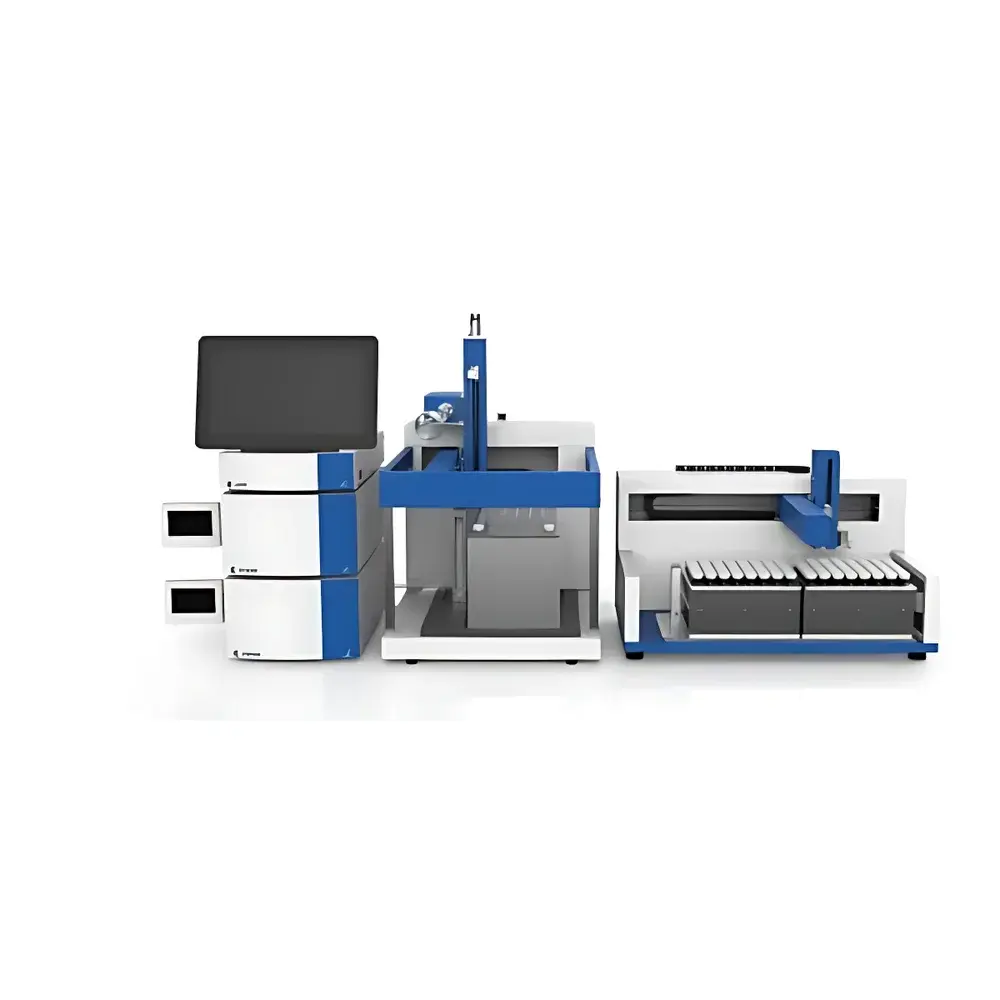
KEZHE GelMaster-4000 Automated Gel Permeation Chromatography (GPC) Cleanup System
| Brand | KEZHE SHANGHAI |
|---|---|
| Origin | Shanghai, China |
| Manufacturer Type | Direct Manufacturer |
| Model | GelMaster-4000 |
| Flow Rate | 0–50 mL/min |
| Auto-sampler Volume | 5 mL standard loop (customizable), 66-position 20 mL vial tray |
| Fraction Collector Capacity | 96-position 60 mL vial tray (customizable) |
| UV Detection Wavelength Range | 190–800 nm |
| GPC Column | 20 × 300 mm, Bio-Beads S-X3 (200–400 mesh), eluent: ethyl acetate/cyclohexane (3:7, v/v) |
| Compliance | AOAC 984.21, EPA SW-846 Method 3640A, FDA 2905A, EN 12393, EN 1528, S-19, S35L00.00-34 |
Overview
The KEZHE GelMaster-4000 is an automated gel permeation chromatography (GPC) cleanup system engineered for high-throughput, reproducible removal of macromolecular interferences—such as lipids, proteins, pigments, and polymeric matrix components—from complex environmental, food, agricultural, and biological extracts. Based on the principle of size-exclusion separation in a porous gel matrix, the system separates analytes by hydrodynamic volume under isocratic elution conditions. Unlike adsorption-based cleanup methods, GPC provides orthogonal selectivity and minimal analyte loss or degradation, making it indispensable for trace-level analysis of small-molecule contaminants—including pesticides, veterinary drugs, polycyclic aromatic hydrocarbons (PAHs), polychlorinated biphenyls (PCBs), mycotoxins, and natural pigments—prior to GC or LC-MS/MS quantification.
Key Features
- Stable, low-dead-volume autosampler with septum-piercing needle design to minimize sample volatilization and carryover during repeated injections;
- Stainless-steel GPC columns rated for sustained operation at elevated backpressures, enabling faster flow rates (up to 50 mL/min) without column deformation or bed collapse;
- Full-spectrum UV-Vis detector equipped with dual deuterium/tungsten lamp source, delivering continuous wavelength coverage from 190 nm to 800 nm for flexible method development and multi-analyte monitoring;
- High-pressure, precision auto-injection valve (imported) with <100 nL injection repeatability and <0.5% RSD over 100 injections;
- Dual-piston preparative HPLC pump offering linear flow control across 0–50 mL/min, with pressure stability ≤ ±0.5% over 24 h and pulsation <1.5%;
- Modular fraction collector supporting 96-position 60 mL vial trays; optional configurations include deep-well plates and custom tube racks;
- Integrated immersion-style cleaning station for both injection and collection needles—automatically flushing internal and external surfaces with solvent between runs;
- One-touch power management interface: single-button initiation/shutdown sequence synchronizing pump, UV detector, autosampler, fraction collector, and switching valves;
- Motor-driven syringe pump for precise sample aspiration, ensuring volumetric accuracy ±1% and inter-run repeatability <0.8% RSD;
- Unified 10.1-inch capacitive touchscreen HMI with native Chinese UI and full component control logic—no external PC required for routine operation;
- System architecture compliant with GLP documentation requirements: audit-trail-enabled event logging, user-access levels, and timestamped method storage.
Sample Compatibility & Compliance
The GelMaster-4000 accommodates crude extracts from diverse matrices—including homogenized animal tissue, ground cereal grains, soil slurries, herbal powders, and edible oil filtrates—without pre-filtration or dilution. Its robust solvent compatibility (including chlorinated, ester-, and hydrocarbon-based mobile phases) supports established GPC protocols per AOAC 984.21 (pesticide residue cleanup in food), EPA SW-846 Method 3640A (organochlorine pesticide cleanup), FDA 2905A (mycotoxin isolation), and EU standards EN 12393 (fat removal in milk), EN 1528 (PAHs in food), and S-19/S35L00.00-34 (multi-residue screening). All hardware materials are inert to common GPC solvents (e.g., cyclohexane, ethyl acetate, dichloromethane), and fluidic pathways are constructed from stainless steel and PEEK to prevent leaching or adsorption artifacts.
Software & Data Management
Control firmware includes embedded method editor, real-time chromatogram display, peak integration engine, and fraction-triggering logic based on UV threshold or time window. Raw data files (.csv, .txt) are timestamped and stored locally with metadata (operator ID, method name, run date/time, column lot, solvent batch). The system supports 21 CFR Part 11-compliant optional software modules for electronic signatures, role-based access control, and change-controlled method versioning—enabling seamless integration into regulated QC/QA laboratories operating under ISO/IEC 17025, GMP, or GLP frameworks. Audit trails record all parameter modifications, instrument status changes, and user logins with immutable timestamps.
Applications
- Cleanup of lipid-rich food extracts prior to GC-MS analysis of organophosphate and pyrethroid pesticides;
- Removal of chlorophyll and carotenoids from plant tissue digests for accurate quantification of aflatoxins and ochratoxin A;
- Depletion of triglycerides and phospholipids from serum or liver homogenates in veterinary drug residue monitoring;
- Isolation of PAHs and PCBs from sediment and sludge samples for regulatory compliance testing;
- Preparative-scale pigment fractionation in natural colorant R&D, including anthocyanin, curcumin, and betalain separation;
- Matrix simplification for LC-HRMS workflows targeting emerging contaminants (e.g., microplastic additives, flame retardants) in environmental monitoring programs.
FAQ
What column packing material is supplied with the GelMaster-4000, and can alternative media be used?
The system ships with a 20 × 300 mm column packed with Bio-Beads S-X3 (200–400 mesh). Other commercially available GPC media—including Styragel HR, TSK-GEL PW, and Sephadex LH-20—are compatible via standard 1/4″ Swagelok fittings and appropriate solvent conditioning.
Is the UV detector capable of simultaneous multi-wavelength acquisition?
Yes—the full-spectrum detector acquires absorbance data across 190–800 nm at 1 nm resolution; users may define up to four independent wavelength channels for real-time ratio monitoring or dual-wavelength baseline correction.
How does the system handle carryover between high-concentration and low-concentration samples?
The immersion cleaning station performs three-stage needle wash (solvent A → solvent B → air dry) with programmable dwell times; combined with septum-piercing geometry and positive-pressure purge, carryover remains below 0.05% for spiked recovery tests across 100 consecutive injections.
Can the GelMaster-4000 be integrated with third-party LC or GC systems?
Yes—fraction collector output ports support direct connection to autosampler loops or 6-port switching valves; TTL and RS-232 interfaces enable hardware synchronization with external instruments for offline or online hyphenated workflows.
Does the system meet regulatory requirements for accredited testing laboratories?
The base configuration meets essential performance criteria outlined in ISO/IEC 17025:2017 Clause 6.4.1 (equipment verification) and supports validation per ICH Q2(R2); optional 21 CFR Part 11 software add-ons provide full electronic record integrity for FDA- or EMA-audited environments.



