
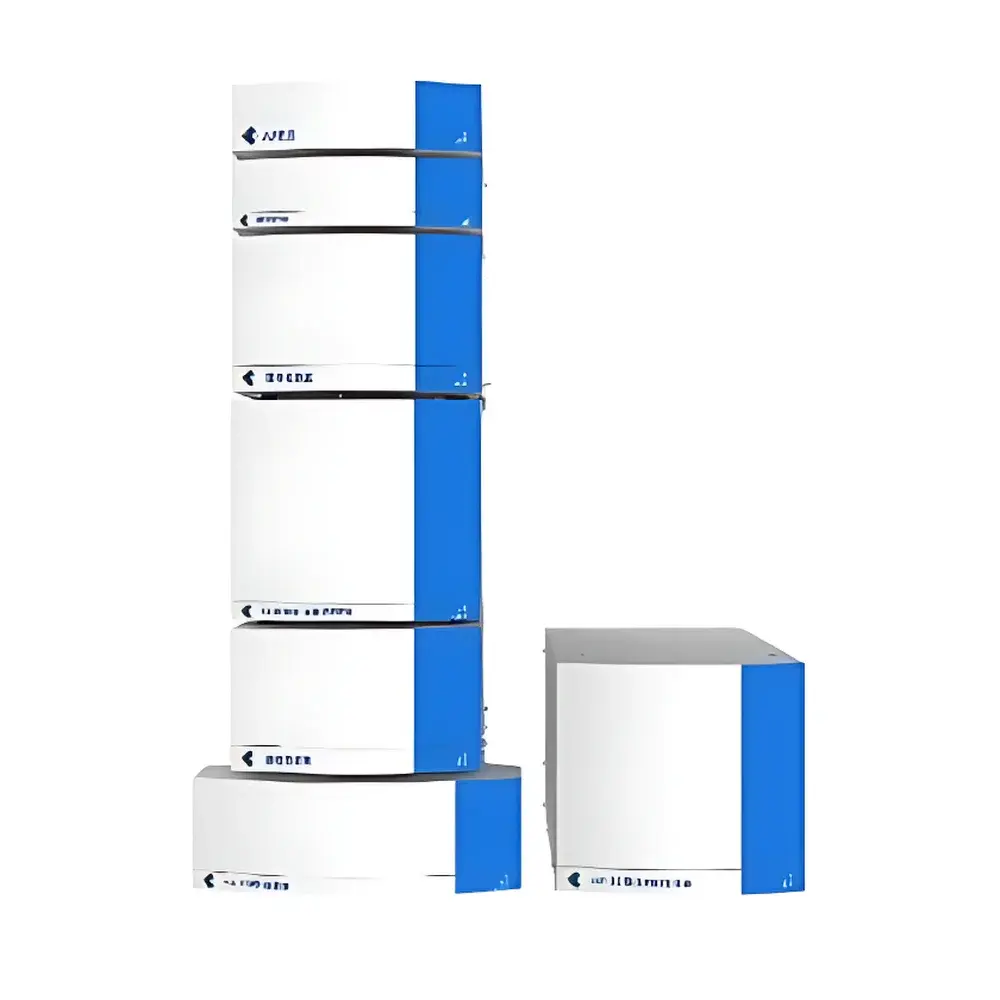
KEZHE Anters-1500G High-Temperature Gel Permeation Chromatography System (with Column Kit)
| Brand | KEZHE SHANGHAI |
|---|---|
| Origin | Shanghai, China |
| Manufacturer Type | Direct Manufacturer |
| Regional Classification | Domestic (China) |
| Model | Anters-1500G (with Column Kit) |
| Instrument Type | High-Temperature GPC System |
| Key Specifications | Pump Flow Range: 0.001–10 mL/min |
| Max Pressure | 40 MPa |
| Flow Precision | <0.3% RSD |
| Flow Accuracy | <0.06% |
| Autosampler Capacity | 144 × 2 mL vials (standard) |
| Injection Volume | 0.1–100 µL |
| Injection Precision | <0.3% RSD |
| Carryover | <0.1% |
| Column Oven Temp Range | 4–100 °C |
| Temp Stability | ±0.15 °C |
| RI Detector Range | 1.00–1.75 RIU |
| Noise | ≤5×10⁻⁷ RIU |
| Drift | ≤5×10⁻⁶ RIU/30 min |
| Flow Cell Volume | 8 µL |
Overview
The KEZHE Anters-1500G is a high-temperature gel permeation chromatography (GPC) system engineered for precise molecular weight distribution (MWD) analysis of synthetic polymers, natural macromolecules, and thermally stable oligomers. Unlike conventional size-exclusion chromatography (SEC), this system operates with enhanced thermal control—supporting column oven temperatures up to 100 °C—to ensure complete dissolution and conformational stability of high-melting-point or semi-crystalline samples such as polyolefins, polyesters, and engineering thermoplastics. The system employs the fundamental principle of hydrodynamic volume separation in porous gel matrices: analytes elute inversely proportional to their hydrodynamic radius, enabling calibration against narrow-distribution polymer standards (e.g., polystyrene). Coupled with a high-stability refractive index (RI) detector and low-dispersion fluidic architecture, the Anters-1500G delivers reproducible retention times and quantitative peak integration essential for regulatory-compliant polymer characterization in R&D, quality control, and process validation environments.
Key Features
- High-precision dual-piston HPLC pump with flow accuracy <0.06% and precision <0.3% RSD across 0.001–10 mL/min—optimized for low-flow GPC applications requiring long gradient runs and high-resolution separation.
- Automated sample introduction via 144-position refrigerated autosampler (4–40 °C optional), featuring needle wash, vial presence sensing, and programmable injection volumes from 0.1 to 100 µL with carryover <0.1%.
- Thermostatically controlled column compartment supporting three 30-cm columns (expandable to six) with temperature resolution of 0.1 °C, stability ±0.15 °C, and accuracy ±0.5 °C—critical for minimizing thermal band broadening and ensuring retention time reproducibility.
- Integrated vacuum degasser upstream of the pump to eliminate dissolved gas interference—especially vital for RI detection where baseline noise and drift are highly sensitive to microbubbles.
- Modular hardware design enables seamless coupling with complementary detectors including UV-Vis, fluorescence, or mass spectrometers—facilitating multi-detector SEC (e.g., light scattering + RI) for absolute molecular weight determination.
- Rugged stainless-steel fluidic path rated to 40 MPa, compatible with chlorinated solvents (e.g., trichlorobenzene, o-dichlorobenzene) and high-boiling-point mobile phases used in high-temperature GPC.
Sample Compatibility & Compliance
The Anters-1500G is validated for analysis of polymeric materials across diverse chemical families—including polyethylene, polypropylene, poly(methyl methacrylate), polycarbonate, and polysaccharides—when dissolved in appropriate high-temperature solvents. Its RI detector (range: 1.00–1.75 RIU; noise ≤5×10⁻⁷ RIU) provides universal, non-destructive detection ideal for analytes lacking chromophores—such as many natural polymers, lipids, and polysaccharides prevalent in pharmaceutical excipients and botanical extracts. The system supports ASTM D5296, ISO 16014, and USP guidelines for SEC/GPC method validation. Software audit trails, electronic signatures, and role-based user management comply with FDA 21 CFR Part 11 requirements for regulated laboratories conducting GLP or GMP-aligned polymer testing.
Software & Data Management
The bundled modular GPC workstation software provides full instrument control, real-time monitoring of pump pressure, column temperature, detector signal, and autosampler status—all synchronized on a single timeline view. It supports automated peak detection, baseline correction, multi-point calibration using polystyrene standards, and calculation of number-average (Mn), weight-average (Mw), and polydispersity index (Đ = Mw/Mn). Data security features include encrypted database storage, time-stamped audit trails, session logging, and configurable user permissions (administrator, analyst, viewer). The software exports results in ASTM E1382-compliant .csv and .cdf formats and interfaces with LIMS via ODBC. All interface elements are localized in English and designed for intuitive navigation without requiring domain-specific programming knowledge.
Applications
- Quality control of synthetic polymers in petrochemical and plastics manufacturing—verifying batch-to-batch consistency in MWD and detecting low- or high-molecular-weight tails affecting mechanical performance.
- Characterization of biodegradable polymers (e.g., PLA, PHA) for medical device and packaging applications—assessing degradation-induced shifts in MWD under accelerated aging conditions.
- Analysis of natural macromolecules in herbal medicine research—quantifying polysaccharide fractions from traditional Chinese medicinal herbs where UV-inactive components dominate.
- Development of polymer-drug conjugates in pharmaceutical formulation—determining conjugation efficiency and residual free drug via differential elution profiles.
- Supporting ISO 13885-1 and ASTM D6474 methods for tire rubber compound analysis—evaluating molecular architecture of solution-SBR and BR elastomers.
FAQ
Is the Anters-1500G compatible with organic solvents commonly used in high-temperature GPC?
Yes—the fluidic system is constructed from solvent-resistant stainless steel and PEEK components, fully compatible with trichlorobenzene (TCB), o-dichlorobenzene (ODCB), and 1,2,4-trichlorobenzene at temperatures up to 100 °C.
Can the system be upgraded to include light-scattering detection?
Yes—its open detector interface supports integration of multi-angle light scattering (MALS) or low-angle laser light scattering (LALLS) modules for absolute molecular weight determination without calibration standards.
Does the software support 21 CFR Part 11 compliance out-of-the-box?
Yes—audit trail logging, electronic signatures, user access controls, and data integrity safeguards are enabled by default and configurable per organizational SOPs.
What column configurations are supported for extended resolution?
The standard configuration accommodates three 30-cm columns; optional column switch valves enable serial or parallel configurations of up to six columns for enhanced resolution across broad molecular weight ranges.
Is technical support available outside China?
KEZHE provides remote application support, method development consultation, and firmware updates globally through authorized regional service partners—with documentation and training delivered in English.
Related Products







