
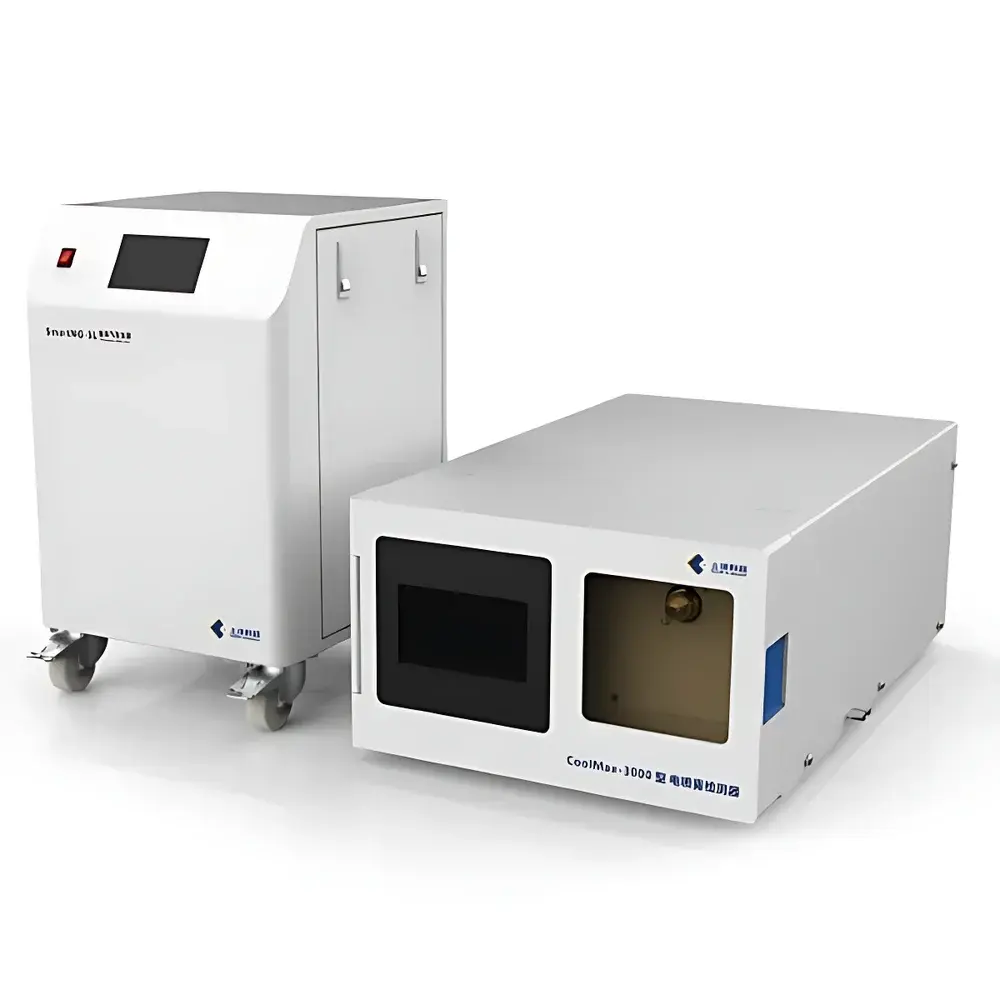
CoolMax-3000 Electrospray Detector by KEZHE Shanghai
| Brand | KEZHE Shanghai |
|---|---|
| Origin | Shanghai, China |
| Manufacturer Type | Direct Manufacturer |
| Origin Category | Domestic (China) |
| Model | CoolMax-3000 |
| Price | USD 28,000 (approx.) |
| 雾化方� | �: FocusJet coaxial flow design |
| 流动相流速 | 0.2–2 mL/min |
| 材料 | 316 stainless steel, PEEK, fused silica, PTFE |
| 数字数据采集速率(最大) | 100 Hz |
| 数字噪声滤波 | 4th-order low-pass Bessel filter |
| 模拟信号输出 | 0–1 V DC (optional) |
| 蒸发温度 | 35 °C or 50 °C |
| 预热时间 | <15 min to 35 °C |
| 气体进口压力 | 70–80 psi (0.4–0.5 MPa) |
| 气体消耗 | 4 L/min |
| 气体压力控制 | Manual |
| 控制方� | �: PC + touchscreen interface |
| 氮气发生器原理 | Membrane separation |
| 氮气输出流量 | 5 L/min |
| 氮气输出压力 | 0.6 MPa |
| 氮气纯度 | 99.9% |
| 露点 | −45 °C |
| AD转换器 | 24-bit |
| 检测限 | pg-level |
Overview
The CoolMax-3000 Electrospray Detector is a high-sensitivity, universal mass-independent detector engineered for the quantitative and qualitative analysis of non-chromophoric compounds—particularly prevalent in traditional Chinese medicine (TCM), natural product extracts, antibiotics, and polar or thermally labile analytes. Unlike UV-Vis or refractive index detectors, the CoolMax-3000 operates on electrospray ionization (ESI) principles adapted for HPLC effluent post-column detection: liquid-phase analytes are nebulized into fine droplets, desolvated under controlled temperature and inert gas flow, and subsequently charged via corona discharge. The resulting ion current is measured with high-fidelity analog-to-digital conversion (24-bit resolution) and digitally filtered using a fourth-order low-pass Bessel algorithm to suppress high-frequency noise while preserving signal integrity. Its design eliminates reliance on chromophore presence or volatility—making it uniquely suited for glycosides, saponins, polysaccharide fragments, organic acids, and other UV-transparent molecules commonly encountered in botanical and pharmaceutical QC/QA workflows.
Key Features
- FocusJet coaxial nebulization architecture ensures stable, reproducible droplet formation across flow rates from 0.2 to 2 mL/min—optimized for analytical and semi-preparative HPLC systems.
- Robust fluidic path constructed entirely from 316 stainless steel, PEEK, fused silica, and PTFE—resistant to aggressive solvents (e.g., acetonitrile, methanol, acidic/basic mobile phases) and minimizing adsorption artifacts.
- Integrated evaporator with dual preset temperature modes (35 °C and 50 °C); achieves thermal equilibrium in under 15 minutes—critical for method transfer and routine laboratory throughput.
- Full electronic monitoring and PC/touchscreen control of gas pressure, flow rate, and evaporation temperature—enabling precise parameter logging and audit-ready operation.
- Self-calibrating gas flow and temperature regulation modules reduce manual tuning effort and improve inter-day reproducibility during long-term stability studies.
- Specialized nozzle surface treatment significantly reduces clogging incidence—eliminating routine solvent flushes and extending maintenance intervals without compromising sensitivity.
- Modular analog output (0–1 V DC) and digital data acquisition at up to 100 Hz enable seamless integration with third-party chromatography data systems (CDS) and LIMS platforms.
Sample Compatibility & Compliance
The CoolMax-3000 demonstrates broad compatibility with reversed-phase, HILIC, and ion-exchange chromatographic separations. It reliably detects non-volatile, semi-volatile, and thermally sensitive compounds—including flavonoid glycosides, triterpenoid saponins, alkaloid salts, nucleosides, and peptide fragments—without derivatization. All wetted materials comply with USP Class VI biocompatibility standards. The detector supports GLP- and GMP-aligned workflows through timestamped parameter logging, user-access-controlled settings, and full traceability of instrument conditions per injection. While not a regulated mass spectrometer, its performance aligns with ASTM D7213 (for universal detection in natural product analysis) and supports compliance with ICH Q2(R2) validation requirements when used in conjunction with validated HPLC methods.
Software & Data Management
The CoolMax-3000 ships with dedicated CoolMax Chromatography Workstation software—compatible with Windows 10/11 and supporting direct interfacing with Agilent, Waters, Shimadzu, and Thermo HPLC systems via USB or Ethernet. The software provides real-time signal visualization, baseline correction, peak integration (with customizable slope/threshold settings), and export to CSV, AIA (.cdf), or PDF formats. Audit trail functionality records all parameter changes, method edits, and user logins—meeting FDA 21 CFR Part 11 requirements for electronic records and signatures when deployed on validated network infrastructure. Raw data files retain full 24-bit dynamic range metadata, enabling retrospective reprocessing without signal degradation.
Applications
- Quantification of UV-transparent active ingredients in TCM decoctions and standardized extracts (e.g., ginsenosides, astragalosides, puerarin).
- Stability-indicating assays for heat-labile antibiotics such as β-lactams and macrolides during forced degradation studies.
- Method development support for natural product isolation—used in parallel with UV and RID detectors to resolve co-eluting peaks lacking differential absorbance.
- Preparative HPLC fraction collection monitoring where conventional detectors fail due to low extinction coefficients or solvent interference.
- QC release testing of herbal injectables and polysaccharide-based biologics requiring non-destructive, response-uniform detection.
FAQ
Can the CoolMax-3000 be used with gradient elution methods?
Yes—the detector maintains stable response across mobile phase composition changes, provided the nitrogen gas flow and evaporation temperature remain constant. Gradient-compatible calibration curves can be established using internal standardization.
Is the nitrogen generator included as standard equipment?
Yes—the integrated membrane-based nitrogen generator (5 L/min, 99.9% purity, −45 °C dew point) is supplied as part of the base configuration.
Does the CoolMax-3000 require daily recalibration?
No—its self-correcting gas flow and temperature modules ensure drift < ±0.5% over 48 hours; annual verification against certified reference standards is recommended per ISO/IEC 17025 guidelines.
Can it be operated without a computer?
Basic functions (temperature setpoint, gas on/off, status display) are accessible via the front-panel touchscreen; however, data acquisition, integration, and report generation require the workstation software.
What is the typical detection limit for sucrose under standard HPLC conditions?
Under optimized conditions (C18 column, 1 mL/min methanol/water, 35 °C evaporation), the limit of detection (S/N = 3) is ≤50 pg on-column for sucrose—demonstrating pg-level sensitivity across diverse compound classes.



