
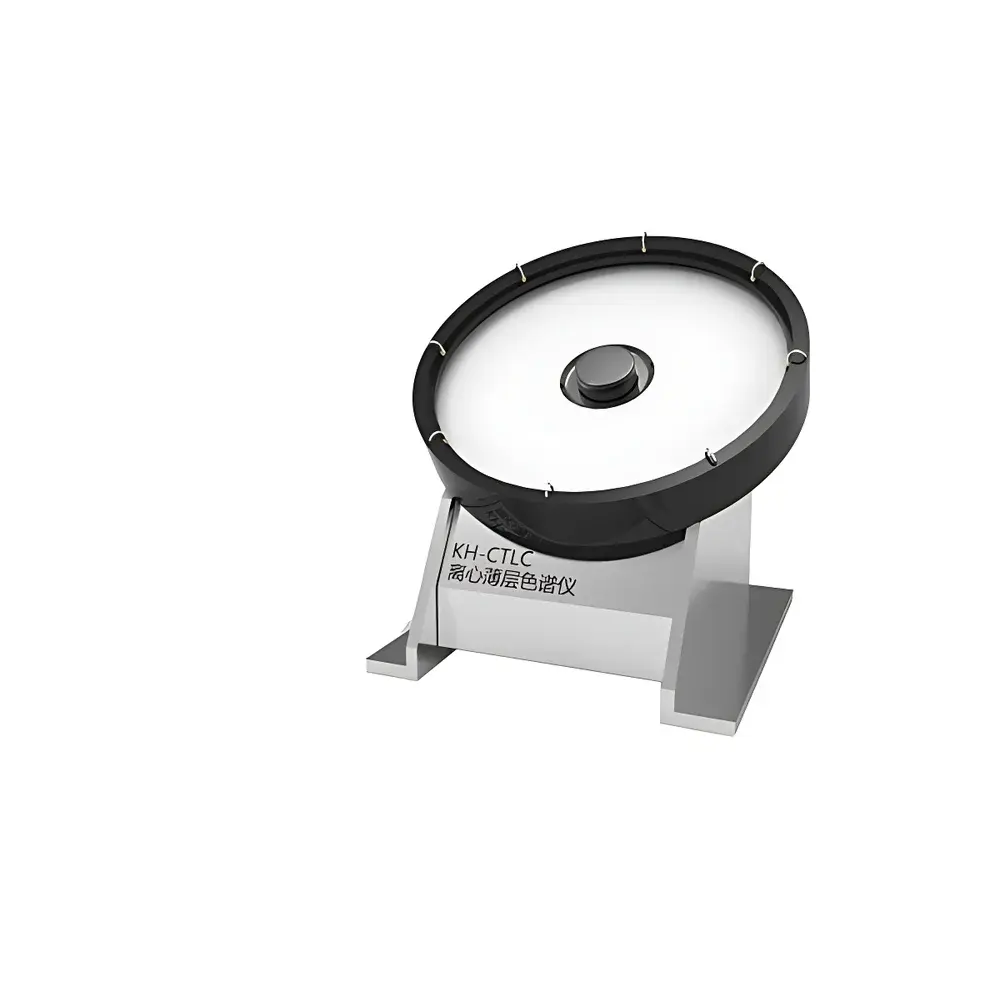
KH-CTLC-III Preparative Centrifugal Thin-Layer Chromatography System
| Brand | KEZHE SHANGHAI |
|---|---|
| Origin | Shanghai, China |
| Manufacturer Type | Direct Manufacturer |
| Instrument Category | Domestic |
| Model | KH-CTLC-III |
| Price Range | USD 7,000–14,000 (FOB Shanghai) |
| Instrument Type | Forced-Flow Centrifugal TLC System |
| Wavelength Range | 190–700 nm |
| Light Source | Dual-Wavelength UV Lamp (254 nm & 365 nm) |
| Detection Mode | Full-Spectrum UV Absorbance Detection |
| Sample Loading Capacity | 100 mg – 2 g per run |
| Rotational Speed | 100–1450 rpm |
| TLC Plate Diameter | 245 mm |
| Plate Thickness Options | 1, 2, 3, 4, 6, 8 mm |
| Flow Rate Range | 0–20 mL/min |
| Fraction Collection | X-Y Robotic Fraction Collector (120 positions, 15 mm test tubes) |
| Medium-Pressure Column | 15 × 400 mm glass column |
| Max. Operating Pressure | 0–50 kgf/cm² (0–4.9 MPa) |
| Plate Spinning Mechanism | CNC-Machined Precision Rotating Platform |
| Pump Type | Stepper-Motor-Driven Constant-Flow Peristaltic Pump |
| Integrated Sample Filtration | In-line Cartridge Filter for Adsorption Mitigation |
Overview
The KH-CTLC-III Preparative Centrifugal Thin-Layer Chromatography System is an engineered solution for high-resolution, milligram-to-gram scale compound isolation in natural product chemistry, synthetic organic analysis, and pharmaceutical process development. Unlike conventional planar TLC or gravity-fed column chromatography, the KH-CTLC-III employs centrifugal force-driven mobile phase migration across a rotating circular silica gel plate — a principle rooted in forced-flow thin-layer chromatography (FF-TLC). This hydrodynamic separation mechanism enables rapid, reproducible band sharpening and enhanced resolution by minimizing longitudinal diffusion and boundary layer effects. The system integrates two orthogonal purification modalities: centrifugal TLC for rapid screening and fractionation, and medium-pressure liquid chromatography (MPLC) using standardized glass columns — both operated from a single platform with shared fluidic control, detection, and collection infrastructure. Designed for laboratory environments where throughput, space efficiency, and method transferability are critical, the KH-CTLC-III supports GLP-aligned workflows through traceable instrument parameters and audit-ready operation logs.
Key Features
- Modular dual-mode architecture: seamless switching between centrifugal TLC and medium-pressure column chromatography without hardware reconfiguration
- CNC-machined rotating stage ensures <±0.02 mm radial runout, delivering consistent centrifugal field uniformity and high inter-run reproducibility
- Dual-wavelength UV detection (254 nm / 365 nm) integrated with full-spectrum absorbance monitoring (190–700 nm), enabling real-time spectral profiling of eluting bands
- Stepper-motor-controlled peristaltic pump with linear flow calibration (0–20 mL/min, ±1.5% accuracy at 5 mL/min), supporting gradient and isocratic elution protocols
- X-Y robotic fraction collector with 120-position capacity (15 mm test tubes), programmable by time, volume, or UV threshold triggers
- In-line sample filtration module (replaceable 0.45 µm PTFE cartridge) to minimize irreversible adsorption on stationary phase surfaces
- Interchangeable plate thickness options (1–8 mm) accommodate analytical scouting (1 mm), semi-preparative (2–4 mm), and preparative-scale (6–8 mm) applications
- Optically sealed observation chamber with quartz window permits real-time visual monitoring under ambient or UV illumination without interrupting rotation
Sample Compatibility & Compliance
The KH-CTLC-III accommodates a broad range of polar and non-polar analytes, including alkaloids, flavonoids, terpenoids, glycosides, and synthetic intermediates. Its solvent compatibility spans hexane, ethyl acetate, methanol, chloroform, dichloromethane, and aqueous buffer systems (pH 2–10), provided viscosity remains below 15 cP. All wetted components — including pump tubing, filter housings, and fraction collector vials — are chemically resistant to common organic solvents. The system conforms to ISO 9001:2015 manufacturing standards and supports documentation requirements for GLP-compliant laboratories. While not certified for GMP production use, its parameter logging, user-accessible calibration records, and electronic audit trail (via optional software module) align with FDA 21 CFR Part 11 data integrity expectations when deployed with validated IT infrastructure.
Software & Data Management
The KH-CTLC-III operates via embedded firmware with local touchscreen interface; optional PC-based software (KEZHE ChromaSuite v4.x) provides advanced method development tools, spectral deconvolution, peak integration, and export to CSV, PDF, or CDF formats compatible with third-party cheminformatics platforms (e.g., ChemDraw, OpenChrom). All acquisition parameters — rotational speed, flow rate, UV absorbance traces, fraction trigger events, and timestamped operational logs — are stored internally with microSD backup capability. Software supports multi-user authentication, role-based access control, and electronic signature capture for method validation and report generation. Raw spectral data adheres to JCAMP-DX v5.0 conventions for interoperability with LIMS and ELN systems.
Applications
- Isolation of bioactive constituents from plant extracts (e.g., curcuminoids, saponins, indole alkaloids)
- Purification of reaction mixtures post-Suzuki coupling, esterification, or reductive amination
- Removal of catalyst residues (Pd, Ni) and unreacted starting materials in API intermediate synthesis
- Stability-indicating method development for degradation product isolation
- Preparative-scale chiral separation using coated chiral plates (e.g., cellulose tris(3,5-dimethylphenylcarbamate))
- Method scouting prior to HPLC or SFC scale-up, reducing method transfer time by >60% versus traditional approaches
FAQ
What is the maximum sample loading capacity per run on a 245 mm plate?
Up to 2 g total mass can be applied as a concentrated band (≤10 mm width) using the included applicator syringe; optimal resolution is achieved at 200–500 mg for most natural product extracts.
Can the system operate under inert atmosphere?
Yes — the optical cover seal and inlet/outlet fittings support nitrogen purging; optional glove-box integration kit available upon request.
Is method transfer from analytical TLC to KH-CTLC-III straightforward?
Rf values correlate within ±0.05 when using identical stationary phase chemistry and solvent composition; centrifugal acceleration introduces minor retention time compression but preserves selectivity order.
What maintenance is required for long-term reliability?
No routine mechanical maintenance is specified; annual verification of pump tubing elasticity, UV lamp intensity (using NIST-traceable reference standard), and rotational encoder linearity is recommended.
Does the system support gradient elution in centrifugal mode?
Yes — via dual-pump configuration (optional upgrade) or sequential solvent reservoir switching with programmable dwell time control.
Related Products






