
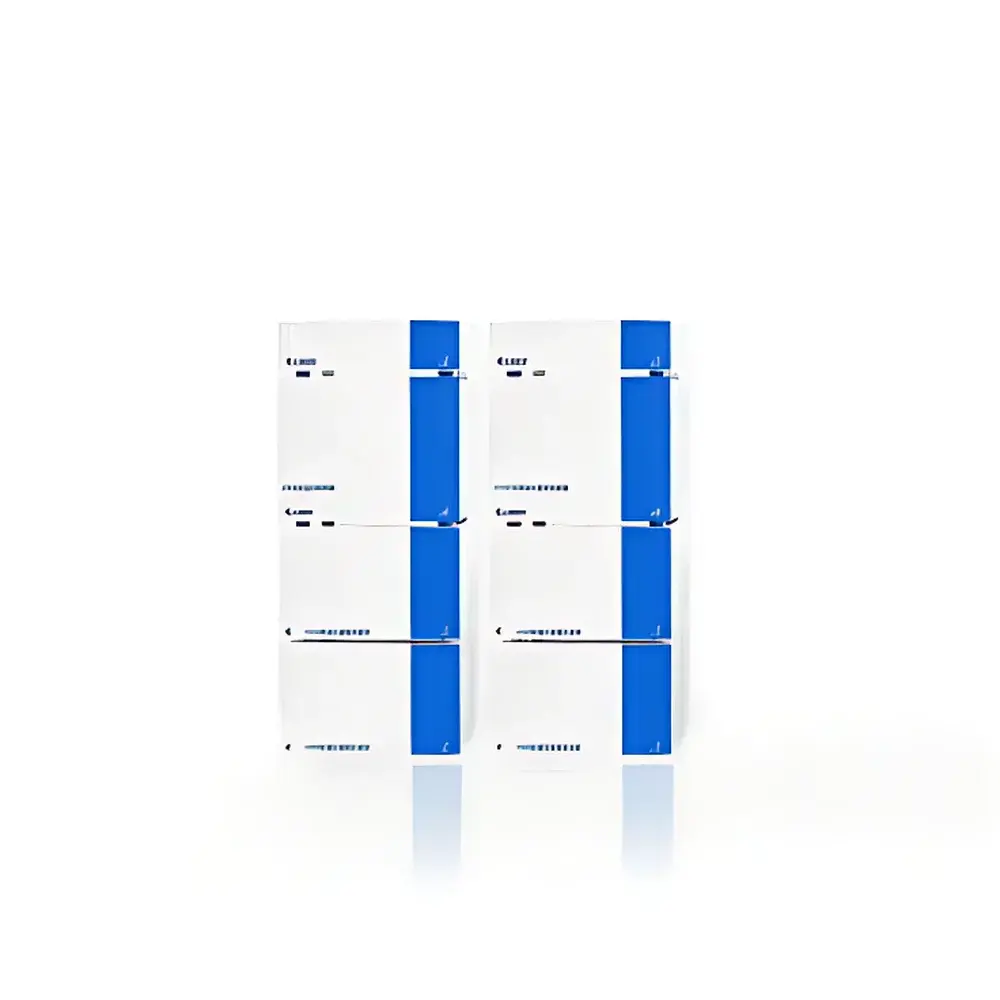
KEZHE SHANGHAI 2DMax1100A2/P2 Comprehensive Reversed-Phase × Reversed-Phase Two-Dimensional Liquid Chromatography System
| Brand | KEZHE SHANGHAI |
|---|---|
| Origin | Shanghai, China |
| Manufacturer Type | Original Equipment Manufacturer (OEM) |
| Product Category | Domestic |
| Model | 2DMax1100A2 / 2DMax1100P2 |
| Flow Range | 0–200 mL/min (customizable up to higher rates) |
| Maximum Pressure | 4000 psi with overpressure protection |
| UV-VIS Wavelength Range | 190–850 nm (quad-wavelength simultaneous detection), wavelength accuracy: ±0.2 nm |
| Light Source | Deuterium lamp + Tungsten lamp |
| Autosampler Capacity | 144 vials (sealed vial design with needle wash function) |
| Fraction Collector (2DMax1100P2 only) | 160 positions, 15 mm tube diameter |
| Software Platform | Windows 7/10 (64-bit) |
| Communication Interface | Ethernet |
Overview
The KEZHE SHANGHAI 2DMax1100A2/P2 is a fully integrated, modular reversed-phase × reversed-phase two-dimensional liquid chromatography (RP×RP 2D-LC) system engineered for high-resolution separation of complex mixtures where conventional one-dimensional HPLC reaches peak capacity limitations. Unlike orthogonal 2D-LC configurations (e.g., SCX × RP), this system leverages two independent reversed-phase columns—typically differing in selectivity via stationary phase chemistry (e.g., C18 vs. phenyl-hexyl), particle size, or pore structure—to achieve enhanced orthogonality within chemically compatible solvent systems. The core architecture employs a high-pressure, quaternary gradient pump capable of precise solvent blending across both dimensions, synchronized with a high-speed, low-dead-volume switching valve that enables automated heart-cutting or comprehensive modulation without manual intervention. This design eliminates solvent incompatibility issues common in normal-phase × reversed-phase setups, ensuring seamless transfer of first-dimension effluent into the second dimension while maintaining column integrity and reproducible retention.
Key Features
- Modular dual-gradient architecture supporting independent flow and gradient programming for both dimensions, enabling method development flexibility and robust method transfer.
- Quad-wavelength UV-VIS detector with simultaneous 190–850 nm acquisition, optimized for multi-analyte detection in pharmaceutical impurity profiling, natural product fractionation, and polymer additive analysis.
- High-capacity 144-position autosampler with sealed vial housing and programmable needle wash protocol—minimizing carryover and cross-contamination in regulated QC environments.
- Intelligent 2D switching valve system with <100 µL internal volume and <50 ms actuation time, certified for >500,000 cycles under continuous operation at 4000 psi.
- For preparative applications (2DMax1100P2 variant): integrated fraction collector with 160-position 15 mm tube rack, position-accurate triggering synchronized to UV signal thresholds or retention time windows.
- Fully compliant modular liquid chromatography workstation software supporting IQ/OQ documentation templates, audit trail logging, and electronic signature capability per FDA 21 CFR Part 11 requirements.
Sample Compatibility & Compliance
The 2DMax1100A2/P2 accommodates a broad range of sample matrices—including small-molecule APIs, oligonucleotides, peptides, polar metabolites, and synthetic polymers—without requiring derivatization or extensive pre-purification. Its RP×RP configuration ensures compatibility with aqueous/organic mobile phases (e.g., water/acetonitrile or water/methanol gradients), eliminating the need for solvent exchange interfaces or evaporation steps. All fluidic components are constructed from biocompatible stainless steel and PEEK, validated for use with pH 1.5–10.5 mobile phases and low-UV-transparent solvents. The system meets ISO 9001 manufacturing standards and supports GLP/GMP workflows through configurable user access levels, instrument calibration logs, and raw data immutability features. It is routinely deployed in laboratories adhering to ICH Q2(R2), USP <621>, and ASTM E2639-21 guidelines for chromatographic method validation.
Software & Data Management
The modular LC workstation provides unified control of all hardware modules via Ethernet-based communication, supporting real-time monitoring of pressure, flow, UV absorbance, and valve position. Method development tools include automated gradient scouting, peak tracking across dimensions, and 2D contour plot generation with retention time alignment correction. Raw data files comply with ANDI/NetCDF format for third-party processing (e.g., MSConvert, OpenMS). Audit trails record every parameter change, injection event, and software update with timestamp, operator ID, and reason-for-change fields. Data backup and export functions support encrypted ZIP archives and direct SQL database integration for LIMS synchronization. Validation packages include installation qualification (IQ), operational qualification (OQ), and performance qualification (PQ) protocols aligned with GAMP5 principles.
Applications
- Pharmaceutical quality control: Resolving co-eluting degradation products and process-related impurities in stability-indicating assays.
- Natural product research: Fractionating plant extracts with overlapping polarity profiles—e.g., flavonoid glycosides vs. aglycones—prior to NMR or HRMS identification.
- Proteomics support: Orthogonal peptide mapping of enzymatically digested proteins under denaturing conditions, improving sequence coverage by 30–50% versus 1D-LC.
- Food safety testing: Simultaneous quantification of mycotoxins, pesticides, and veterinary drug residues in complex food matrices (e.g., infant formula, honey, spices).
- Polymers and additives: Characterizing oligomeric distributions and residual monomers in polyethylene glycols, silicone oils, and plasticizers.
FAQ
What distinguishes the 2DMax1100A2 from the 2DMax1100P2 configuration?
The A2 variant is optimized for analytical-scale separations with a focus on detection sensitivity and resolution; the P2 adds a fraction collector and preparative column interface for milligram-scale isolation of target peaks.
Can the system perform comprehensive 2D-LC (LC×LC), or is it limited to heart-cutting mode?
Both modes are supported: the valve timing module allows user-defined modulation periods (200 ms to 5 min) and programmable trapping/elution sequences for true LC×LC operation.
Is method transfer possible between different 2D-LC platforms?
Yes—method parameters (gradient tables, dwell volumes, valve timing) are stored in vendor-neutral XML format and can be imported/exported for cross-platform validation studies.
Does the software support compliance with FDA 21 CFR Part 11?
Yes—electronic signatures, role-based permissions, and immutable audit trails are enabled by default and documented in the system validation package.
What maintenance intervals are recommended for the switching valve and pump seals?
Valve maintenance is scheduled at 12-month or 500,000-cycle intervals (whichever occurs first); pump seal replacement is recommended every 6 months under continuous operation at >3000 psi.



