
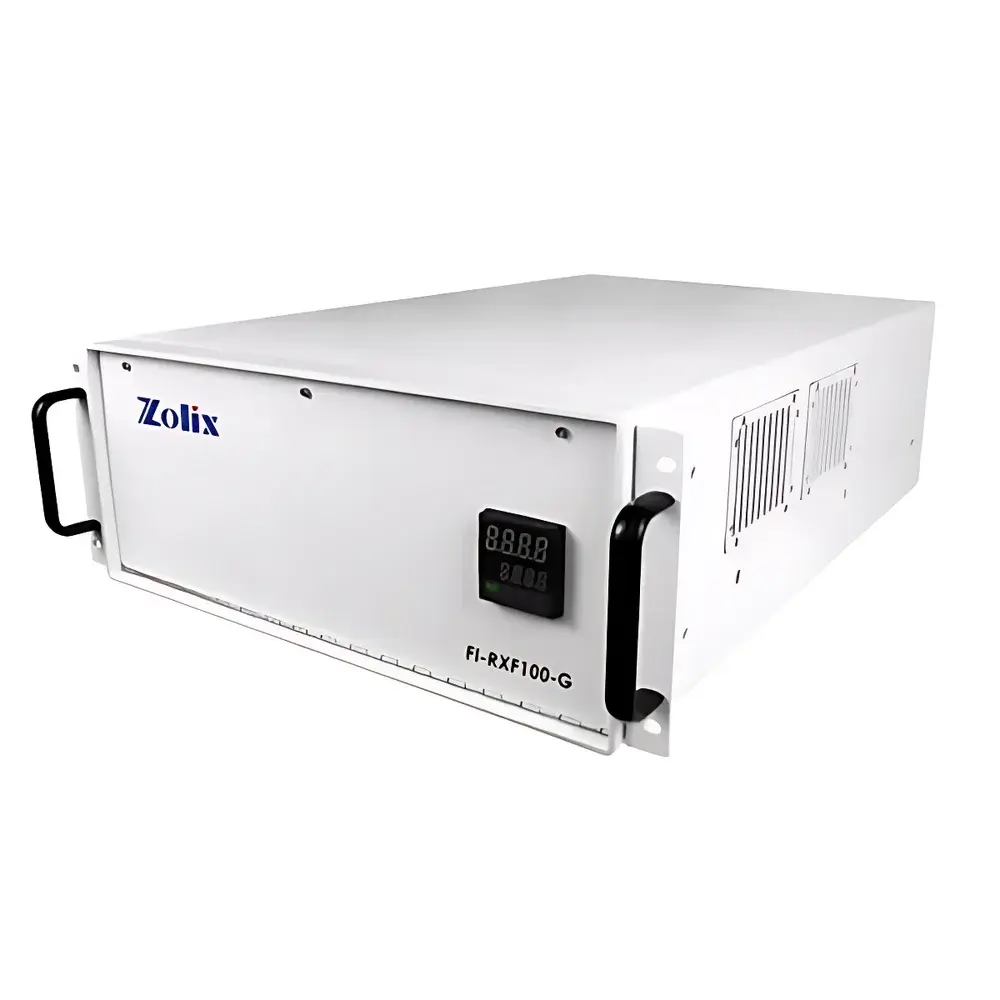
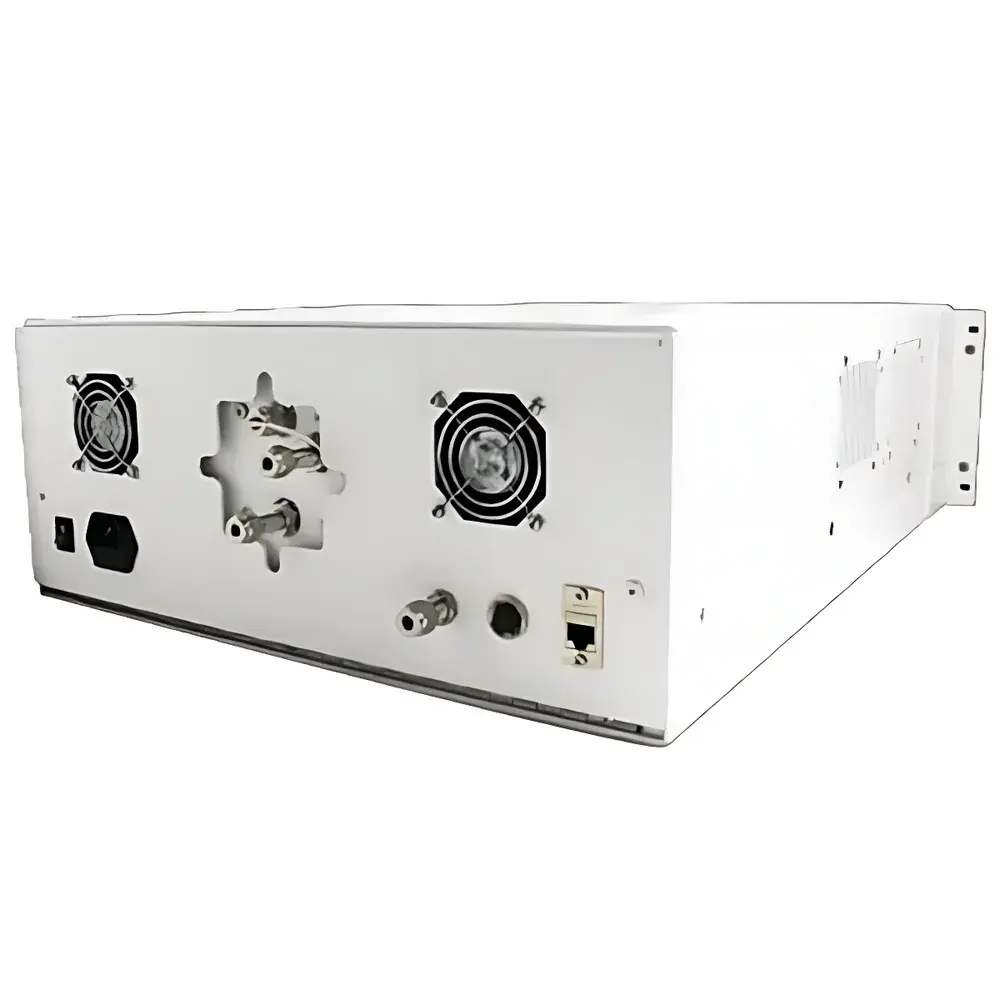
ZOLIX FI-RXF100-G Portable High-Temperature Fourier Transform Infrared (FTIR) Gas Analyzer
| Brand | ZOLIX |
|---|---|
| Model | FI-RXF100-G |
| Instrument Type | Portable FTIR Gas Analyzer |
| Spectral Range | 500–5000 cm⁻¹ |
| Spectral Resolution | <1 cm⁻¹ (software-selectable: 2, 4, or 8 cm⁻¹) |
| Optical Design | Michelson Interferometer with Solid-Angle Retroreflector Mirrors |
| Beam Splitter | ZnSe, Anti-Humidity Coated |
| Detector Options | DTGS (ambient-temperature), Thermoelectrically Cooled MCT, or Liquid-Nitrogen-Cooled MCT |
| Light Source | Air-Cooled Mid-IR Ceramic Source (1550 K) |
| Laser | Solid-State Stabilized Reference Laser (≥10 yr lifetime) |
| Gas Cell | Multi-Pass Stainless Steel Cell (5–9.8 m pathlength, heated to 180 °C) |
| System Dimensions (L×W×H, excl. handles) | 590 × 430 × 176 mm |
| Weight | 18 kg (fully integrated configuration) |
| Response Time (T₉₀) | <120 s |
| Spectral Repeatability | <0.01 cm⁻¹ |
| Linearity Error | ≤±2% F.S. |
| Sampling Modes | Single-shot, Continuous, or Automated Sequence Acquisition |
Overview
The ZOLIX FI-RXF100-G is a purpose-engineered portable Fourier Transform Infrared (FTIR) gas analyzer designed for quantitative and qualitative analysis of complex, high-temperature, and high-humidity gas streams in demanding industrial and environmental field applications. It operates on the principle of interferometric spectral acquisition—utilizing a high-stability solid-angle retroreflector Michelson interferometer—to deliver high-fidelity mid-infrared absorbance spectra across a broad wavenumber range (500–5000 cm⁻¹). Unlike dispersive IR systems, the FI-RXF100-G benefits from Fellgett’s (multiplex) and Jacquinot’s (throughput) advantages, enabling rapid, high signal-to-noise ratio measurements without mechanical wavelength scanning. Its integrated high-temperature gas handling architecture—including a thermally stabilized multi-pass stainless steel cell (5–9.8 m optical path), ZnSe anti-humidity beam splitter and windows, and optional heated sampling line (up to 200 °C)—ensures robust performance under real-world emission monitoring conditions, including waste incineration flue gas, catalytic exhaust, and combustion process streams.
Key Features
- Compact, fully integrated optical-mechanical design: All core components—including interferometer, light source, detector, gas cell, thermal management system, and coupling chamber—are co-aligned and rigidly mounted on a single baseplate to eliminate misalignment drift and external vibration sensitivity.
- Industrial-grade optical train: Gold-coated mirrors (>98% reflectivity in mid-IR) provide superior oxidation resistance and long-term spectral stability compared to aluminum-coated alternatives.
- Thermally managed gas measurement: Integrated heating system maintains cell temperature up to 180 °C, preventing condensation and adsorption artifacts in high-moisture gas matrices.
- Flexible detection architecture: Standard ambient-temperature DTGS detector enables plug-and-play operation; optional Peltier-cooled or liquid-nitrogen-cooled MCT detectors support trace-level detection limits and extended dynamic range.
- Field-hardened optics: ZnSe beam splitter and windows feature hydrophobic anti-humidity coatings, significantly extending service intervals in humid or corrosive atmospheres.
- Modular sampling interface: Optional heated probe (1.5 m) and insulated heating line (3 m, rated to 200 °C) enable direct hot-gas extraction without dilution or cooling-induced species loss.
Sample Compatibility & Compliance
The FI-RXF100-G is validated for continuous, in-situ analysis of multi-component gas mixtures containing CO, CO₂, NO, NO₂, SO₂, NH₃, HCl, HF, CH₄, N₂O, H₂O vapor, and volatile organic compounds (VOCs) at elevated temperatures (≤180 °C) and relative humidity levels up to 95% RH. Its hardware and firmware architecture supports compliance with key regulatory frameworks governing emissions monitoring, including EN 15267-3 (QAL1 certification readiness), EPA Methods 320 and PS-15, and ISO 14064-1 for GHG quantification. The system meets electromagnetic compatibility requirements per IEC 61326-1 and carries CE marking for industrial use. Data integrity features—including time-stamped spectral logging, audit trail-enabled software, and user-access-controlled calibration history—align with GLP and 21 CFR Part 11 principles when deployed in QA/QC or regulatory reporting environments.
Software & Data Management
The FI-RXF100-G is operated via ZOLIX’s proprietary SpectraPro FTIR software, a Windows-based application supporting real-time spectral acquisition, background subtraction, peak integration, and multivariate quantitative analysis using classical least-squares (CLS) or partial least-squares (PLS) algorithms. The embedded spectral library contains pre-validated quantitative calibration models for 50 common industrial gases, each traceable to NIST-certified reference spectra. Users may expand the library via custom spectral acquisition and model generation workflows, with support for importing >40,000 reference spectra from commercial and public-domain IR databases (e.g., HITRAN, NIST Chemistry WebBook). Raw interferograms and processed spectra are stored in standardized JCAMP-DX format. Export options include CSV, ASCII, and XML for integration with SCADA, DCS, or LIMS platforms. Software updates and remote diagnostics are supported via secure TLS-encrypted Ethernet or Wi-Fi connection.
Applications
- Continuous emissions monitoring (CEMS) in municipal solid waste incinerators, cement kilns, and coal-fired power plants.
- In-situ catalytic reaction monitoring during R&D and pilot-scale testing of SCR, SNCR, and VOC abatement systems.
- Emergency response and mobile environmental screening for hazardous gas leaks (e.g., HF, HCl, NH₃) at industrial sites or transport corridors.
- Occupational hygiene assessment in confined-space entry scenarios requiring real-time exposure evaluation against OSHA/ACGIH TLVs.
- Process analytical technology (PAT) implementation for closed-loop control of combustion stoichiometry, fuel-air ratio, and aftertreatment efficiency.
- Research-grade gas-phase reaction kinetics studies involving transient intermediates and thermally labile species.
FAQ
What is the maximum operating temperature of the integrated gas cell?
The stainless steel multi-pass gas cell is rated for continuous operation at up to 180 °C, with active PID temperature control and thermal insulation to minimize heat loss.
Can the instrument perform real-time concentration trending?
Yes—spectral acquisition rates up to 1 spectrum per second (at 8 cm⁻¹ resolution) enable continuous concentration profiling with T₉₀ response under 120 seconds.
Is the system compatible with third-party data acquisition or control systems?
Yes—the instrument supports Modbus TCP and OPC UA protocols for bidirectional communication with PLCs, DCS, or enterprise-level analytics platforms.
Does the FI-RXF100-G require liquid nitrogen or other cryogens for standard operation?
No—standard configuration uses an ambient-temperature DTGS detector. Cryogenic MCT operation is optional and requires separate LN₂ infrastructure.
How is spectral calibration maintained under field conditions?
A built-in solid-state reference laser provides continuous wavenumber calibration; automated background collection routines compensate for thermal drift and optical contamination.




