
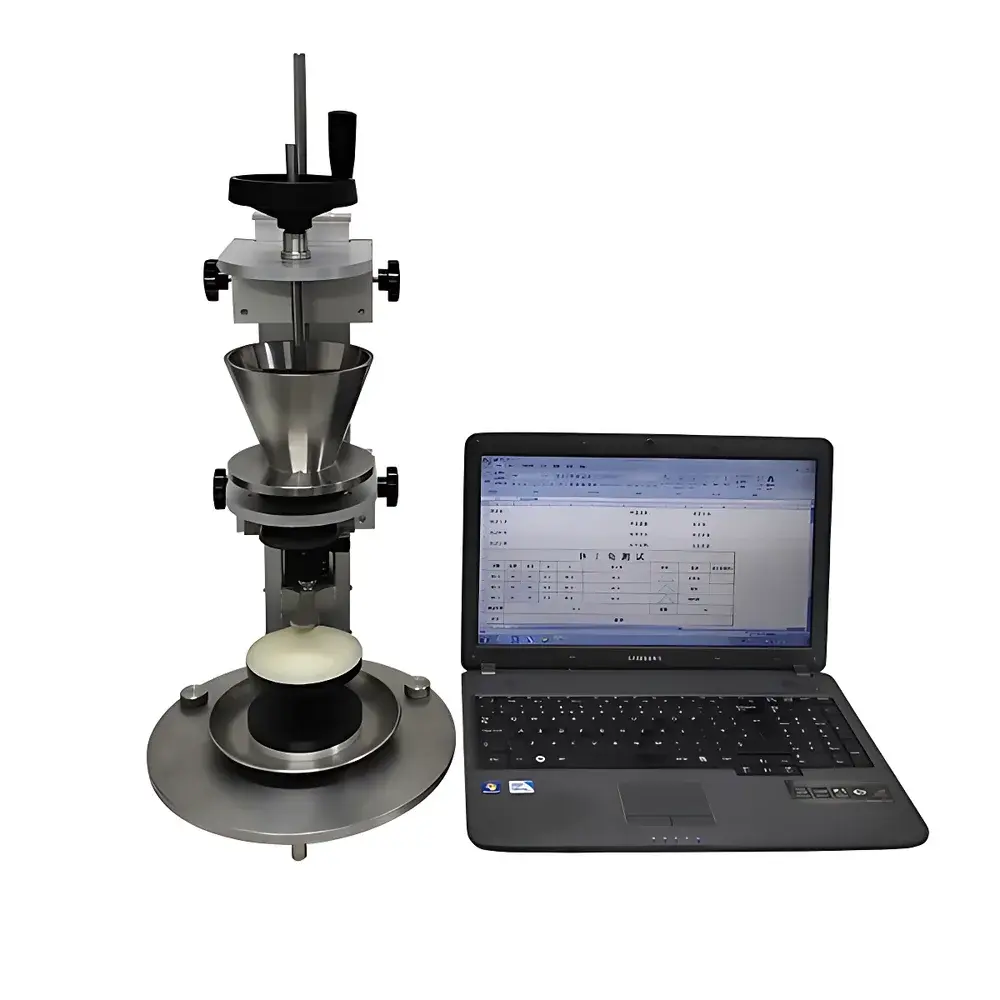
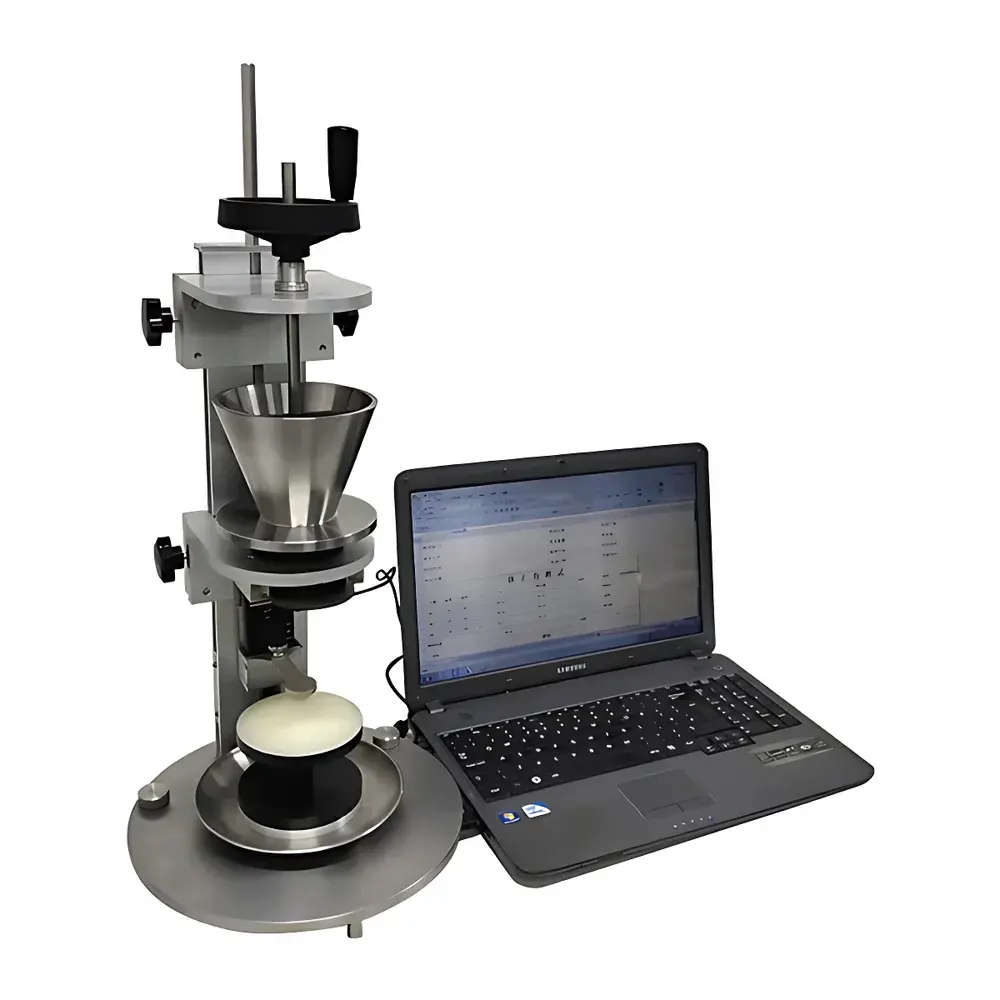
Aode AODE-309 Powder Flowability Tester – Angle of Repose Analyzer
| Brand | Aode |
|---|---|
| Origin | Liaoning, China |
| Manufacturer Type | Direct Manufacturer |
| Country of Origin | China |
| Model | AODE-309 (20219) |
| Instrument Category | Powder Flowability Tester |
| Measurable Parameters | Angle of Repose (Static & Dynamic), Angle of Rest, Flow Time, Flow Rate |
| Maximum Sample Vessel Capacity | 500 mL |
| Minimum Sample Volume | 10 mL |
| Power Supply | 5 V DC |
| Dimensions (W×D×H) | 280 × 280 × 600 mm |
| Weight | 8 kg |
| Funnel Volume | 520 mL |
| Adjustable Orifice Diameters | 4, 6, 8, 10, 13, 15, 18, 20 mm |
| Construction Materials | 304 Stainless Steel Body + Aluminum Alloy Components |
| Compliance | GB/T 21060–2007, ISO 4324 |
Overview
The Aode AODE-309 Powder Flowability Tester is a precision-engineered instrument designed to quantify the static angle of repose — a fundamental parameter in powder rheology that reflects interparticle friction, cohesion, and surface energy. Based on the gravitational heap method, the device measures the natural inclination angle formed when a bulk powder flows freely from a fixed-height orifice onto a horizontal base plate. This angle — commonly referred to as the angle of repose or angle of rest — serves as an empirically validated proxy for flow behavior under gravity-driven handling conditions such as hopper discharge, filling, and pneumatic conveying. Unlike dynamic shear cell or rotational rheometry methods, the AODE-309 implements a standardized, low-energy, non-invasive protocol aligned with ISO 4324 and GB/T 21060–2007, making it particularly suitable for routine QC screening in regulated and non-regulated environments where reproducibility, simplicity, and traceability are prioritized.
Key Features
- Automated digital analysis via dedicated Windows-based software that calculates angle of repose from high-contrast image capture — eliminating manual protractor measurement and associated operator variability.
- Multi-orifice funnel system with eight interchangeable outlet diameters (4–20 mm) enabling method development across particle size distributions and flow regimes per ASTM D6393 and USP <1174> guidance.
- Integrated mechanical agitator (stirring rod) for controlled assistance during flow initiation — critical for cohesive, hygroscopic, or electrostatically charged powders that exhibit bridging or rat-holing tendencies.
- Corrosion-resistant 304 stainless steel sample chamber and base platform ensure long-term dimensional stability, cleanability, and compliance with GMP hygiene requirements.
- Compact benchtop footprint (280 × 280 × 600 mm) and low-power 5 V DC operation support integration into QA labs, pilot-scale facilities, and R&D workstations without dedicated power infrastructure.
- Full audit trail functionality: software logs timestamped test records, operator ID, orifice selection, sample ID, and calculated metrics — supporting 21 CFR Part 11 readiness when deployed with appropriate system validation protocols.
Sample Compatibility & Compliance
The AODE-309 accommodates dry, free-flowing to marginally cohesive powders within the 10–500 mL volume range. It is routinely applied to pharmaceutical excipients (e.g., microcrystalline cellulose, lactose monohydrate), polymer granules (polyethylene, polypropylene), ceramic precursors, metal powders (non-reactive grades), food ingredients (sugar, flour blends), and battery cathode/anode materials. The instrument conforms to ISO 4324:2015 (Determination of angle of repose of powders using the funnel method) and Chinese national standard GB/T 21060–2007. While not a replacement for shear-based flow function assessment (e.g., Jenike testing), it provides a rapid, comparative metric for batch-to-batch consistency checks and raw material release testing under GLP and GMP frameworks.
Software & Data Management
The proprietary acquisition and analysis software supports real-time video capture, automatic edge detection of the powder cone profile, trigonometric calculation of the repose angle, and classification against predefined flowability tiers (e.g., “Excellent”, “Good”, “Fair”, “Poor”) per USP <1174> criteria. All raw images, metadata, and calculated results are stored in encrypted .csv and PDF report formats. Export options include Excel-compatible datasets for statistical process control (SPC) integration and LIMS upload. Audit log entries record user login, test sequence, parameter configuration, and export actions — essential for regulatory submissions requiring data integrity assurance.
Applications
- Pre-production qualification of incoming raw materials in pharmaceutical solid dosage manufacturing.
- Formulation screening during early-stage development of dry powder inhalers (DPIs) and direct compression tablets.
- Process validation support for powder blending, die-filling, and capsule filling operations.
- Quality control of polymer granules prior to extrusion or injection molding.
- Research into humidity- or temperature-induced flow degradation in hygroscopic systems.
- Educational use in materials science and chemical engineering laboratories for teaching powder characterization fundamentals.
FAQ
What standards does the AODE-309 comply with?
It adheres to ISO 4324:2015 and GB/T 21060–2007 for angle of repose determination using the funnel method.
Can the instrument measure both static and dynamic angles of repose?
Yes — static angle is measured after free flow cessation; dynamic angle may be estimated via sequential timed imaging during flow, though the primary design emphasizes static heap geometry per standard protocols.
Is calibration required before each test?
No routine calibration is needed; however, geometric verification using certified reference cones is recommended quarterly or after mechanical impact.
Does the software support multi-user access with role-based permissions?
Basic version includes user-defined operator profiles; enterprise deployment supports LDAP integration and granular permission assignment when configured with validated IT infrastructure.
How is data integrity ensured for regulated environments?
All measurements generate immutable digital records with embedded timestamps, user IDs, and checksum-verified exports — fully compatible with ALCOA+ principles when implemented within a validated computerized system environment.



