
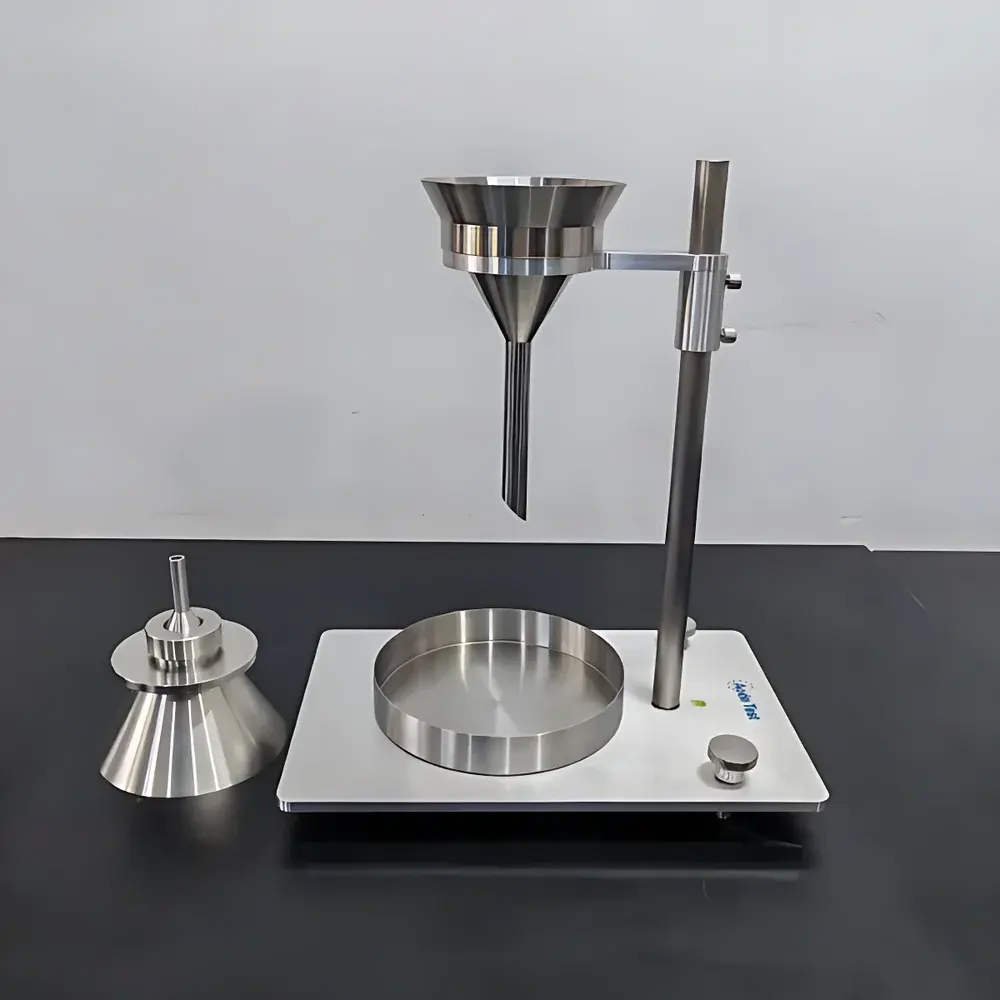
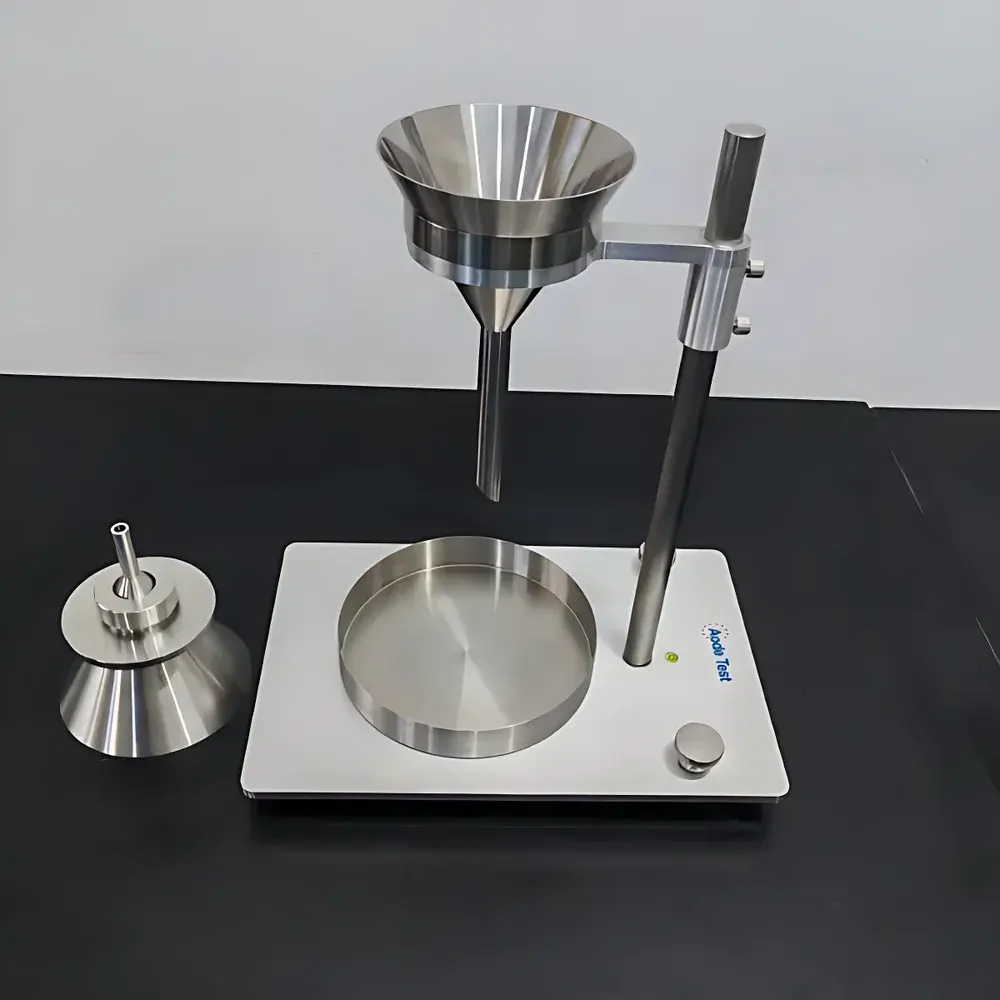
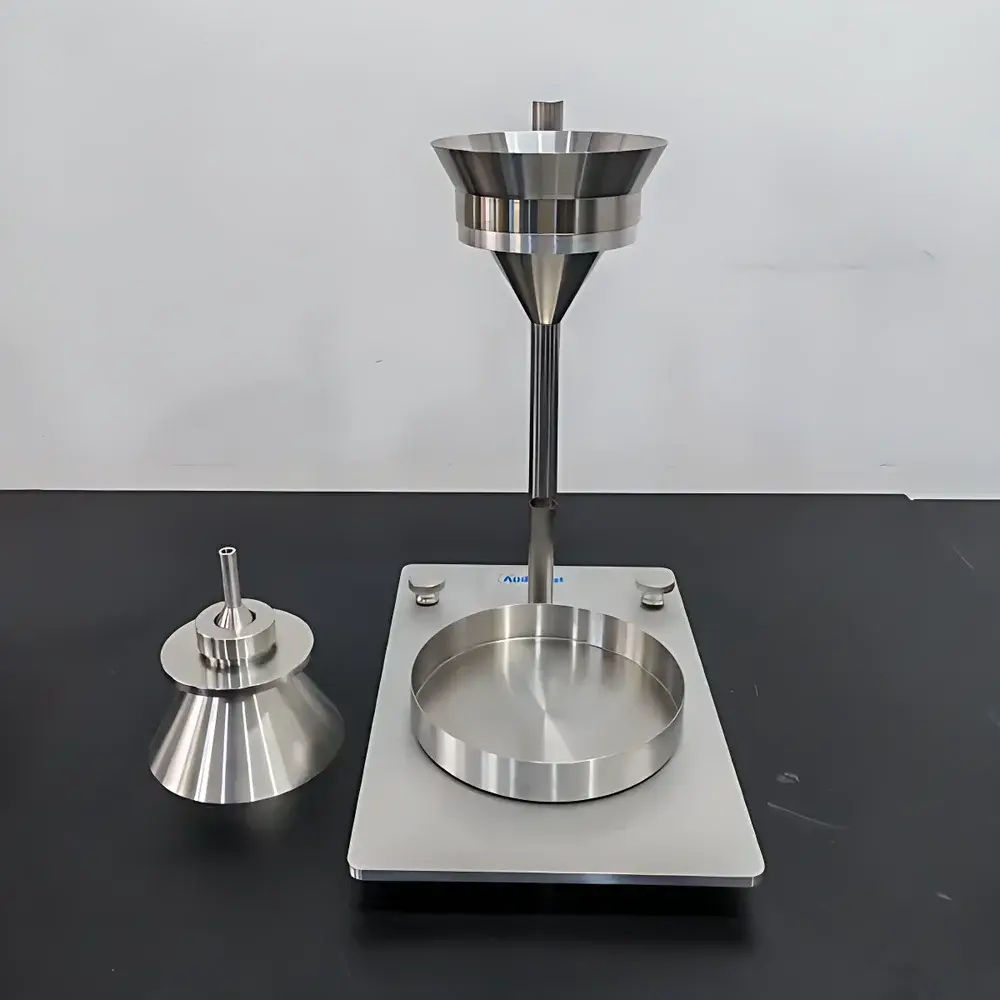
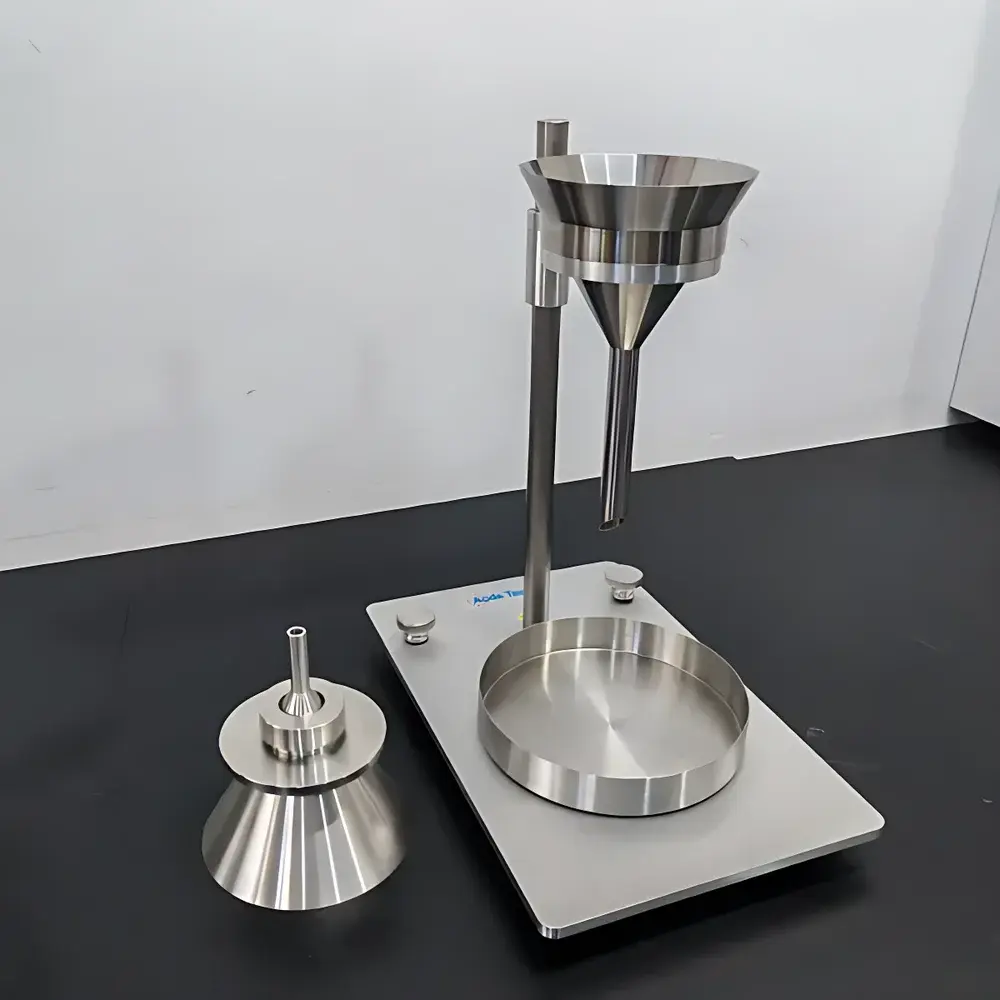
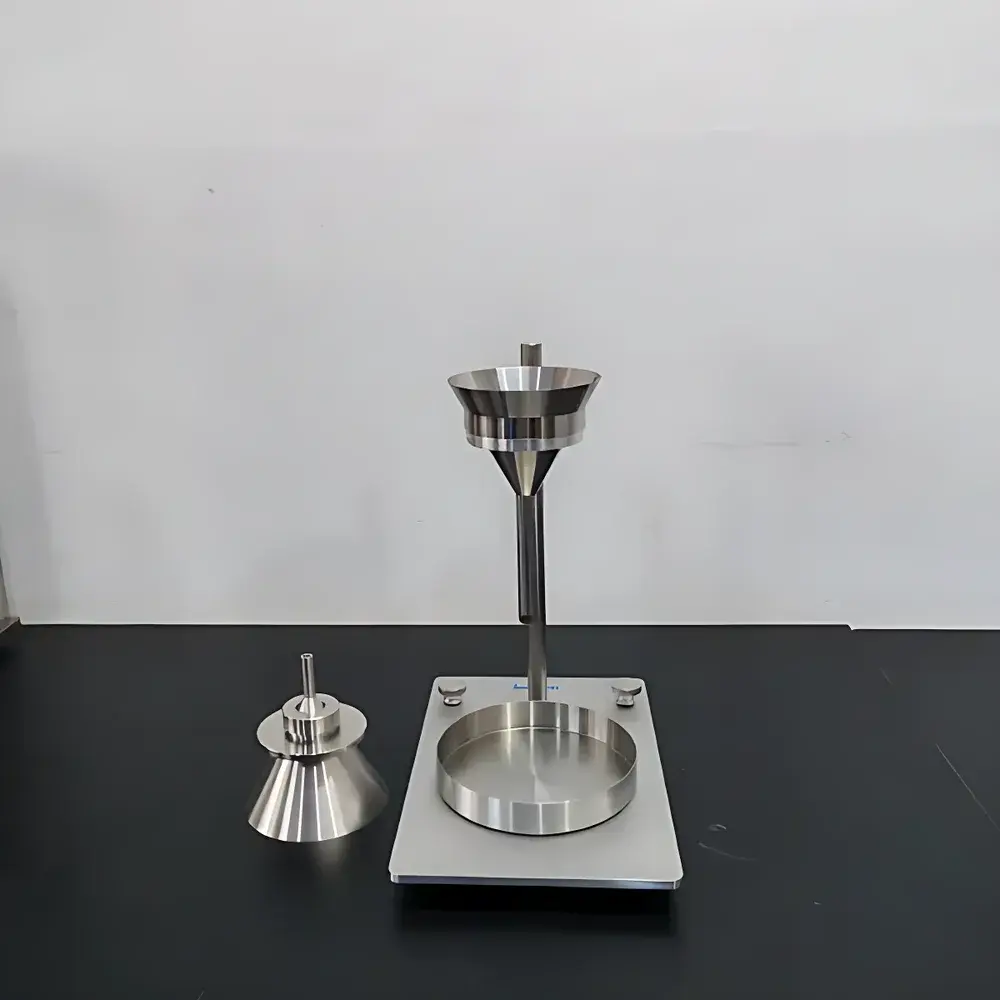
Aode Aode-315 European Pharmacopoeia Powder Flowability Tester
| Brand | Aode |
|---|---|
| Origin | Liaoning, China |
| Manufacturer Type | Manufacturer |
| Product Category | Domestic |
| Model | Aode-315 |
| Instrument Type | European Pharmacopoeia Powder Flowability Tester |
| Measurable Parameter | Flowability |
| Maximum Sample Cup Capacity | 520 mL |
| Minimum Sample Volume | 10 mL |
| Funnel Internal Orifice Diameter | 12 mm |
| Funnel Angle | 60° |
| Funnel Stem Length | 125 mm |
| Funnel Outlet Angle | 45° |
| Funnel Wall Thickness | 1.5 mm |
| Funnel Material | ASTM A240 Type 304 Stainless Steel |
| Compliance Standard | Ph. Eur. 2.9.16 |
Overview
The Aode Aode-315 European Pharmacopoeia Powder Flowability Tester is a precision-engineered instrument designed to quantitatively assess the flow behavior of pharmaceutical powders in strict accordance with Ph. Eur. 2.9.16 “Powder Flow.” This standard defines a gravity-driven, orifice-based method—commonly referred to as the *funnel flow time test*—in which dry, free-flowing powder is allowed to discharge under its own weight through a standardized stainless steel funnel. The primary output metric is either (a) the time required for a fixed mass (typically 100 g ± 0.5%) to completely evacuate the funnel, or (b) the mass discharged within a fixed duration (e.g., 10 s), depending on the material’s inherent mobility. Unlike dynamic or shear-based rheometers, this tester operates on fundamental gravitational and geometric principles, delivering reproducible, operator-independent results essential for batch release, formulation development, and excipient qualification in regulated pharmaceutical environments.
Key Features
- Full compliance with Ph. Eur. 2.9.16 dimensional and procedural specifications—including 12 mm internal orifice diameter, 60° funnel cone angle, 45° outlet angle, and 125 mm stem length—ensuring regulatory traceability.
- High-precision 304 stainless steel funnel fabricated to ASTM A240 standards, with uniform 1.5 mm wall thickness and electropolished interior surface to minimize adhesion and static charge retention.
- Dedicated sample cup assembly with calibrated capacity up to 520 mL and minimum usable volume of 10 mL, supporting both small-scale R&D screening and full-pharmacopeial testing protocols.
- Stable, vibration-isolated base platform with vertical alignment verification marks to eliminate tilt-induced variability—a critical requirement explicitly stated in Ph. Eur. 2.9.16.
- No moving parts or motorized components; eliminates mechanical drift and ensures long-term calibration stability without periodic recalibration cycles.
Sample Compatibility & Compliance
The Aode-315 is validated for use with dry, non-cohesive to moderately cohesive pharmaceutical powders—including APIs, lactose monohydrate, microcrystalline cellulose (MCC), mannitol, and silicified microcrystalline cellulose (SMCC). Samples must be passed through a 1.0 mm sieve prior to testing if agglomeration is observed, per Ph. Eur. 2.9.16 Section 2.2. The instrument supports GLP-compliant workflows: all test parameters (mass, time, ambient temperature/humidity) are manually recorded in accordance with Annex 11 and FDA 21 CFR Part 11 expectations for paper-based or hybrid documentation systems. While the device itself does not generate electronic audit trails, its design enables seamless integration into validated laboratory notebooks and controlled test procedure records required for EU GMP Annex 15 and ICH Q5C submissions.
Software & Data Management
The Aode-315 operates as a standalone physical measurement system with no embedded firmware or proprietary software. All data acquisition is manual: users record mass (via external analytical balance, ISO/IEC 17025-calibrated), flow time (via stopwatch traceable to NIST standards), and environmental conditions. This architecture aligns with ALCOA+ principles—particularly ‘Attributable’, ‘Legible’, ‘Contemporaneous’, and ‘Original’—by eliminating electronic data intermediaries that could introduce integrity risks. Laboratories may integrate results into LIMS or ELN platforms using standardized CSV or PDF report templates. No cloud connectivity, remote access, or automatic data export is provided—consistent with secure, air-gapped QC environments common in API manufacturing facilities.
Applications
- Pharmaceutical formulation development: comparative assessment of flow performance across excipient blends and granulation endpoints.
- Batch release testing for solid oral dosage forms, supporting compliance with Ph. Eur. General Chapter 2.9.16 and USP <1174> Powder Flow.
- Excipient supplier qualification and incoming raw material inspection against pre-defined flow time acceptance criteria.
- Stability-indicating studies: monitoring flow degradation due to moisture uptake, crystallinity shifts, or particle surface oxidation over accelerated storage conditions.
- Supporting QbD initiatives by linking flow metrics to critical quality attributes (CQAs) such as tablet weight variation, content uniformity, and die fill consistency.
FAQ
Does the Aode-315 meet both Ph. Eur. 2.9.16 and USP <1174> requirements?
Yes—the geometric and procedural specifications fully satisfy Ph. Eur. 2.9.16; while USP <1174> permits multiple methods, the funnel flow time test described therein is functionally identical and widely accepted as equivalent.
Is calibration certification included with the instrument?
No formal calibration certificate is supplied, as the device contains no adjustable metrological components; however, dimensional verification reports (CMM-measured orifice, angles, stem length) are available upon request for IQ/OQ documentation.
Can the funnel be cleaned in an autoclave?
The 304 stainless steel funnel is compatible with standard autoclaving cycles (121°C, 15 psi, 15 min); repeated exposure may affect surface finish but does not compromise dimensional conformity to Ph. Eur. 2.9.16.
What is the recommended frequency for verifying funnel geometry?
Initial verification at installation and after any physical impact or thermal shock; routine re-verification is not mandated unless deviations in flow time exceed ±5% relative to historical control data across three consecutive batches.



