
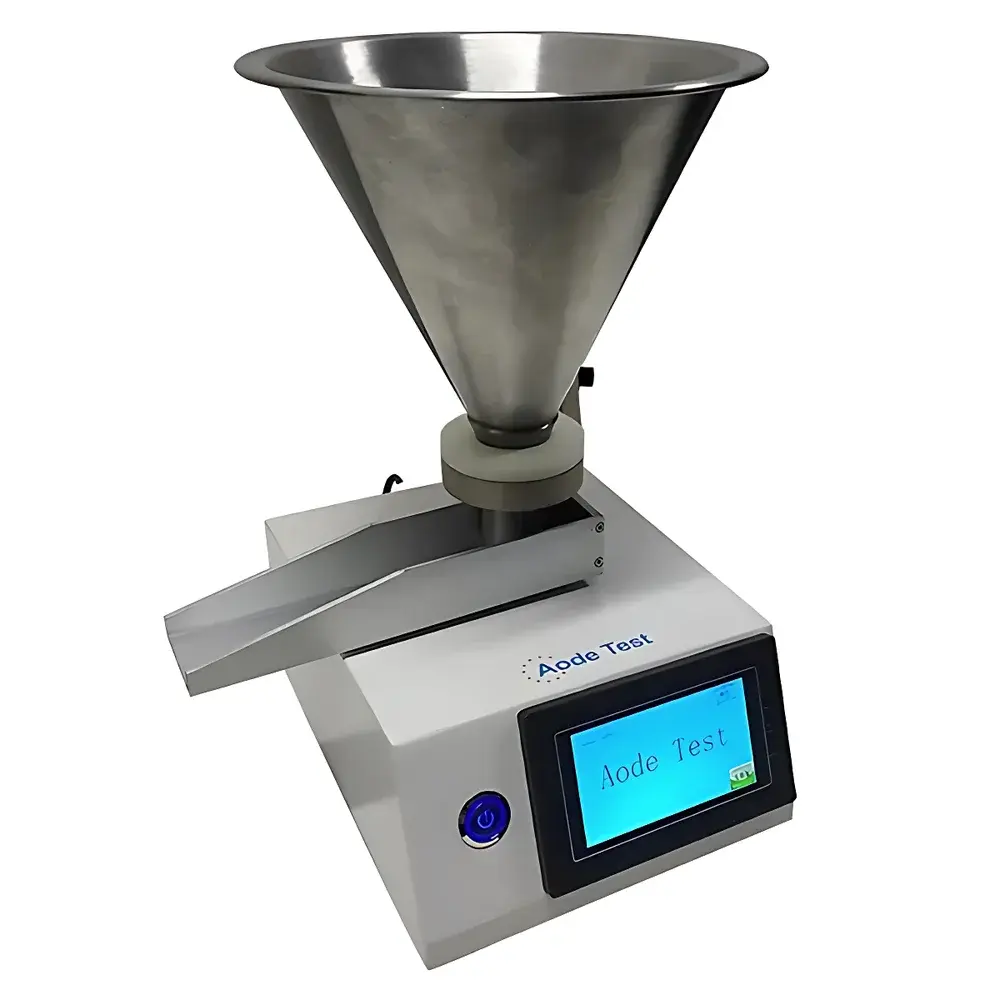
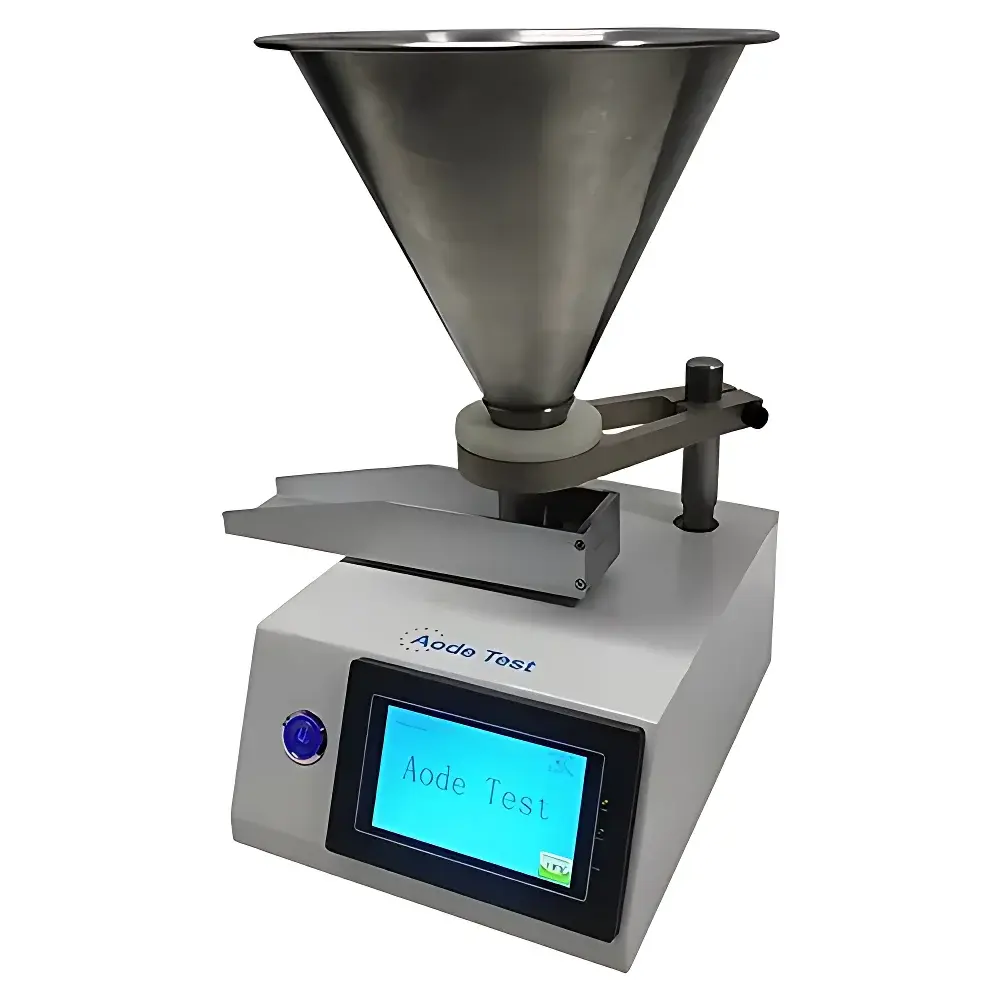
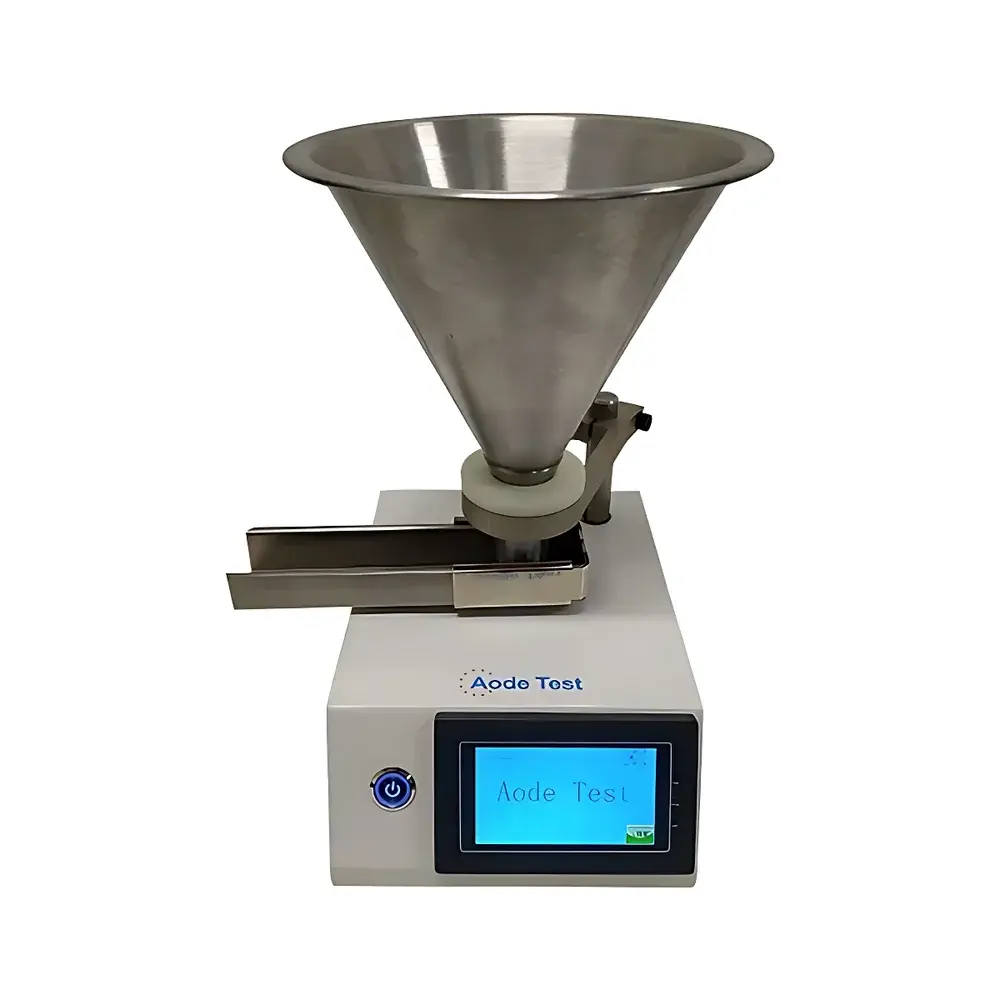
Aode Aode-105 Automatic Powder and Granular Sample Feeder
| Brand | Aode |
|---|---|
| Origin | Liaoning, China |
| Manufacturer Type | Direct Manufacturer |
| Country of Origin | China |
| Model | Aode-105 |
| Price Range | USD 2,800 – 7,000 |
| Power Supply | 220 V, 50 Hz, 30 W |
| Weight | 9 kg |
| Feed Tray Length | 210 mm |
| Adjustable Hopper Height | Yes |
| Feed Rate Control | Electromagnetic Vibration Frequency & Hopper Clearance |
| Feed Tray Outlet Width Options | 15 mm |
| Feed Tray Material | ASTM A240 Type 304 Stainless Steel |
| Maximum Particle Size Handling | ≤ 50 mm |
| Sample Types | Free-flowing dry powders, granules, pastes, and semi-fluid emulsions |
| Compliance | Designed for GLP-compliant laboratory workflows |
Overview
The Aode Aode-105 Automatic Powder and Granular Sample Feeder is an electromagnetically driven vibratory sample delivery system engineered for precision, repeatability, and integration within physical property testing laboratories. It operates on the principle of controlled harmonic vibration—generated by a linear electromagnetic actuator—to induce progressive, metered forward displacement of bulk solid materials along a precision-machined stainless-steel feed tray. Unlike gravity-fed or rotary auger systems, the Aode-105 relies on tunable oscillation amplitude and frequency to regulate mass flow rate without mechanical contact or shear-induced particle degradation. This makes it particularly suitable for fragile, cohesive, or electrostatically sensitive powders where consistent volumetric throughput and minimal segregation are critical. The device functions as a standalone feeder or as an integrated front-end module for downstream analyzers—including laser diffraction particle size analyzers, dynamic image analysis systems, bulk density testers, and automated sieve shakers—ensuring traceable, operator-independent sample introduction in accordance with ISO/IEC 17025 method validation requirements.
Key Features
- Touchscreen human-machine interface (HMI) with intuitive parameter configuration for vibration frequency (10–120 Hz range), dwell time, and start/stop sequencing
- Electromagnetic drive mechanism delivering high-resolution speed control and long-term operational stability without motor wear or belt slippage
- Adjustable hopper height mechanism enabling precise regulation of material bed depth on the feed tray—critical for controlling mass flow consistency across varying bulk densities
- Modular feed tray system fabricated from ASTM A240 Type 304 stainless steel, resistant to corrosion, abrasion, and chemical exposure during routine cleaning and validation cycles
- Interchangeable feed tray configurations: U-shaped, V-shaped, narrow-width (15 mm), standard-width (40 mm), and wide-width (75 mm) outlets—each optimized for specific downstream inlet geometries and flow regimes
- Low-power consumption design (30 W nominal) supporting continuous operation in ambient laboratory environments without thermal drift or cooling requirements
Sample Compatibility & Compliance
The Aode-105 accommodates free-flowing and marginally cohesive solid-phase samples with maximum particle dimensions up to 50 mm—enabling use with coarse granulates, milled aggregates, pharmaceutical excipients, mineral ores, and food-grade particulates. Its non-contact vibratory transport minimizes attrition and prevents compaction-induced channeling. The system complies with foundational sampling standards including ISO 4497 (metal powder sampling), ISO 14687 (hydrogen fuel quality—particulate specification), and ASTM D6377 (flow function determination). When deployed in regulated environments (e.g., pharmaceutical QC labs), the Aode-105 supports audit-ready workflows when paired with instruments validated under FDA 21 CFR Part 11 and EU Annex 11—particularly where electronic batch records require timestamped, user-attributed feed initiation events.
Software & Data Management
While the Aode-105 operates as a hardware-integrated feeder without embedded data logging, its touchscreen controller stores up to 100 programmable method profiles—including vibration frequency, hopper clearance setting, and run duration—with password-protected access levels for operator, supervisor, and administrator roles. All parameter changes are logged with timestamps and user IDs, generating CSV-exportable audit trails compatible with LIMS integration via RS-232 or optional USB-to-serial interface. Firmware updates are performed offline using encrypted firmware packages, ensuring integrity verification prior to installation—a requirement aligned with ICH Q9 risk management principles.
Applications
- Pre-analytical conditioning for laser diffraction (ISO 13320) and dynamic image analysis (ISO 13322-2) particle sizing instruments
- Automated feeding into rotating sample dividers (ISO 17892-2) and riffle splitters for representative sub-sampling of heterogeneous bulk solids
- Controlled delivery to jaw crushers, mortar grinders, and disc mills—reducing manual loading variability and improving reproducibility of comminution outcomes
- Continuous dosing into bulk density testers (ASTM D1895), tapped density analyzers (USP <616>), and flowability testers (ASTM D6393)
- Integration with automated dissolution testers and powder rheometers requiring constant mass flux input
FAQ
What types of materials can be fed reliably using the Aode-105?
Free-flowing dry powders, granules, pellets, and low-viscosity emulsions or pastes—provided they exhibit no significant adhesion, bridging, or static charge accumulation.
Is the feed rate quantitatively calibrated or traceably measurable?
The Aode-105 provides repeatable volumetric delivery under fixed settings but does not include built-in mass flow sensors. For gravimetric calibration, users integrate it with certified balance systems per ASTM E177 guidelines.
Can the Aode-105 be validated under GMP/GLP conditions?
Yes—its deterministic mechanical design, parameter logging capability, and stainless-steel wetted surfaces support IQ/OQ documentation. Full PQ requires co-validation with the connected analytical instrument.
Does the unit support external trigger signals for synchronized operation?
Standard configuration includes dry-contact start/stop inputs; optional TTL-level digital I/O modules enable synchronization with PLCs or analyzer start commands.
What maintenance is required during routine operation?
No scheduled lubrication or consumable replacement is needed. Recommended quarterly inspection includes electromagnetic coil impedance verification and feed tray surface integrity check per manufacturer’s service protocol.



