
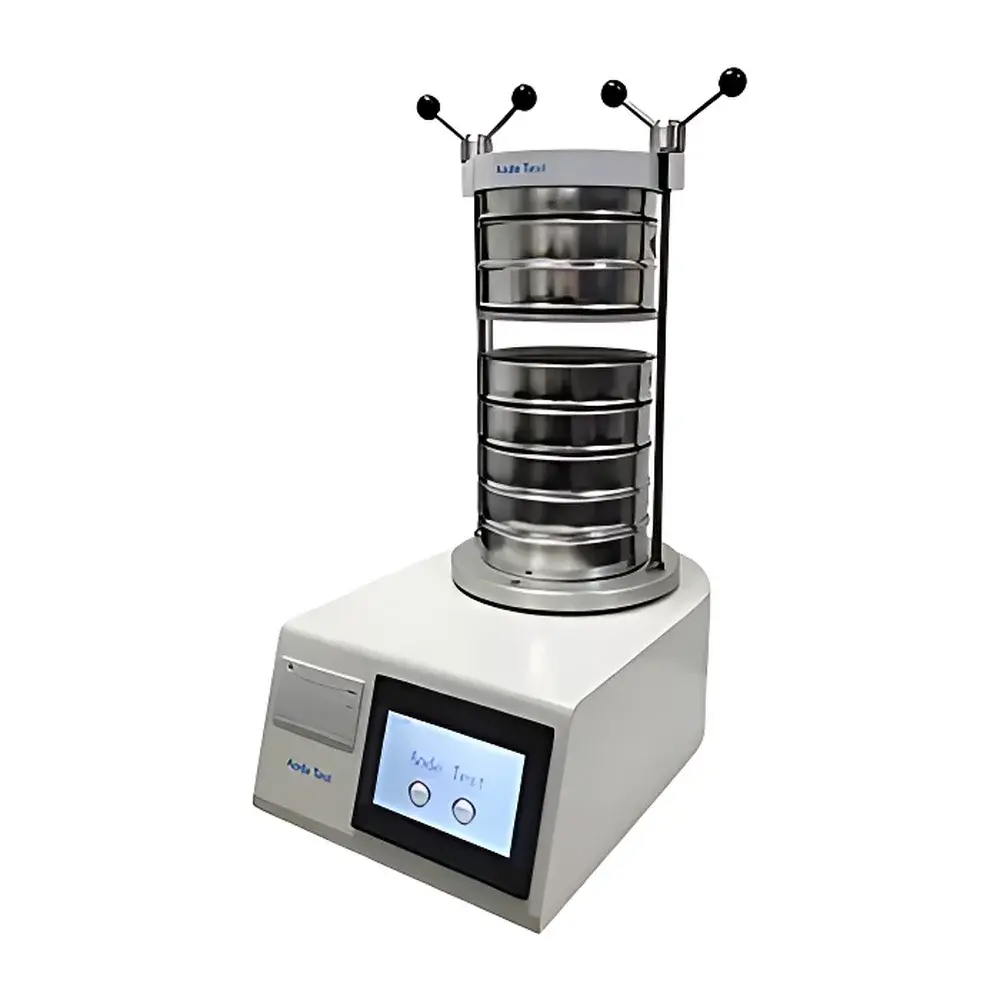
Aode AD200A Electromagnetic Sieve Analyzer
| Brand | Aode |
|---|---|
| Origin | Liaoning, China |
| Manufacturer Type | Direct Manufacturer |
| Country of Origin | China |
| Model | AD200A |
| Price | USD 5,300 (approx.) |
| Sieve Diameter Options | 75 mm / 100 mm / 150 mm / 200 mm / 203 mm |
| Particle Size Range | 20 µm – 80 mm |
| Vibration Mode | Electromagnetic 3D Oscillation |
| Frequency | 3000 cycles/min |
| Adjustable Amplitude | 0–3 mm |
| Sieve Stack Capacity | 12-tier (full-height, 50 mm) or 24-tier (half-height, 25 mm) |
| Operating Modes | Continuous or Intermittent |
| Sample Weight Capacity | 6 kg |
| Power Supply | 220 V, 50 Hz, 400 W, 5 A |
| Dimensions (W×H×D) | 350 × 520 × 200 mm |
| Weight | 30 kg |
| Display | 7-inch TFT capacitive touchscreen |
| Interface | RS-232 for PC connectivity |
| Software | Integrated sieve analysis software with GLP-compliant audit trail, user role management (admin/operator), auto-weight integration, real-time calculation of residue %, passing %, cumulative retained %, and distribution curve generation |
| Compliance | Designed to support USP <786>, ASTM E11, ISO 3310-1, and pharmacopoeial sieve testing requirements |
Overview
The Aode AD200A Electromagnetic Sieve Analyzer is a precision-engineered laboratory instrument designed for standardized particle size distribution analysis via dry or wet sieving. Unlike conventional mechanical shakers that rely on horizontal reciprocating motion—where particle inertia and density significantly affect separation efficiency—the AD200A employs electromagnetic actuation to generate high-frequency, three-dimensional oscillatory motion (3000 cycles per minute). This vertical and lateral “toss-and-roll” action ensures consistent particle agitation across the sieve surface, effectively dislodging blinding particles from apertures and enabling reliable separation even for low-density, cohesive, or irregularly shaped powders. The system complies with internationally recognized standards including ASTM E11 (Specification for Wire Cloth and Sieves for Testing Purposes), ISO 3310-1 (Test Sieves — Technical Requirements and Testing), and USP <786> (Particle Size Distribution), making it suitable for regulated environments in pharmaceutical development, construction materials QA/QC, and advanced powder R&D.
Key Features
- Electromagnetic 3D vibration drive delivering uniform energy transfer across all sieve levels, eliminating mechanical wear associated with cam-driven or eccentric-motor systems
- Adjustable amplitude (0–3 mm) and programmable duration (continuous or intermittent modes) for method optimization across diverse sample types
- Modular sieve stack configuration supporting up to 12 full-height (50 mm) or 24 half-height (25 mm) decks, compatible with standard sieve diameters (75 mm to 203 mm)
- Integrated 7-inch capacitive touchscreen interface with intuitive workflow navigation, real-time status visualization, and multilingual UI (English/Chinese)
- Gradual start-up and ramp-down sequences to minimize mechanical stress and extend service life of internal components
- RS-232 serial interface for bidirectional communication with host PCs running the dedicated Aode Sieve Analysis Software
Sample Compatibility & Compliance
The AD200A accommodates both dry and wet sieving protocols, enabling flexibility for hygroscopic, electrostatic, or agglomerated materials. Its 6 kg maximum sample load supports routine QC batch testing as well as research-scale characterization. All operational parameters—including time, amplitude, mode, and sieve configuration—are fully configurable and stored with timestamped metadata. The instrument’s firmware and software architecture are engineered to meet GLP and GMP documentation requirements: each test session logs operator ID, date/time, sieve specifications, raw weight inputs, calculated mass percentages, and final distribution curves. Audit trails are immutable and exportable in CSV/PDF formats—fully traceable for FDA 21 CFR Part 11 readiness when paired with validated electronic signatures.
Software & Data Management
The included Aode Sieve Analysis Software performs automated computation of key metrics: individual sieve residue (% w/w), percent passing, cumulative retained percentage, and graphical representation of particle size distribution (PSD) curves (linear, logarithmic, or probability scale). Raw data from integrated analytical balances (not included but supported via RS-232 or USB-serial bridge) is ingested directly; no manual entry is required. User access control allows assignment of administrator and operator roles with differentiated permissions. All test records—including method settings, intermediate values, and final reports—are stored indefinitely in a local SQLite database. Export options include Excel-compatible spreadsheets, printable PDF reports with header/footer branding, and image exports of PSD plots. Software updates are delivered via secure HTTPS download with version-controlled release notes.
Applications
The AD200A serves critical functions across multiple regulated and industrial domains: pharmaceutical solid dosage form development (e.g., API granulation screening per USP <786>), mineral aggregate gradation testing (ASTM C136/C136M for coarse/fine aggregates), catalyst support particle sizing, metal powder qualification for additive manufacturing (per ASTM B856), ceramic raw material classification, and food ingredient consistency verification. Its ability to resolve particles from 20 µm to 80 mm makes it uniquely suited for multi-stage cascade analysis—such as simultaneous evaluation of fines, intermediates, and oversize fractions in a single run—reducing inter-run variability and increasing throughput versus sequential mechanical shakers.
FAQ
Does the AD200A require calibration certificates or third-party verification?
While the instrument itself does not require periodic recalibration (as it has no analog sensors subject to drift), users must validate balance integration, sieve mesh conformity (via certified reference sieves), and software output against known standards during initial qualification and at defined intervals per internal SOPs.
Can the software generate reports compliant with FDA 21 CFR Part 11?
Yes—when deployed with validated electronic signature workflows and appropriate IT infrastructure (e.g., domain authentication, encrypted storage, backup policies), the audit-trail-enabled software meets core technical requirements for Part 11 compliance.
Is wet sieving supported without modification?
Yes—the base unit includes corrosion-resistant housing and sealed electromagnetic driver; users supply compatible liquid-tight sieve frames and drainage trays per ASTM D1140 or ISO 17892-4 protocols.
What sieve standards are physically supported?
All standard aperture series per ISO 3310-1 (R40/3, R20, R10) and ASTM E11 (including Tyler, US Standard, and metric equivalents) in diameters 75 mm through 203 mm.
How is maintenance performed on the electromagnetic drive system?
The solid-state electromagnetic actuator contains no brushes, belts, or lubricated bearings; routine maintenance is limited to external cleaning, visual inspection of mounting hardware, and annual verification of coil impedance using a multimeter per the service manual.



