
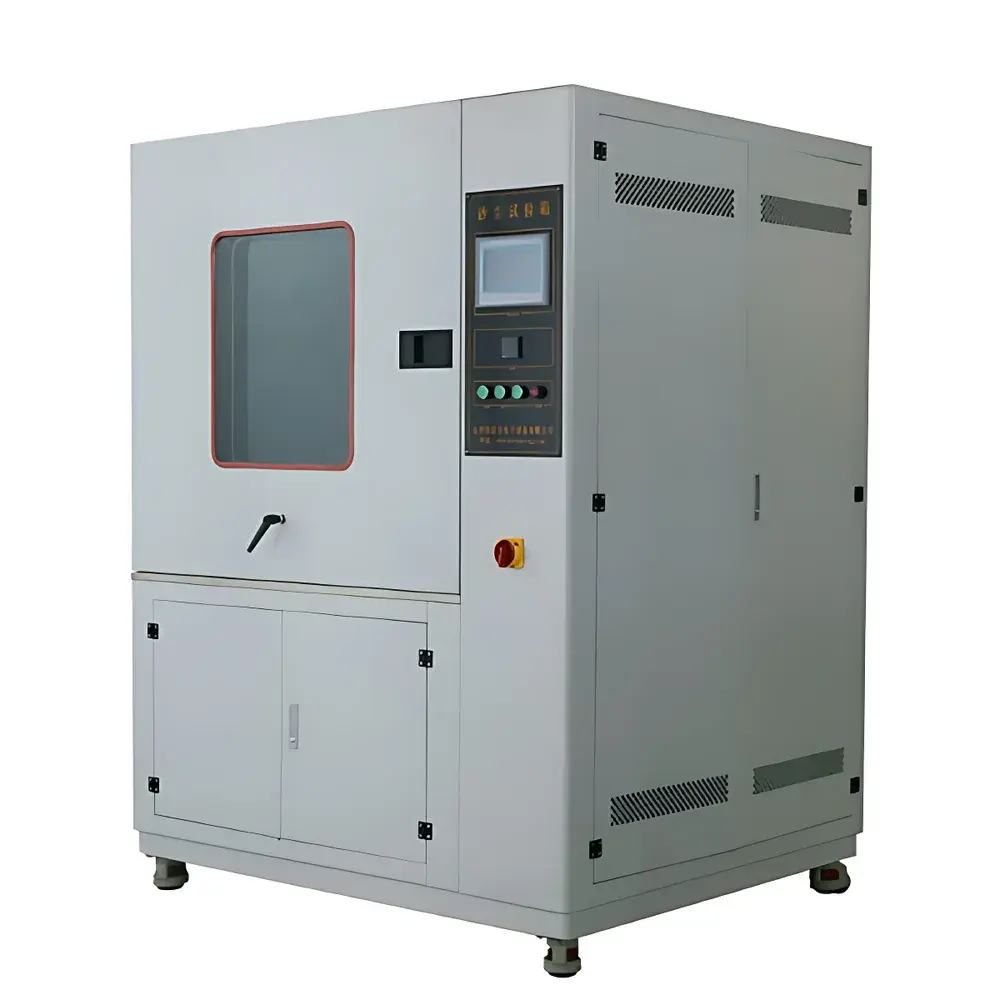
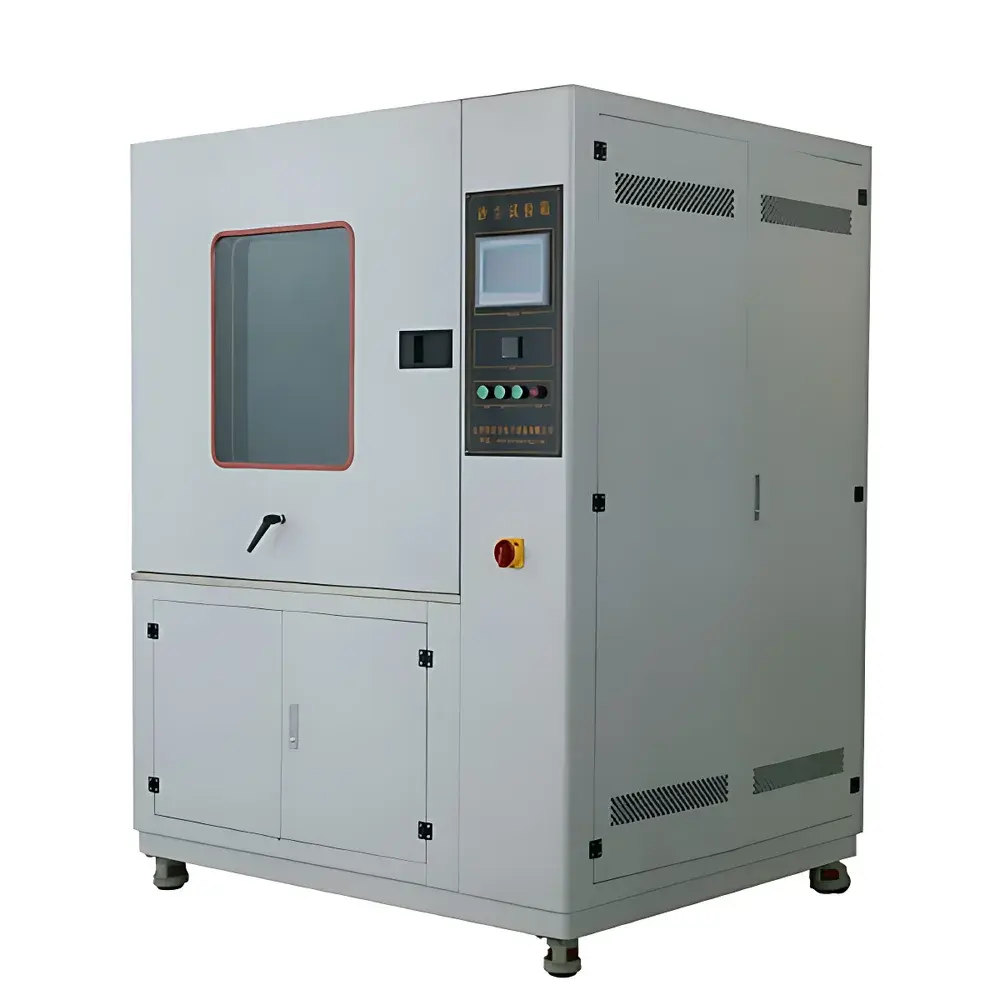
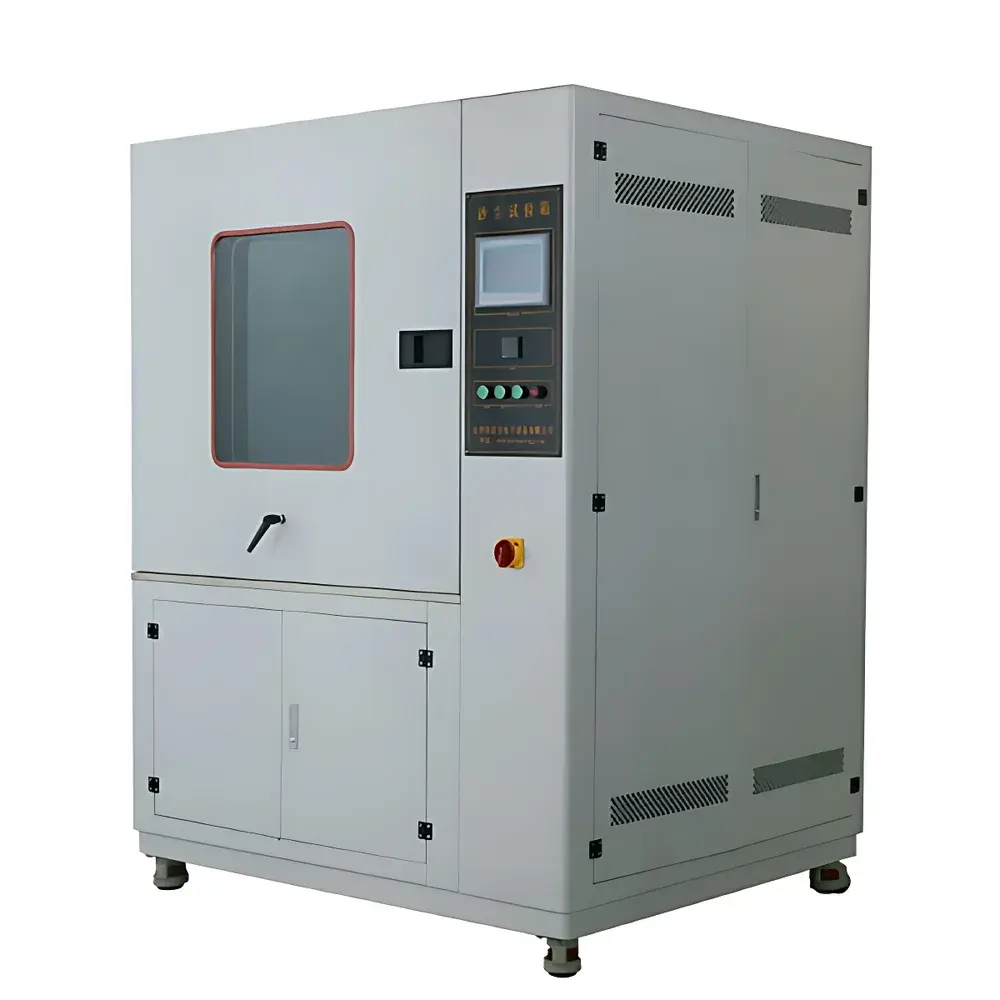
HESON HS-SC-100 Sand and Dust Test Chamber
| Brand | HESON |
|---|---|
| Origin | Shanghai, China |
| Manufacturer Type | Direct Manufacturer |
| Product Origin | Domestic (China) |
| Model | HS-SC-100 |
| Test Chamber Volume | 1 m³ (1000 × 1000 × 1000 mm W×H×D) |
| External Dimensions | 1480 × 1960 × 1450 mm (W×H×D) |
| Temperature Range | RT+10°C to +60°C (adjustable) |
| Humidity Control | ≤25% RH (displayed on controller) |
| Dust Medium | Dry talc or silica cement powder, particle size ≤75 µm (mesh aperture), metal wire diameter 50 µm |
| Dust Concentration | 2–4 kg/m³ |
| Airflow Velocity | 0–15 m/s (adjustable, nominal test velocity 2 m/s) |
| Settling Dust Rate | 6 g/m²/day |
| Vibration Mode | Intermittent/continuous (0–9999 min adjustable) |
| Blowing Mode | Intermittent/continuous (time programmable) |
| Vacuum Pump Flow Rate | 60–600 L/h |
| Dust Recovery System | Conical stainless steel dust collector with shaker mechanism |
| Chamber Interior | SUS304 stainless steel (1.2 mm thickness) |
| Exterior | SECC steel (1.5 mm thickness), powder-coated |
| Control System | PLC-based programmable logic controller with high-precision microcomputer interface |
| Compliance | GB/T 2423.37–2006, GJB 150.12, GB/T 10485–2007, GB 4208–2017 (IP5X/IP6X) |
Overview
The HESON HS-SC-100 Sand and Dust Test Chamber is a precision-engineered environmental simulation system designed to evaluate the ingress protection (IP) performance of enclosures against airborne particulates under controlled, repeatable conditions. It operates on the principle of forced-air circulation of standardized test dust—typically dry talc or silica-based cement powder—within a fully sealed, recirculating vertical airflow path. This “O-type” closed-loop configuration ensures uniform dust dispersion across the test specimen surface while minimizing material loss and enabling long-duration testing with consistent aerosol concentration. The chamber meets the physical and operational requirements for IP5X (limited dust ingress without functional impairment) and IP6X (complete dust-tightness) verification per IEC 60529, as implemented in national standards including GB 4208–2017, GB/T 2423.37–2006, and GJB 150.12. Its architecture supports both steady-state and cyclic exposure protocols, accommodating evaluation of mechanical integrity, sealing efficacy, and functional reliability of devices subjected to arid, dusty, or desert-like environments.
Key Features
- 1 m³ test volume (1000 × 1000 × 1000 mm) with full stainless-steel interior (SUS304, 1.2 mm) and robust SECC exterior (1.5 mm, powder-coated) for corrosion resistance and structural rigidity.
- Recirculating vertical airflow system driven by a high-efficiency, low-noise centrifugal blower with variable-frequency speed control (0–15 m/s range), enabling precise replication of field-relevant wind speeds—including the standard 2 m/s for IP5X/IP6X qualification.
- Dust suspension and dispersion optimized via integrated conical dust recovery funnel, programmable mechanical shaker, and strategically positioned top-mounted diffuser outlets to ensure homogeneous particulate distribution and minimal sedimentation bias.
- PLC-based control architecture with a high-resolution programmable microcomputer controller supporting both fixed-value and multi-step program modes; real-time monitoring of temperature (RT+10°C to +60°C), relative humidity (≤25% RH), elapsed time, and cycle parameters.
- Dedicated vacuum-assisted dust aspiration subsystem (60–600 L/h flow rate) compliant with negative-pressure test requirements for evaluating enclosure integrity under differential pressure conditions.
- Comprehensive dust management: reusable test medium (dry talc, ≤75 µm particle size, 50 µm wire mesh specification), adjustable blow duration (0–9999 h/min/sec), intermittent/continuous vibration (0–9999 min), and cumulative runtime tracking.
Sample Compatibility & Compliance
The HS-SC-100 accommodates a broad range of sample geometries and mounting configurations—including handheld electronics (e.g., smartphones, tablets), automotive lighting assemblies, electrical junction boxes, outdoor sensors, and military-grade connectors—provided they fit within the 1 m³ workspace and do not obstruct airflow or dust recirculation pathways. All test procedures adhere strictly to internationally recognized dust ingress test methodologies: IEC/EN 60529 (IP code definitions), ISO 20653 (road vehicles), SAE J575 (lighting durability), and MIL-STD-810H Method 510.7 (sand and dust). It satisfies full validation requirements for GLP-compliant laboratories and supports audit-ready documentation through timestamped parameter logging, operator ID tagging, and event-triggered alarm records—facilitating traceability under FDA 21 CFR Part 11 and ISO/IEC 17025 frameworks.
Software & Data Management
Control firmware integrates native data logging with configurable sampling intervals (1 s to 60 min), storing up to 10,000 data points per test cycle. Export formats include CSV and Excel-compatible .xls files, compatible with LIMS integration and statistical process control (SPC) platforms. The interface supports user-defined test profiles, password-protected parameter locks, and automatic report generation including test start/stop timestamps, deviation alerts, and pass/fail status per GB 4208–2017 clause 14.2. Audit trail functionality captures all manual interventions, setpoint changes, and system faults with immutable timestamps—meeting requirements for regulated industries operating under GMP or ISO 9001 quality management systems.
Applications
- Verification of IP5X and IP6X compliance for consumer electronics, industrial control panels, and smart infrastructure components.
- Evaluation of long-term sealing degradation in automotive lighting, brake actuators, and EV battery enclosures exposed to desert or off-road conditions.
- Qualification of aerospace avionics housings per MIL-STD-810H Method 510.7 for sand ingestion resistance during ground operations.
- Accelerated wear assessment of gaskets, O-rings, and membrane switches under abrasive particulate loading.
- Research into dust filtration efficiency and electrostatic particle adhesion mechanisms in sensor protection systems.
FAQ
What dust specifications are required for IP5X/IP6X testing?
Per GB 4208–2017 and IEC 60529, the standard test medium is dry, non-hygroscopic talcum powder with ≥75 µm sieve retention and ≤50 µm metal wire diameter; typical concentration is 2–4 kg/m³.
Can the chamber operate continuously for extended durations?
Yes—the system supports uninterrupted operation up to 9999 hours with programmable dust replenishment intervals and automated vibration cycles to prevent powder compaction.
Is vacuum capability built-in or optional?
A fully integrated vacuum pump (60–600 L/h) is standard, enabling simultaneous positive-pressure blowing and negative-pressure suction tests per GJB 150.12 Annex A.
Does the controller support remote monitoring or network connectivity?
The base configuration includes RS485 Modbus RTU output; Ethernet or Wi-Fi modules are available as factory-installed options for SCADA integration.
How is dust concentration calibrated and verified?
Concentration is validated using gravimetric sampling with pre-weighed filters (ISO 14644-1 methodology) and confirmed via optical particle counter (OPC) cross-check at designated measurement ports.



