
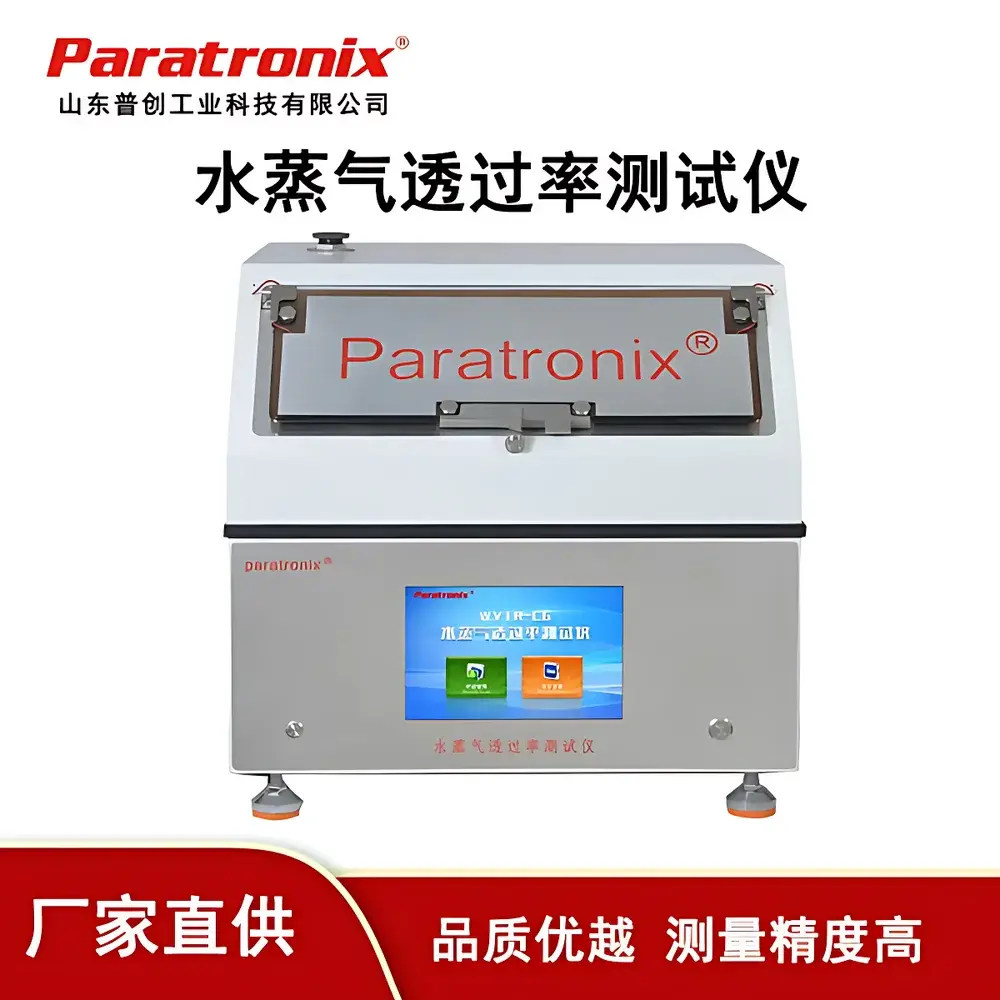
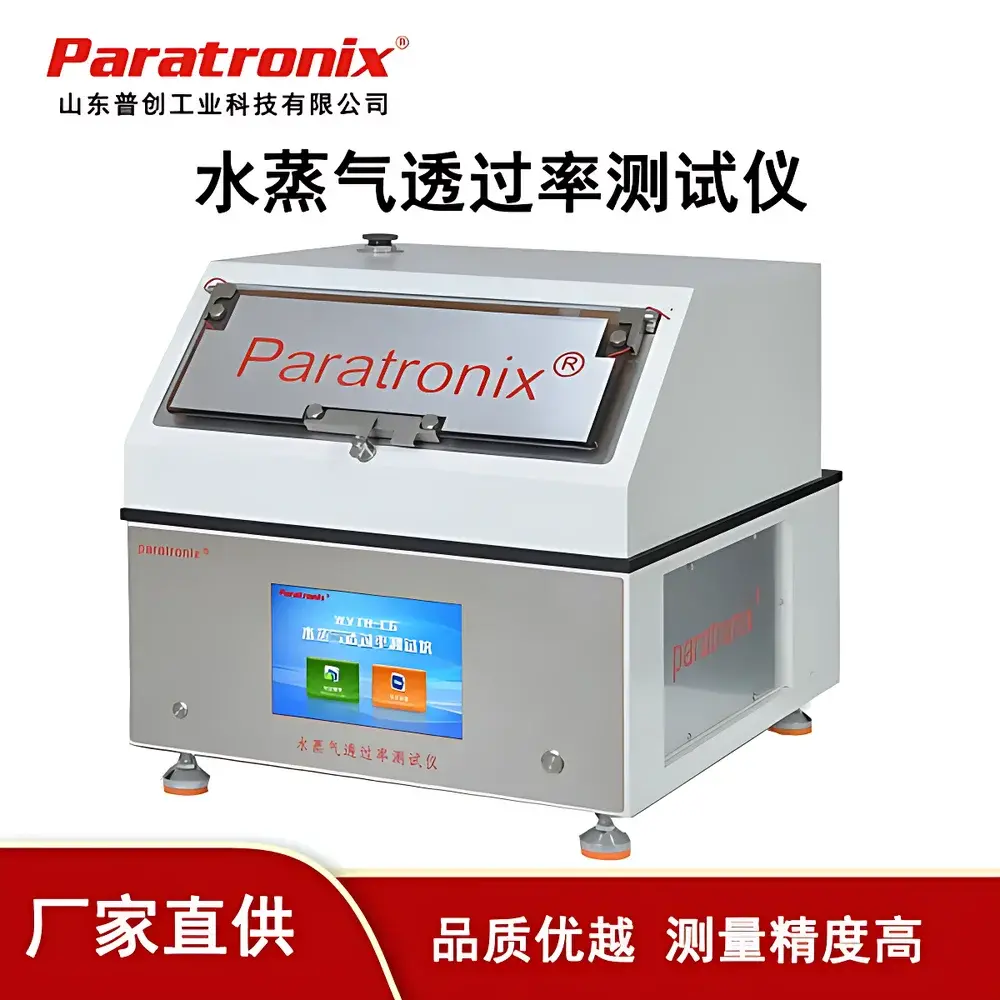
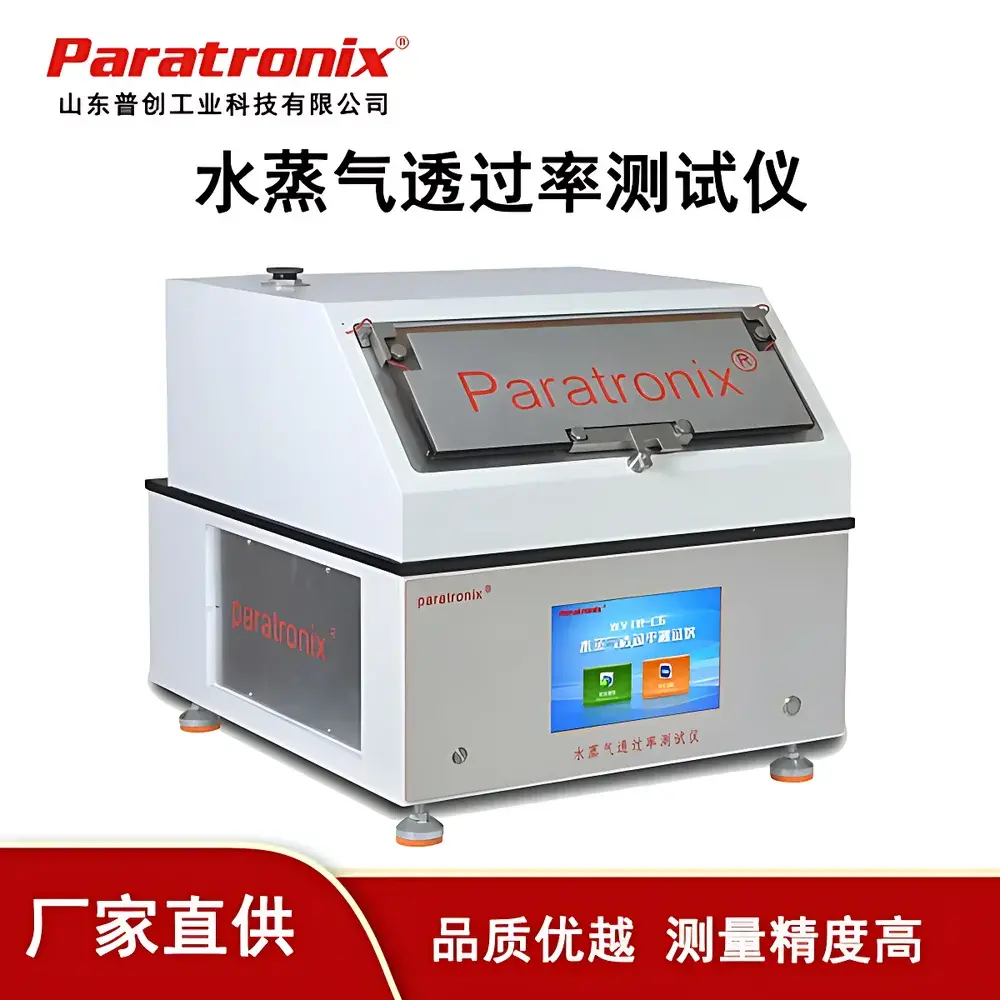
Paratronix WVTR-C6 Gravimetric Cup Method Water Vapor Transmission Rate Tester
| Brand | Paratronix |
|---|---|
| Model | WVTR-C6 |
| Origin | Shandong, China |
| Manufacturer Type | Direct Manufacturer |
| Country of Origin | China |
| Test Principle | Gravimetric Cup Method (Weight Change over Time) |
| Measurement Range | 0.1–10,000 g/m²·24h |
| Sample Capacity | 6 independent stations |
| Resolution | 0.0001 g |
| Accuracy | ±0.01 g/m²·24h |
| Temperature Control Range | 15–55°C (standard) |
| Temp. Stability | ±0.1°C |
| Humidity Control Range | 10–90% RH (standard 90% RH) |
| RH Stability | ±1% RH |
| Airflow Velocity | 0.5–2.5 m/s (customizable) |
| Max. Sample Thickness | ≤3 mm (customizable) |
| Test Area | 33 cm² |
| Sample Diameter | Φ74 mm |
| Test Modes | Desiccant Method (Standard), Moisture Gain Method (Optional), Dual-Mode (Optional) |
| Power Supply | 220 VAC 50 Hz / 120 VAC 60 Hz |
| Dimensions (L×W×H) | 660 × 480 × 525 mm |
| Net Weight | 70 kg |
| Gas Supply Pressure | 0.6 MPa |
| Tubing Interface | Φ6 mm polyurethane tube |
Overview
The Paratronix WVTR-C6 is a precision-engineered gravimetric cup method water vapor transmission rate (WVTR) tester designed for rigorous regulatory and R&D environments in packaging, medical device, pharmaceutical, and advanced materials development. It operates on the standardized ASTM E96/E96M and ISO 15106-1 principles—measuring mass change of sealed permeation cups containing desiccant (or water) over time under controlled temperature and relative humidity (RH) conditions. The instrument establishes a defined vapor pressure gradient across a planar specimen, enabling quantitative determination of water vapor diffusion kinetics through films, foils, laminates, and nonwovens. Its dual-chamber environmental control system maintains stable thermal and hygrometric profiles per test station, ensuring high inter- and intra-batch reproducibility required for GLP-compliant material qualification and shelf-life modeling.
Key Features
- Six independent test stations with fully isolated environmental chambers—enabling concurrent evaluation of heterogeneous samples under identical or differentiated T/RH conditions.
- High-resolution microbalance (0.0001 g resolution) integrated into each cup holder, calibrated traceably to NIST standards and validated per USP <788> weighing performance criteria.
- Precise dual-zone climate control: ±0.1°C temperature stability and ±1% RH accuracy across the full operational range (15–55°C / 10–90% RH), with optional extended ranges (5–95°C) available for accelerated aging protocols.
- Configurable test methodology: standard desiccant (weight-loss) mode; optional moisture-gain (inverted cup) mode for hydrophilic or asymmetric barrier layers; dual-mode capability supports cross-validation per ISO 15106-3.
- Dynamic software architecture allowing real-time pausing, mid-test data extraction, and post-hoc re-calculation from any timestamp—critical for troubleshooting edge-case permeation behavior or validating transient diffusion models.
- Modular sample fixtures accommodating thicknesses up to 3 mm and diameters of Φ74 mm; custom tooling available for non-standard geometries including curved substrates and multi-layer composites.
Sample Compatibility & Compliance
The WVTR-C6 supports broad material classes essential for functional barrier validation: polymer films (PET, PE, PP, PVDC, EVOH), metallized laminates, aluminum foils, paperboard, coated papers (e.g., cigarette packaging), breathable medical fabrics (spunbond/meltblown nonwovens), wound dressings, transdermal patches, biodegradable matrices (PLA, starch-based films), solar backsheet polymers, and display protection films. All testing workflows align with ASTM D1653 (plastic film), ISO 2528 (paper and board), and YY/T 0681.10 (sterile medical packaging). Instrument firmware and audit trail logs comply with FDA 21 CFR Part 11 requirements when operated with validated electronic signatures and user access controls.
Software & Data Management
The embedded Windows-based control software provides full ICH-GCP-aligned data governance: automated timestamped audit trails, electronic signature support, role-based user permissions, and encrypted raw-data archiving. All weight vs. time datasets are exported in CSV and XML formats compatible with LIMS integration. Per-test reports include slope-derived WVTR values, coefficient of variation (%CV), linear regression statistics (R² ≥ 0.995 threshold), and deviation flags for non-linear permeation onset. Calibration logs, maintenance records, and environmental chamber validation summaries are retained within the secure database for internal QA review and external regulatory inspection.
Applications
- Packaging R&D: Quantifying moisture barrier efficacy of flexible food pouches, pharmaceutical blister lidding, and vacuum-sealed medical device trays.
- Medical Device Development: Validating WVTR specifications for surgical drapes, implantable membrane coatings, and negative-pressure wound therapy films.
- Pharmaceutical Packaging: Assessing moisture ingress risk for lyophilized vial stoppers, desiccant-containing sachets, and child-resistant blister cards.
- Renewable Energy Materials: Characterizing encapsulant and backsheet permeability in photovoltaic module qualification per IEC 61215.
- Personal Care & Cosmetics: Measuring hydration retention in facial masks, hydrocolloid wound covers, and transdermal delivery systems.
- Sustainable Materials Testing: Benchmarking water vapor resistance of compostable films against conventional PET benchmarks under identical ISO 15106-1 conditions.
FAQ
What standards does the WVTR-C6 comply with?
It adheres to ASTM E96/E96M (desiccant and water methods), ISO 15106-1 (gravimetric cup method), ISO 2528 (paper/board), and YY/T 0681.10 (medical packaging). Optional IQ/OQ documentation supports GMP facility validation.
Can the system perform inverted (moisture gain) testing?
Yes—when equipped with optional inverted cup fixtures and humidified lower chambers, it supports ASTM E96 Method B and ISO 15106-2 protocols for hydrophilic or asymmetric membranes.
Is calibration traceable to national standards?
All microbalances are factory-calibrated using NIST-traceable weights; annual recalibration services include uncertainty reporting per ISO/IEC 17025.
How is data integrity ensured for regulated environments?
The system implements 21 CFR Part 11-compliant electronic records: audit trails with immutable timestamps, operator authentication, and encrypted database backups with version-controlled report generation.
What maintenance is required for long-term accuracy?
Recommended quarterly verification of chamber uniformity (ASTM F2476), biannual balance recalibration, and annual sensor drift validation using certified RH/T reference standards.




