
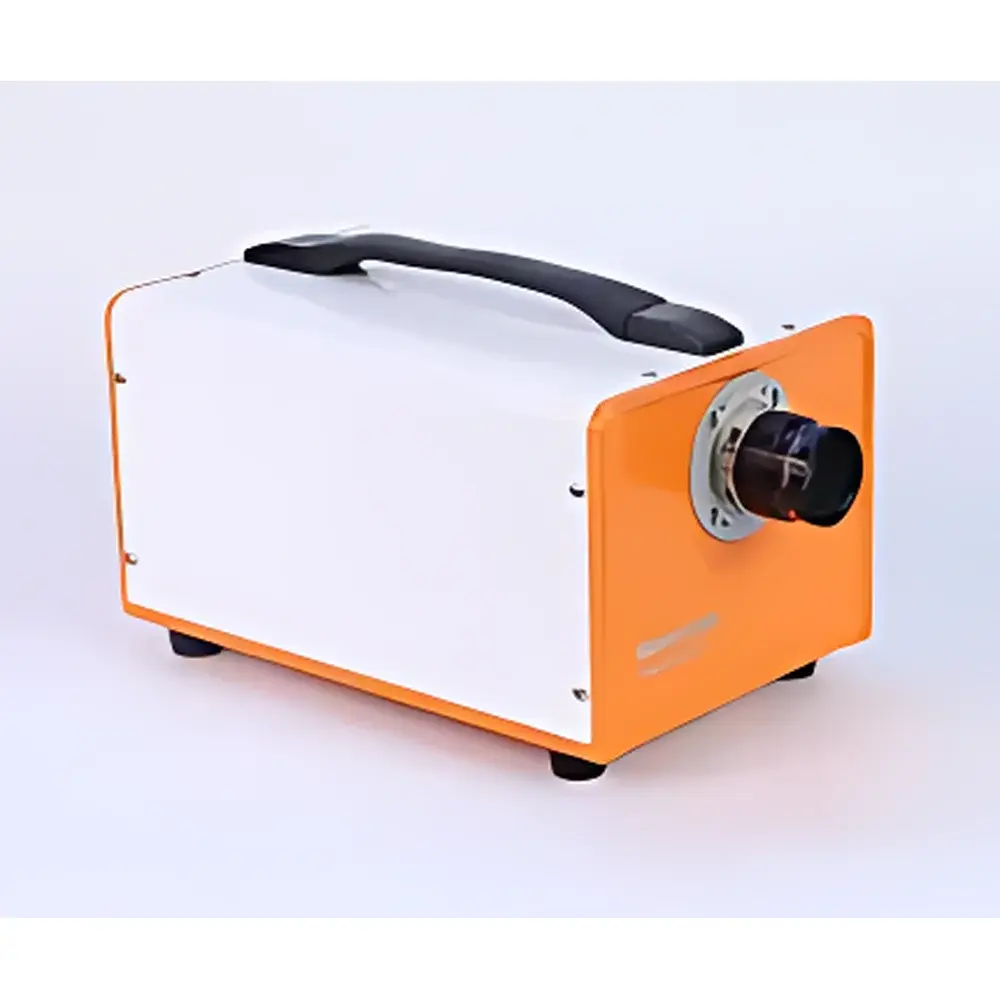
GaiaField-V10 Lite Portable Visible-Near-Infrared Hyperspectral Imaging Camera
| Origin | Beijing |
|---|---|
| Manufacturer Type | Distributor |
| Origin Category | Domestic |
| Model | GaiaField-V10 Lite |
| Price Range | USD 70,000–140,000 |
| Operating Principle | Push-broom |
| Imaging Modality | Computed Tomographic Imaging (CTI)-assisted Hyperspectral Data Acquisition |
| Deployment Mode | Ground-based & Airborne Compatible |
| Spectral Range | 400–1000 nm |
| Spectral Resolution | 3.5 nm |
| Field of View (TFOV) | 22° |
| Instantaneous Field of View (IFOV) | 696 × 700 pixels (2× binning) |
| F-number | f/2.8 |
| Slit Size | 30 µm × 9.6 mm |
| Detector | CCD, 1392 × 1040 pixels (spatial × spectral) |
| Spectral Bands | 1040 (1×), 520 (2×), 256 (4×, default), 128 (8×) |
| Dynamic Range | 14-bit |
| Interface | USB 2.0 |
| Weight | 2.8 kg |
| Integrated Battery | 40 Wh (≥4 h continuous operation) |
Overview
The GaiaField-V10 Lite is a portable, push-broom hyperspectral imaging camera engineered for high-fidelity spectral data acquisition across the visible and near-infrared (VNIR) spectrum (400–1000 nm). It operates on the principle of spatial-spectral scanning—where a linear array detector captures one spatial line per integration time while the sensor or target moves orthogonally—enabling full 3D (x, y, λ) data cube generation. Unlike snapshot or tunable-filter systems, this architecture delivers inherent radiometric stability, high spectral fidelity, and robust geometric consistency across diverse deployment platforms—including handheld, tripod-mounted, UAV-integrated, and vehicle-based configurations. Its compact form factor (2.8 kg), integrated 40 Wh battery, and USB 2.0 interface eliminate reliance on external power or complex cabling, making it suitable for field-deployable spectroscopic surveys under variable ambient lighting and logistical constraints.
Key Features
- Intelligent Adaptive Acquisition: Real-time auto-exposure control dynamically determines optimal integration time based on scene irradiance, preventing saturation while maximizing signal-to-noise ratio (SNR); integrated overexposure warning provides immediate visual feedback during acquisition.
- Auto-Scanning Speed Matching: The system computes optimal scan velocity in real time by correlating measured frame rate, exposure duration, and platform motion—ensuring geometric integrity of hyperspectral cubes without spatial distortion (e.g., stretching or compression).
- Modular Optical Design: Interchangeable lenses support application-specific field-of-view (FOV) and ground sampling distance (GSD) requirements; standard 23 mm lens yields 22° TFOV and an IFOV of 696 × 700 pixels at 2× binning.
- Onboard Radiometric Calibration Suite: Includes real-time radiance correction, reflectance normalization (via reference panel input), region-of-interest (ROI) calibration, lens vignetting compensation, and flat-field uniformity correction—all executed pre-storage to reduce post-processing latency.
- High-Fidelity Spectral Sampling: Delivers up to 1040 contiguous spectral channels across 400–1000 nm with ≤3.5 nm spectral resolution (FWHM), enabling discrimination of narrow absorption features critical for pigment identification, moisture quantification, and biochemical constituent mapping.
- Plug-and-Play Integration: Native USB 2.0 connectivity supports direct communication with Windows 7–10 (32-/64-bit); no additional frame grabbers or proprietary hardware drivers required.
Sample Compatibility & Compliance
The GaiaField-V10 Lite is designed for non-contact, non-destructive spectral characterization of heterogeneous surfaces—including vegetation canopies, soil substrates, painted artifacts, biological tissues, and industrial materials. Its VNIR sensitivity aligns with widely adopted standards for reflectance-based analysis, including ASTM E275, ISO 11664-2, and USP (Spectrophotometry and Light Scattering). While not certified for GMP/GLP environments out-of-the-box, its deterministic acquisition workflow, timestamped metadata embedding, and reproducible calibration protocols support traceability requirements under FDA 21 CFR Part 11 when deployed within validated laboratory or field workflows. All raw data are stored in ENVI-compatible BIL/BIP formats, facilitating audit-ready archival and third-party validation.
Software & Data Management
Data acquisition and preprocessing are managed via GaiaField Control Software—a native Windows application supporting live preview, spectral profile extraction, ROI annotation, and batch calibration. Exported data cubes comply with industry-standard formats (e.g., ENVI .hdr/.dat, Evince .hsi, SpecSight .raw), ensuring seamless interoperability with MATLAB, Python (scikit-image, spectral), R (hyperSpec), and commercial platforms such as ENVI, ERDAS IMAGINE, and PCI Geomatica. Metadata—including GPS timestamps (when synchronized with external GNSS), exposure parameters, lens ID, and calibration history—is embedded in header files to maintain provenance. For regulated environments, optional software modules provide electronic logbooks, user access controls, and audit-trail generation aligned with GLP documentation practices.
Applications
- Environmental Monitoring: Crop health assessment (NDVI, PRI, MCARI), soil organic carbon estimation, water quality parameter retrieval (chlorophyll-a, suspended solids), and wetland species classification.
- Cultural Heritage Science: Pigment identification in paintings and manuscripts, detection of retouching or degradation products, and stratigraphic layer analysis via spectral unmixing.
- Forensic Investigation: Differentiation of ink formulations, blood residue detection under ambient light, and fiber-type classification using spectral library matching.
- Industrial Quality Control: Real-time sorting of plastics, pharmaceutical tablets, or food products based on spectral signatures correlated with composition or contamination.
- Defense & Security: Camouflage detection, material anomaly identification, and concealed object screening via spectral anomaly mapping.
FAQ
What spectral calibration standards does the GaiaField-V10 Lite support?
It accepts user-provided reflectance panels (e.g., Spectralon® 99% or 50%) for empirical reflectance calibration and includes factory-measured dark current and flat-field profiles for radiometric correction.
Is airborne integration supported?
Yes—the system’s low mass, shock-resistant housing, and synchronization I/O port enable stable integration with UAV gimbals and GNSS-INS systems; recommended minimum forward speed is 2 m/s for optimal push-broom sampling.
Can spectral binning be adjusted during acquisition?
Yes—binning modes (1×, 2×, 4×, 8×) are selectable in real time via software, trading spectral resolution for increased SNR or frame rate depending on illumination conditions and motion constraints.
Does the system meet export control regulations?
The GaiaField-V10 Lite falls outside EAR99 and ITAR jurisdiction due to its non-military-grade spatial resolution and lack of active illumination; however, end-user verification remains the responsibility of the purchaser per national licensing requirements.
How is geometric distortion corrected?
Lens distortion coefficients are pre-characterized and applied during onboard processing; optional ground-control-point (GCP)-based georectification is available through ENVI or QGIS plugins using exported GeoTIFF outputs.





