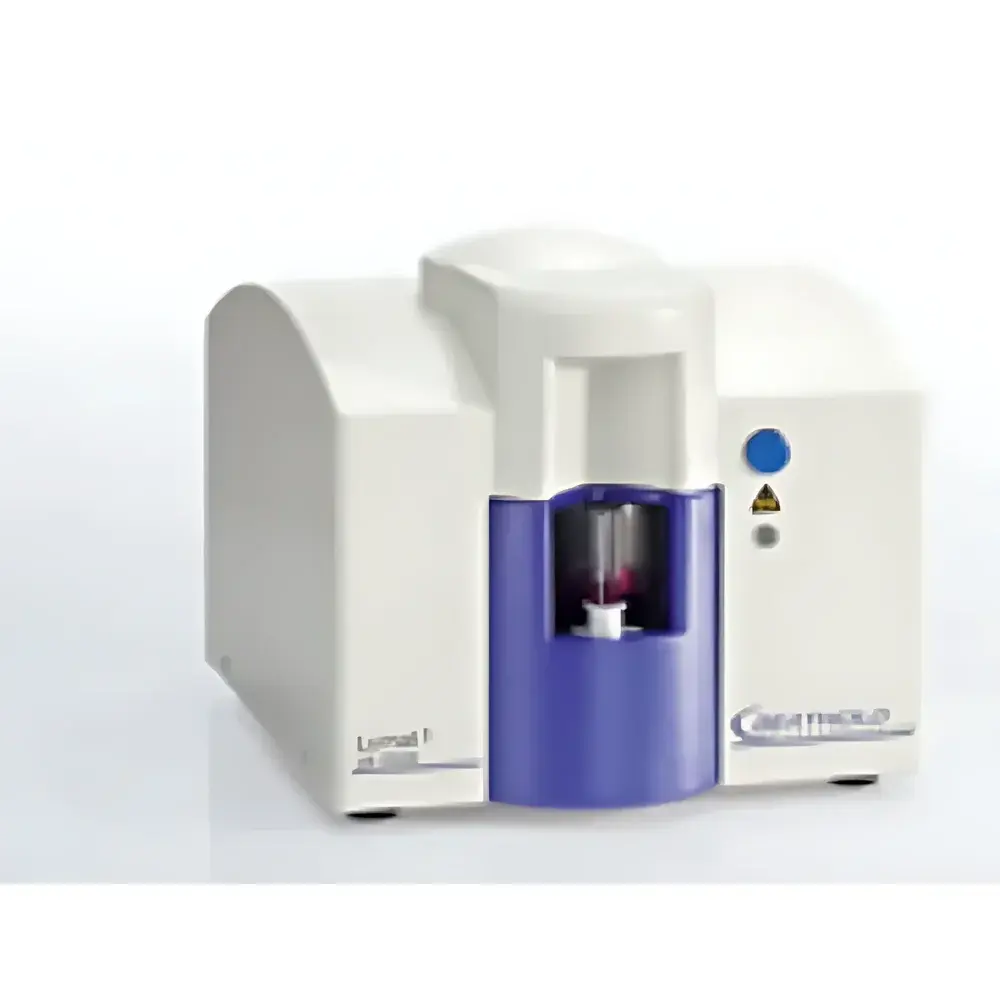
Berthold LB9508 Tube Luminometer
| Brand | Berthold |
|---|---|
| Origin | Germany |
| Model | LB9508 |
| Instrument Type | Electrochemiluminescence Analyzer |
| Automation Level | Fully Automated |
| Detector | Ultra-High-Speed, Low-Noise Photon-Counting Photomultiplier Tube (PMT) |
| Wavelength Range | 280–630 nm |
| Detection Sensitivity | <1 amol ATP |
| Sample Introduction | JET Injection Technology |
| Compatible Tube Formats | 12 × 75 mm, 12 × 55 mm, 12 × 47 mm luminometer tubes |
| Injection Volume Range | 10–100 µL or 25–300 µL per channel |
| Injection Accuracy | >98% |
| Software | ICE Operating System with Wizard-Based Interface |
Overview
The Berthold LB9508 Tube Luminometer is a fully automated, high-sensitivity chemiluminescence detection platform engineered for quantitative measurement of light emission from biological and biochemical reactions in standard luminometer tubes. It operates on the principle of photon-counting luminometry—capturing individual photons generated during enzymatic (e.g., luciferase), chemical (e.g., luminol), or electrochemical (e.g., ruthenium-based) luminescent reactions. Its core architecture integrates a proprietary 360° photon collection chamber, ultra-low-noise photon-counting PMT detectors, and precision JET injection technology to ensure maximal signal capture, minimal background noise (<0.5 zmol firefly luciferase), and exceptional reproducibility across low-abundance analyte measurements. Designed and manufactured in Germany, the LB9508 meets stringent requirements for assay development, clinical diagnostics validation, and regulated research environments where trace-level quantification—such as ATP monitoring in cell viability assays or reporter gene expression kinetics—is critical.
Key Features
- Fully automated dual-position rotating detection chamber enabling simultaneous sample loading and measurement—doubling throughput without compromising timing precision.
- Two independently programmable JET injectors with adjustable volume ranges (10–100 µL or 25–300 µL), delivering >98% volumetric accuracy and rapid, homogeneous reagent mixing essential for flash-type luminescence kinetics.
- Ultra-high-speed, low-noise photon-counting PMT optimized for wavelengths from 280 nm to 630 nm, supporting both short-duration flash assays (e.g., luciferase) and sustained glow reactions (e.g., alkaline phosphatase–AMPPD).
- 360° isotropic photon collection geometry ensures near-unity quantum efficiency for cylindrical tube formats—including 12 × 75 mm, 12 × 55 mm, 12 × 47 mm luminometer tubes and standard Eppendorf tubes (1 mL, 1.5 mL, 2 mL).
- Rugged optical shielding and thermally stabilized detector housing minimize dark current drift and environmental interference, supporting long-term stability required for kinetic time-course experiments.
Sample Compatibility & Compliance
The LB9508 accommodates a broad range of commercially available luminometer-compatible consumables and assay chemistries. It supports all major flash-type (e.g., Renilla/Firefly dual-reporter, ATP bioluminescence) and glow-type (e.g., β-galactosidase, horseradish peroxidase–enhanced chemiluminescence) detection formats. The system complies with ISO/IEC 17025 principles for test method validation and is routinely deployed in GLP-compliant laboratories performing assay qualification per ICH Q2(R2). While not inherently 21 CFR Part 11–compliant out-of-the-box, its ICE software architecture supports audit-trail-enabling configurations when integrated into validated IT infrastructures meeting FDA regulatory expectations for electronic records.
Software & Data Management
The ICE (Intelligent Control Environment) operating system provides a wizard-driven interface for method setup, protocol execution, and real-time data visualization. It natively supports endpoint, dual-endpoint, and single-kinetic measurement modes, with built-in curve-fitting algorithms (linear, exponential, sigmoidal) for dose–response analysis. Data export options include XLS, DOC, RTF, and PDF formats, with direct printer support and configurable metadata tagging. All acquisition parameters—including injector timing, integration window, gain settings, and temperature logging—are stored alongside raw photon counts, ensuring full traceability for internal QA review or external regulatory submission.
Applications
- Single and dual-reporter gene assays (e.g., Firefly/Renilla normalization in transcriptional regulation studies)
- Immunodetection via chemiluminescent substrates (e.g., HRP- or AP-conjugated secondary antibodies)
- ATP quantification in cell viability, cytotoxicity, and microbial load testing
- Hybridization-based DNA probe detection and nucleic acid quantification
- Phagocytic activity assessment using luminol- or lucigenin-enhanced oxidative burst assays
- Real-time PCR product quantification via post-amplification luminescent detection
- Validation and routine use of CE-marked and FDA-cleared clinical chemiluminescence immunoassay (CLIA) kits
FAQ
What types of luminescence reactions does the LB9508 support?
It supports both flash-type (transient, sub-second peak) and glow-type (sustained, minutes-to-hours emission) chemiluminescent, bioluminescent, and electrochemiluminescent reactions.
Is the LB9508 compatible with microplate-based assays?
No—the LB9508 is specifically engineered for tube-based detection. For microplate applications, Berthold offers the Centro XS or TriStar series luminometers.
Can the JET injectors be calibrated in-house?
Yes—calibration routines for volume verification and dispersion uniformity are accessible via service mode and documented in the ICE maintenance manual.
Does the system support remote operation or network integration?
The LB9508 features Ethernet connectivity and supports TCP/IP-based command protocols, enabling integration into centralized laboratory automation systems and LIMS environments.
What maintenance is required for optimal photon-counting performance?
Annual PM includes PMT gain verification, optical path cleaning, injector seal inspection, and dark-count baseline validation—all traceable to factory reference standards.