
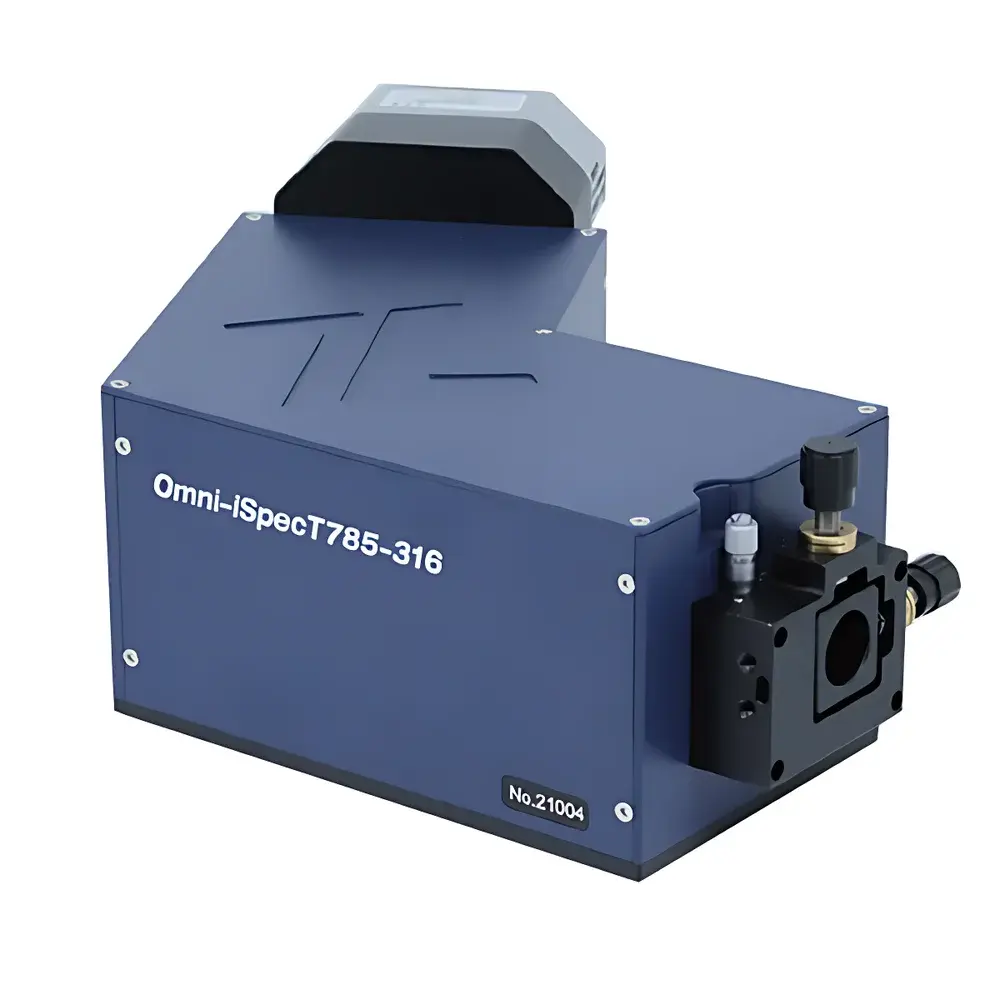
Omni-iSpecT Transmission Grating Spectrometer by ZOLIX
| Brand | ZOLIX |
|---|---|
| Origin | Beijing, China |
| Manufacturer Type | OEM Manufacturer |
| Model | Omni-iSpecT |
| Application Modes | Transmission & Reflection Spectroscopy |
| Grating Mount | Motorized Grating Turret |
| Spectral Resolution | As per Manual |
| Dispersion | As per Manual |
| Wavelength Range | 532–680 nm (Visible) / 0–4100 cm⁻¹ (Raman Shift) |
| F/# | f/1.8 |
| Wavelength Accuracy | ±0.2 nm (typ. at 532 nm), ±1 cm⁻¹ (typ. in Raman shift domain) |
| Stray Light | <0.01% (typ., 532 nm excitation) |
Overview
The Omni-iSpecT Transmission Grating Spectrometer is a high-throughput, research-grade spectroscopic instrument engineered for demanding low-light applications—particularly Raman spectroscopy, plasma emission analysis, and in situ process monitoring. Unlike conventional Czerny-Turner monochromators, the Omni-iSpecT employs a transmission-based volume phase holographic (VPH) grating architecture coupled with f/1.8 broadband anti-reflection coated optics. This optical design minimizes photon loss across the visible (532–680 nm) and Raman-shift domains (0–4100 cm⁻¹), enabling exceptional light collection efficiency—critical when detecting weak spontaneous Raman signals or transient plasma emissions. The system integrates a deep-cooled scientific CCD detector (typically −60 °C operation), delivering high quantum efficiency (>70% at 532 nm) and low read noise (<5 e⁻ rms), thereby optimizing signal-to-noise ratio (SNR) without compromising spectral fidelity. Its fully aligned, monolithic optical bench eliminates drift from thermal expansion or mechanical shock, making it suitable for both laboratory-grade metrology and field-deployable instrumentation under GLP- or ISO/IEC 17025-aligned workflows.
Key Features
- High-throughput optical train with f/1.8 aperture and VPH transmission grating achieving >85% peak diffraction efficiency in visible/NIR bands
- Optimized fiber coupling: accepts full NA 0.22 input with near-100% coupling efficiency via precision XY-adjustable SMA905 adapter
- Compact, rigid monolithic housing with factory-aligned optics—no field recalibration required after transport or vibration exposure
- Simultaneous spatial-spectral imaging across 30 mm detector format, corrected for coma, astigmatism, and field curvature to ≤25 µm RMS spot size across full FOV
- Modular grating turret supporting rapid switching between configurations optimized for 532 nm or 785 nm excitation wavelengths
- OEM-ready SDK (C/C++, Python, LabVIEW APIs) compliant with USB 2.0 interface and standard Windows/Linux drivers
Sample Compatibility & Compliance
The Omni-iSpecT supports transmission, reflection, and backscattering measurement geometries—including fiber-coupled remote probes, free-space collimated inputs, and integrated cuvette holders. It complies with IEC 61000-6-3 (EMC emissions) and IEC 61000-6-2 (immunity). When operated with calibrated NIST-traceable reference sources (e.g., Hg/Ar lamps), it meets ASTM E275–22 requirements for spectrophotometer validation. For regulated environments, data acquisition logs support audit trails compatible with FDA 21 CFR Part 11-compliant software implementations (via third-party middleware). The IP20-rated enclosure satisfies typical laboratory and controlled industrial settings per ISO 14644-1 Class 8 cleanroom operational guidelines.
Software & Data Management
ZOLIX provides the SpectraSight™ control suite (v4.x), featuring real-time spectrum preview, multi-channel background subtraction, dark-frame correction, and wavelength calibration using polynomial or spline fitting algorithms. Export formats include ASCII (.txt), CSV, and industry-standard JCAMP-DX v5.01 for spectral interoperability. Raw frame metadata includes exposure time, temperature, grating position, slit width, and detector gain—enabling traceable post-processing in MATLAB, OriginPro, or Python (NumPy/Pandas). All acquisitions generate timestamped .hdf5 files with embedded HDF5 attributes for FAIR (Findable, Accessible, Interoperable, Reusable) data management protocols.
Applications
- Raman spectroscopy of pharmaceuticals, polymers, and 2D materials (e.g., graphene, MoS₂) using 532 nm or 785 nm excitation
- In-line gas composition monitoring in combustion chambers and semiconductor etch tools via molecular emission fingerprinting
- Biomedical tissue characterization (e.g., cancer margin detection) using autofluorescence-Raman hybrid modalities
- Plasma diagnostics in fusion research and laser-induced breakdown spectroscopy (LIBS)
- Quality assurance in LED manufacturing through spectral power distribution (SPD) and color rendering index (CRI) mapping
- Environmental sensing: dissolved organic carbon (DOC) quantification in water via UV-Vis absorption profiling
FAQ
What excitation wavelengths is the Omni-iSpecT optimized for?
The system is configured for either 532 nm or 785 nm laser excitation—each requiring dedicated long-pass filters and VPH grating alignment. Dual-wavelength operation requires manual reconfiguration.
Can the Omni-iSpecT be used for FTIR-like measurements?
No—it is a dispersive grating spectrometer, not an interferometric system. However, its 0–4100 cm⁻¹ Raman shift range enables direct reporting in wavenumber space without Fourier transformation.
Is the CCD detector thermoelectrically cooled?
Yes—the included scientific CCD features single-stage Peltier cooling to −60 °C nominal, with temperature stability ±0.1 °C over 12 hours.
Does the system support automated slit width adjustment?
No—the entrance slit is manually adjustable (10–200 µm range) via micrometer drive; motorized slits are available as a custom OEM option.
What is the maximum recommended integration time?
Up to 60 seconds for deep-cooled operation; longer exposures risk thermal noise accumulation unless combined with hardware binning or external shutter synchronization.





