
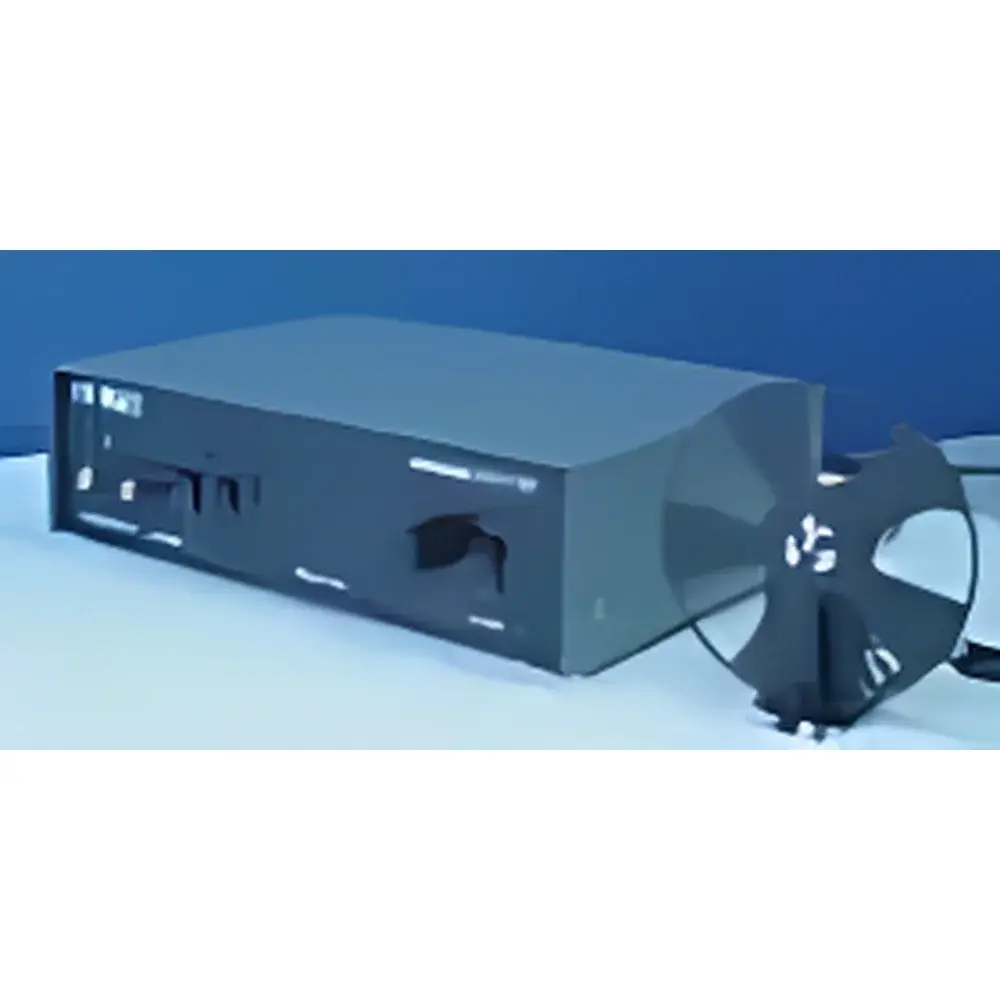
Stanford Research Systems SR540 Dual-Frequency Optical Chopper
| Brand | SRS/Stanford Research Systems |
|---|---|
| Model | SR540 |
| Frequency Range | 4 Hz to 3.7 kHz (inner slot: 4–400 Hz |
| outer slot | 400–3700 Hz) |
| Phase Stability | 0.2°–0.5° |
| Frequency Accuracy | <2% |
| Output Signal | 5 V TTL (HCT-compatible), BNC |
| Control Interface | Front-panel thumbwheel + external 0–10 V analog input |
| Reference Output | Sync TTL pulse with adjustable phase offset |
| Blade Material | Chemically blackened, demagnetized brass |
| Blade Thickness | 0.5 mm |
| Diameter | 102 mm |
| Slot Configurations | Dual concentric slots (inner + outer) |
| Dimensions (Controller) | 216 × 89 × 343 mm |
| Weight (Controller) | 3.2 kg |
| Motor Life | >6000 hours |
| Compliance | CE, RoHS, FCC Class A |
Overview
The Stanford Research Systems SR540 Dual-Frequency Optical Chopper is a precision electromechanical instrument engineered for time-resolved optical modulation in demanding laboratory and industrial measurement environments. It operates on the principle of synchronous mechanical interruption of light beams using a rotating, multi-slot chopper wheel driven by a low-vibration, brushless DC motor. Unlike single-frequency choppers, the SR540 integrates two concentric sets of slots—inner and outer—enabling independent or coordinated modulation at two distinct frequencies within a single rotation cycle. This dual-frequency architecture is essential for advanced optical techniques including balanced detection, lock-in referenced differential spectroscopy, and dual-beam interferometry where reference and signal paths must be modulated at harmonically related or independently tunable rates. The device delivers high temporal fidelity through thermally stable frequency control, sub-degree phase repeatability, and minimal amplitude jitter—critical parameters for maintaining signal integrity in low-light or high-dynamic-range photometric systems.
Key Features
- Dual concentric slot geometry supports simultaneous modulation at two user-selectable frequencies (4–400 Hz inner; 400–3700 Hz outer), eliminating need for multiple choppers in ratio-metric or background-subtraction experiments
- High-stability analog frequency control with front-panel 10-turn potentiometer and external 0–10 V analog input (BNC), enabling seamless integration into automated test benches and feedback-controlled optical systems
- Phase-locked TTL reference output (5 V HCT logic, BNC) with adjustable phase offset ±180° in 0.1° increments—facilitating precise synchronization with lock-in amplifiers (e.g., SRS SR830, Zurich Instruments HF2LI) and pulsed laser drivers
- Chemically blackened, demagnetized brass chopper blades (0.5 mm thick, 102 mm diameter) minimize stray reflections, magnetic interference, and thermal drift—ensuring long-term amplitude stability and compatibility with ultra-low-noise photodetectors
- Brushless DC motor with sintered sleeve bearings rated for >6000 hours MTBF; optimized for low mechanical noise and rotational wobble (<5 µm radial runout), critical for minimizing 1/f noise coupling into downstream electronics
- Front-panel 5-digit LED frequency display with selectable resolution (0.1 Hz or 1 Hz), calibrated against internal quartz oscillator (±50 ppm initial accuracy, ±0.01%/°C tempco)
Sample Compatibility & Compliance
The SR540 is designed for use with collimated or focused free-space optical beams up to Ø25 mm diameter. Its open-frame chopper head allows unobstructed beam access and straightforward alignment with lens tubes, fiber couplers, or vacuum feedthroughs. Blades are compatible with UV-VIS-NIR wavelengths (200–2500 nm) and exhibit negligible outgassing—making them suitable for UHV-compatible optical setups when paired with appropriate mounting hardware. The system complies with CE marking requirements for electromagnetic compatibility (EN 61326-1) and safety (EN 61010-1). It meets RoHS 2011/65/EU material restrictions and FCC Part 15 Class A emission limits for laboratory instrumentation. While not inherently 21 CFR Part 11 compliant, audit-ready operation is achievable via external logging of analog control voltage and frequency readout when integrated into GLP/GMP-validated workflows.
Software & Data Management
The SR540 operates as a standalone analog instrument with no embedded firmware or USB interface. However, its analog control input and TTL sync output enable full programmability via external DAQ systems (e.g., National Instruments PXI, Keysight 34972A) or microcontroller platforms (Arduino, Raspberry Pi Pico). Frequency setpoint, reference phase, and real-time readback can be logged with timestamped metadata using standard SCPI-over-serial adapters (e.g., RS-232-to-USB) when paired with third-party chopper controllers. SRS provides comprehensive LabVIEW VIs and Python API examples (via PyVISA) for automated sweep sequences, closed-loop intensity stabilization, and multi-channel phase correlation analysis—supporting reproducible method transfer across R&D, QC, and production metrology labs.
Applications
- Dual-beam absorption and reflectance spectroscopy (e.g., FTIR background subtraction, ellipsometry)
- Lock-in amplified photothermal deflection measurements (PDS) and photoacoustic spectroscopy
- Time-resolved fluorescence lifetime imaging (FLIM) excitation gating
- Calibration of high-speed photodetectors and oscilloscopes using known modulation envelopes
- Modulation transfer function (MTF) characterization of optical coatings and thin-film stacks
- Stabilization of cavity-enhanced absorption spectrometers (CEAS) via synchronous pump-probe modulation
FAQ
Can the SR540 operate in true dual-frequency mode—i.e., modulating two separate beams at different frequencies simultaneously?
Yes. When used with a beam splitter and spatially separated optical paths, the inner and outer slots can independently modulate two co-aligned beams. The reference output can be configured to track either slot group, enabling independent lock-in detection per channel.
What is the maximum beam diameter supported without vignetting?
The open chopper head accommodates beams up to Ø25 mm. For optimal modulation depth (>99.9%), incident beam height should remain within ±12 mm vertical offset from the blade centerline.
Is phase drift compensated during extended temperature fluctuations?
No active compensation is implemented, but the quartz-referenced frequency generator exhibits ±0.01%/°C stability. For sub-arcminute phase-critical applications over >1 hr, ambient temperature stabilization (±0.5°C) is recommended.
Are replacement blades traceably calibrated?
SRS does not provide NIST-traceable calibration certificates for individual blades. However, slot geometry tolerances (±0.02 mm positional accuracy) and surface flatness (λ/10 @ 633 nm) are verified during manufacturing per ISO 10110-7.
Can the SR540 synchronize with femtosecond laser systems?
While not designed for direct optical triggering, its TTL reference output can serve as a master clock for delay generators (e.g., SRS DG645) to gate ultrafast laser pulses with <1 ns jitter relative to chopper phase zero-crossing.




