KH2PO4 Single Crystal (KDP Crystal) –合肥科晶 OEM, ASTM-Grade NLO Material
| Brand | Hefei Kejing |
|---|---|
| Origin | USA |
| Manufacturer Type | Authorized Distributor |
| Origin Category | Imported |
| Model | KH2PO4 Single Crystal |
| Pricing | Upon Request |
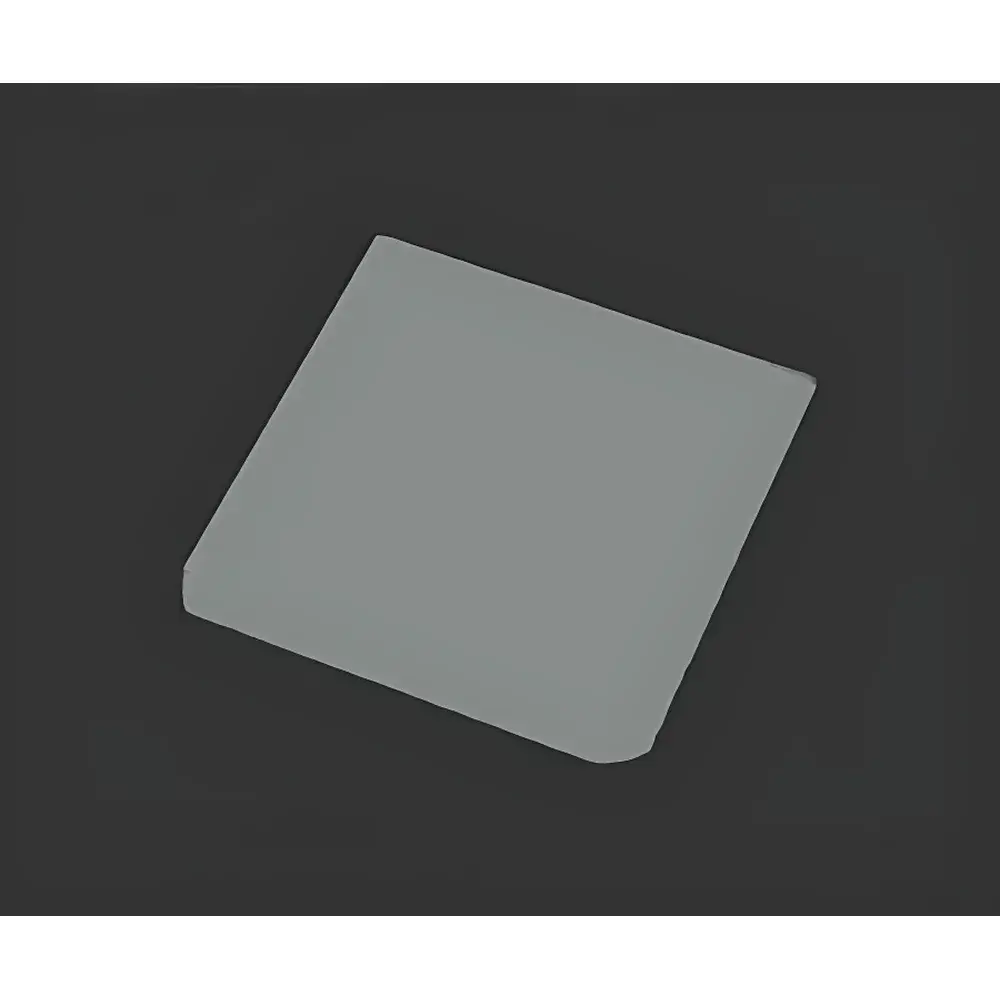
| Dimensions | <100> orientation, 10 × 10 × 0.9 mm |
| Surface Finish | Single-Polished |
| Packaging | Vacuum-sealed in Class 100 cleanroom bag, stored and shipped from Class 1000 cleanroom environment |
Overview
KH2PO4 (monopotassium phosphate), commonly referred to as KDP, is a benchmark non-linear optical (NLO) crystal widely employed in high-precision photonic applications requiring efficient frequency conversion and electro-optic modulation. Engineered for phase-matching stability and low optical absorption across the deep ultraviolet (DUV) to near-infrared (NIR) spectrum (180 nm–1.5 µm), KDP exhibits excellent transparency, high laser-induced damage threshold (LIDT), and well-characterized birefringence. This particular batch is grown via the temperature-lowering solution method under controlled supersaturation conditions and meets ASTM F2632–21 specifications for optical-grade NLO crystals. Its orientation enables type-I critical phase matching for second-harmonic generation (SHG) of Nd:YAG lasers (1064 nm → 532 nm) and supports Pockels cell operation in Q-switched laser systems.
Key Features
- Crystallographic orientation certified as ± 0.5°, verified by X-ray Laue diffraction and confirmed with full orientation report
- Single-polished surface (RMS roughness ≤ 5 Å) on the entrance face; unpolished exit face optimized for anti-reflection coating adhesion
- Optical homogeneity Δn ≤ 2 × 10⁻⁶ over full aperture, measured via interferometric fringe analysis at 632.8 nm
- Extinction ratio > 30 dB at 532 nm, ensuring minimal depolarization in modulator configurations
- Low wavefront distortion (< λ/8 @ 633 nm over 10 mm clear aperture), validated per ISO 10110-5
- Controlled stoichiometry (K:H:P:O = 1:2:1:4 ± 0.3% atomic) confirmed by ICP-MS and Raman spectroscopy
Sample Compatibility & Compliance
This KDP crystal is compatible with standard optomechanical mounts (e.g., Thorlabs KM100, Newport U-CR series) and integrates seamlessly into commercial SHG modules, electro-optic cavities, and pulse pickers. It complies with material traceability requirements outlined in ISO 9001:2015 Clause 8.5.2 and supports GLP-compliant documentation packages including Certificate of Conformance (CoC), spectral transmission data (200–1600 nm), and LIDT test reports (≥ 1 GW/cm², 10 ns, 1064 nm, 10 Hz). While not inherently FDA-regulated, its manufacturing and packaging adhere to cleanroom protocols aligned with ISO 14644-1 Class 5 (Class 100) for surface particulate control — essential for UV-grade optics handling.
Software & Data Management
No embedded firmware or proprietary software is associated with this passive optical component. However, full metrological data—including orientation maps, interferograms, transmission spectra, and LIDT histograms—is delivered in standardized formats (CSV, TIFF, PDF) compliant with 21 CFR Part 11 audit trail requirements when requested. Customers may import spectral and phase-matching data directly into commercial ray-tracing tools (Zemax OpticStudio, Synopsys CODE V) or NLO simulation platforms (SNLO, MATLAB-based Sellmeier solvers) using provided refractive index coefficients (no, ne) and temperature-dependent dispersion models per Boyd–Kleinman formalism.
Applications
- Second-harmonic generation (SHG) in picosecond and nanosecond Nd:YAG and Nd:YLF laser systems
- Electro-optic Q-switching in solid-state laser cavities (e.g., Ti:sapphire, fiber-integrated amplifiers)
- Polarization rotation and amplitude modulation in free-space and integrated photonic testbeds
- Reference standard for calibration of UV-VIS spectrophotometers and ellipsometers
- Substrate for epitaxial growth of ferroelectric thin films (e.g., LiNbO3, BaTiO3) requiring lattice-matched templates
FAQ
Is this crystal AR-coated?
No — this is an uncoated, single-polished KDP blank. Anti-reflection coatings (e.g., MgF2, HfO2/SiO2 multilayer) can be applied upon request per custom specification.
What is the maximum operating temperature?
KDP exhibits reversible ferroelectric-to-paraelectric transition at Tc ≈ 125 °C; continuous operation above 80 °C is not recommended due to increased hygroscopicity and thermal birefringence drift.
Can I obtain full traceability documentation?
Yes — CoC, raw growth log excerpts, orientation verification report, and spectral transmission data are included in the shipment dossier.
Is this crystal suitable for UV femtosecond applications?
Yes, provided pulse energy density remains below 0.1 J/cm² (for τ < 100 fs, 800 nm); group velocity mismatch must be compensated in collinear OPA configurations.
Do you offer custom orientations or thicknesses?
Yes — standard offerings include , , and ; thicknesses from 0.3 mm to 20 mm are available with lead times of 6–10 weeks.