
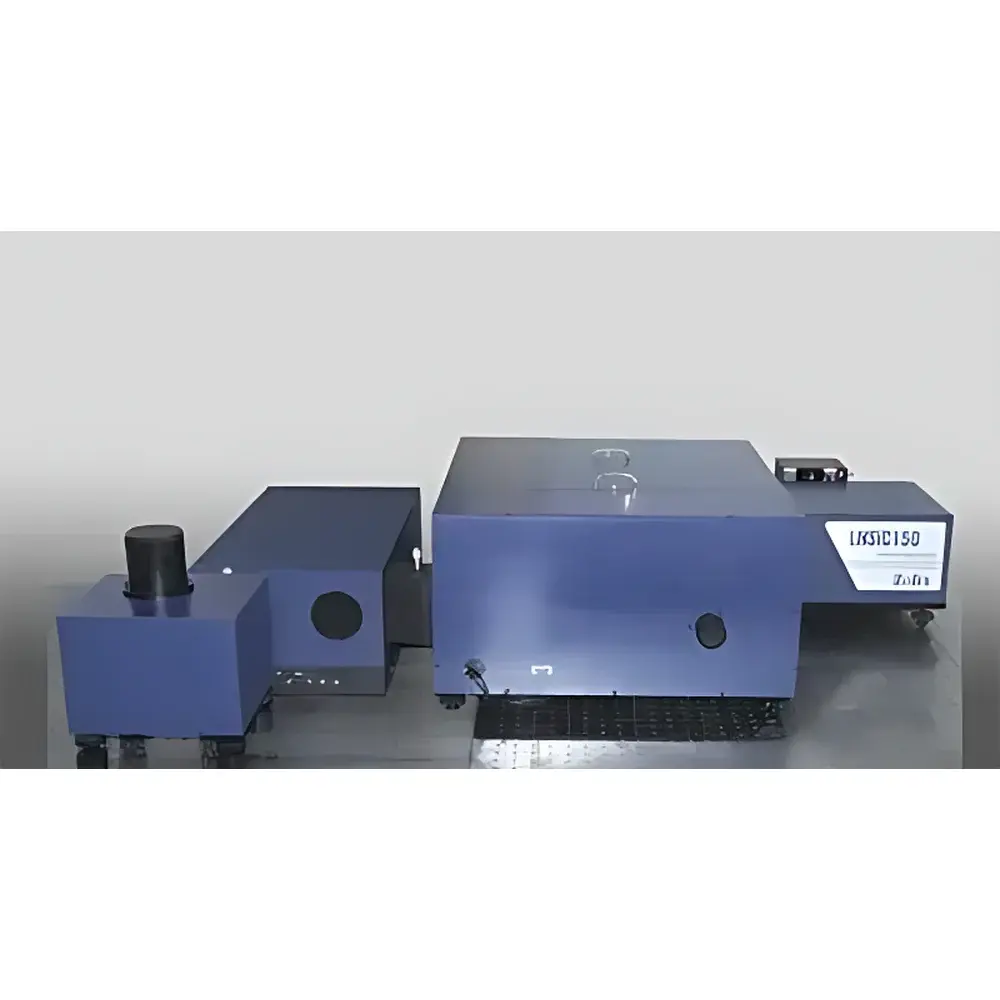
ZOLIX ZLX-AS Time-Resolved Infrared Absorption Spectroscopy System
| Brand | ZOLIX |
|---|---|
| Model | ZLX-AS |
| Detector Options | MCT (2–10 µm), InSb (1–5.5 µm) |
| Time Resolution | <50 ns (MCT), <25 ns (InSb) |
| IR Source | SiC blackbody emitter (1–16 µm) |
| Optical Collection | Gold-coated reflective optics |
| Dual-Function Source | Simultaneous spectral illumination and sample heating |
| Measurement Modes | Continuous-transmission absorption spectroscopy & time-resolved IR transient spectroscopy |
| Origin | Beijing, China |
| Manufacturer Type | Original Equipment Manufacturer (OEM) |
Overview
The ZOLIX ZLX-AS Time-Resolved Infrared Absorption Spectroscopy System is an engineered platform for ultrafast mid-infrared transient absorption measurements in condensed-phase and gas-phase chemical systems. Based on pump-probe Fourier-transform or dispersive grating spectroscopy architecture—depending on configuration—the system delivers synchronized nanosecond-scale temporal resolution with broad spectral coverage across the mid-IR fingerprint region. It employs a high-stability silicon carbide (SiC) blackbody emitter (1–16 µm) as both broadband thermal radiation source and controllable sample heater, enabling correlative thermal activation and spectroscopic interrogation within a single optical path. The system supports dual-detector interchangeability: mercury cadmium telluride (MCT) for extended-range detection (2–10 µm) and indium antimonide (InSb) for higher-speed response (1–5.5 µm, <25 ns time resolution). Its all-reflective, gold-coated optical train maximizes throughput in the IR domain while minimizing chromatic aberration and thermal drift—critical for reproducible kinetic trace acquisition under variable temperature or photoexcitation conditions.
Key Features
- Configurable detector modules: MCT (2–10 µm, <50 ns time resolution) and InSb (1–5.5 µm, <25 ns time resolution) for application-specific spectral-temporal trade-offs
- Integrated SiC infrared source (1–16 µm) with stable radiance output and programmable temperature control (up to 1500 K), serving simultaneously as illumination source and localized sample heater
- All-reflective optical design featuring high-efficiency gold-coated mirrors and off-axis parabolic collection optics to preserve signal fidelity and minimize water vapor absorption artifacts
- Modular beam path architecture supporting both continuous-wave transmission absorption and time-gated transient absorption modes via synchronized chopper/pulse delay electronics
- Motorized grating monochromator with selectable groove density and exit slit control, enabling spectral bandwidth tuning from 1 to 25 cm⁻¹ (FWHM) depending on detector and resolution requirements
- Rugged, vibration-isolated optical bench compatible with glovebox integration or vacuum-compatible enclosures for air-sensitive or low-pressure experiments
Sample Compatibility & Compliance
The ZLX-AS accommodates solid films (e.g., polymer blends, thin-film semiconductors), liquid cells (CaF₂ or BaF₂ windows, path lengths 10–500 µm), and gas-phase samples in static or flow-through cells. Sample stages support temperature control (−196 °C to +300 °C) and electrical biasing for in situ electrochemical IR studies. All optical components comply with ISO 10110 surface quality standards; detector housings meet IEC 61000-6-3 EMC emission limits. The system architecture permits alignment with GLP-compliant documentation workflows, including hardware timestamping of acquisition triggers and detector dark-signal logging for audit-ready data provenance. While not pre-certified for FDA 21 CFR Part 11, its software interface supports third-party electronic signature modules and full audit-trail export for regulated environments.
Software & Data Management
Control and analysis are performed via ZOLIX SpectraView™ v4.x—a Windows-based application supporting real-time spectral preview, multi-channel time-series averaging, and kinetic decay fitting using nonlinear least-squares algorithms (Levenberg-Marquardt). Raw interferograms or monochromator-scanned spectra are saved in HDF5 format with embedded metadata (wavenumber calibration, detector gain, source temperature, chopper frequency, delay stage position). Batch processing scripts (Python API included) enable automated baseline correction (Rubberband, Asymmetric Least Squares), second-derivative transformation, and principal component analysis (PCA) for reaction coordinate extraction. Data exports conform to ASTM E1421-22 standard spectral file structure for inter-laboratory exchange.
Applications
- Ultrafast photoinduced charge transfer kinetics in organic photovoltaic materials (e.g., PCBM/P3HT blends)
- Vibrational energy relaxation dynamics in metal carbonyl complexes following UV excitation
- Proton-coupled electron transfer (PCET) intermediates in catalytic water oxidation catalysts
- Thermally activated conformational changes in biopolymers (e.g., collagen denaturation, amyloid fibril formation)
- In situ monitoring of heterogeneous catalysis on supported metal oxides under reactive gas flow
- Time-resolved identification of short-lived radical species in plasma-assisted chemical synthesis
FAQ
What detector cooling options are available for the ZLX-AS?
MCT detectors require liquid nitrogen (77 K) or Stirling-cycle cryocooling; InSb detectors operate at 77 K only. Integrated dewar interfaces support both LN₂ fill ports and closed-cycle compressor connections.
Can the SiC source be modulated at frequencies above 1 kHz?
Yes—the source driver supports square-wave modulation up to 5 kHz with <100 ns rise/fall times, enabling lock-in detection schemes for enhanced signal-to-noise in low-light transient experiments.
Is vacuum compatibility standard or optional?
Vacuum-rated optical housing and feedthroughs are available as factory-installed options (≤10⁻⁵ mbar); standard configuration operates at ambient pressure with purge gas ports for dry-air or N₂ purging.
Does the system support external laser pump synchronization?
Yes—TTL-compatible trigger inputs accept external pump laser sync signals (rise time <5 ns) with adjustable delay (0–10 ms, 10 ps resolution) via integrated digital delay generator.
What calibration standards are supplied with the instrument?
NIST-traceable polystyrene film (for wavenumber accuracy), certified blackbody reference source (for radiometric calibration), and CO/CO₂ gas cells (for line position validation in 2000–2400 cm⁻¹ range).






