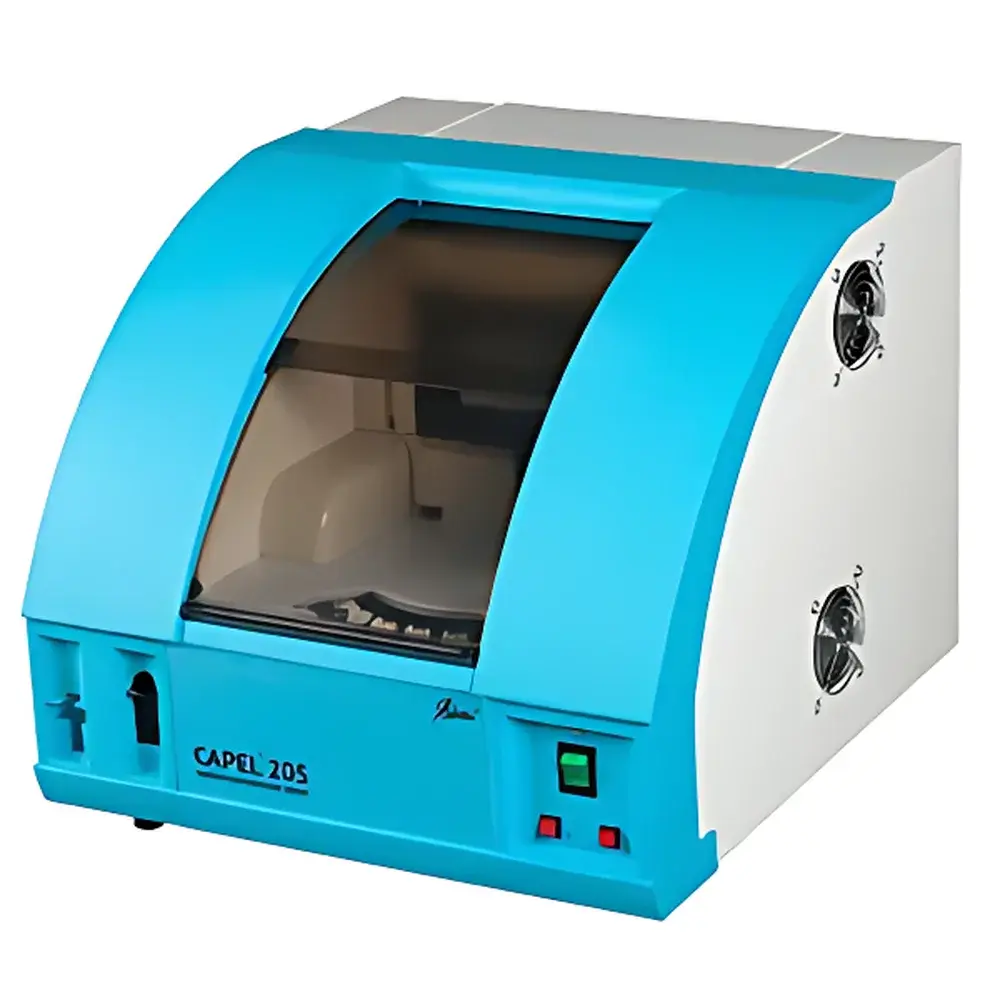
LUMEX Capel 205 High-Performance Capillary Electrophoresis System
| Brand | LUM |
|---|---|
| Origin | Canada |
| Manufacturer Type | Authorized Distributor |
| Instrument Category | Imported |
| Model | Capel 205 |
| Instrument Type | U-Tube Capillary Electrophoresis System |
| Primary Unit | Electrophoresis System with Integrated Separation Chamber |
| Capillary Dimensions | 30–120 cm length × 50 or 75 µm ID |
| Sample Capacity | 59-position autosampler (Eppendorf 2 mL tubes) |
| Voltage Range | ±30 kV (0.1 kV step, polarity auto-switching) |
| Current Range | 0–300 µA |
| Separation Power | Up to 9 W |
| Pressure Range | −100 to +2000 mbar (injection), 500–8000 mbar (flushing, 1 mbar step) |
| Detection Wavelength | 190–600 nm (Xenon lamp, ±1 nm accuracy) |
| Capillary Temperature Control | −10 °C to +65 °C (±0.1 °C stability, water-cooled) |
| Software | Elforun-205 (PC-based, GLP-compliant data acquisition & reporting) |
Overview
The LUMEX Capel 205 is a high-performance capillary electrophoresis (CE) system engineered for precision, reproducibility, and regulatory compliance in analytical laboratories across food safety, environmental monitoring, pharmaceutical development, and clinical research. Based on the fundamental principle of electrophoretic mobility—where analytes migrate under an applied electric field at velocities proportional to their charge-to-size ratio—the Capel 205 delivers rapid, high-resolution separations in fused-silica capillaries. Its U-tube configuration enables efficient thermal management and robust baseline stability, critical for quantitative analysis of complex matrices. Unlike conventional slab-gel or slab-capillary systems, the Capel 205 integrates capillary conditioning, injection, separation, detection, and data processing within a single, compact platform. Designed and assembled in Canada, it meets stringent international performance benchmarks while supporting method transfer across global laboratories.
Key Features
- Patented SPC (Surface Potential Control) technology actively restores the capillary wall’s electroosmotic potential prior to each injection—minimizing memory effects and enhancing migration time reproducibility (RSD < 0.5% over 50 runs).
- Integrated water-cooled capillary jacket with precise temperature regulation (−10 °C to +65 °C, ±0.1 °C stability), eliminating thermal band broadening and enabling consistent resolution across ambient fluctuations.
- High-voltage module delivering ±30 kV (0.1 kV increments, automatic polarity reversal) and programmable current limiting (up to 300 µA), supporting both high-efficiency separations and viscous or low-conductivity samples.
- 59-position autosampler using standard Eppendorf 2 mL tubes; full cap closure ensures vapor-tight sealing during unattended operation—preventing evaporation and cross-contamination.
- Reversible vacuum-assisted pressure injection (−100 to +2000 mbar) enables ultra-fast (<60 s) analyses and on-capillary sample stacking for sub-ppb detection limits.
- Modular capillary cartridge design allows rapid, tool-free replacement with pre-aligned optical path alignment—reducing downtime and operator dependency.
- Optimized dual-beam UV-Vis detection (190–600 nm, xenon lamp source, ±1 nm wavelength accuracy) coupled with low-noise photodiode array ensures high sensitivity and spectral fidelity for peak identification and purity assessment.
Sample Compatibility & Compliance
The Capel 205 supports diverse separation modes—including capillary zone electrophoresis (CZE), micellar electrokinetic chromatography (MEKC), capillary isoelectric focusing (CIEF), and capillary gel electrophoresis (CGE)—enabling analysis of ions, small molecules, peptides, proteins, and chiral compounds. It is validated for use with aqueous, organic-aqueous, and buffered matrices across pH 2–12. The system complies with method requirements specified in EPA Method 6500 (anion analysis in drinking water), ASTM D6508-00 / D7881 / D7882 (industrial water and wastewater), ISO 11290-2 (microbial toxin screening), OIV Resolution OENO 439A-2021 (wine cation/anion profiling), and GB/T 30921.1–2014 (Chinese national standard for food additive testing). All hardware and software components are designed to support GLP/GMP environments, including full audit trail logging, electronic signatures (per FDA 21 CFR Part 11), and instrument qualification documentation packages.
Software & Data Management
Elforun-205 is a Windows-based, CE-dedicated control and analysis suite compliant with ISO/IEC 17025 and ICH M10 guidelines. It provides real-time visualization of voltage, current, pressure, temperature, and absorbance profiles during run execution. Automated method templates cover >120 pre-validated applications—from nitrate in groundwater to amino acids in infant formula—each including optimized buffer composition, voltage ramping, detection wavelength, and integration parameters. Data export supports CSV, ASCII, and AIA (.cdf) formats for LIMS integration. Customizable report generation includes chromatogram overlays, calibration curves with weighting options, system suitability metrics (plate count, tailing factor, resolution), and pass/fail flags against user-defined acceptance criteria. All raw data, method files, and audit logs are digitally signed and stored with immutable timestamps.
Applications
The Capel 205 serves as a primary analytical platform in regulated and research-intensive settings. In food & beverage labs, it quantifies preservatives (sorbates, benzoates), sweeteners (aspartame, sucralose), organic acids (citric, malic), cations (Na⁺, K⁺, Ca²⁺), anions (NO₃⁻, SO₄²⁻, F⁻), and contaminants (melamine, glyphosate metabolites) in beverages, dairy, wine, and infant formula. Environmental laboratories deploy it for EPA-compliant anion/cation speciation in surface water, leachates, and soil extracts—with demonstrated linearity down to 0.5 µg/L for fluoride and chloride. In pharmaceutical QA/QC, it resolves enantiomers (e.g., ibuprofen, warfarin), monitors degradation products in stability studies, and performs CIEF-based charge variant profiling of monoclonal antibodies. Forensic toxicology labs utilize its high-speed MEKC mode for rapid screening of amphetamines, opioids, and explosives residues (e.g., nitroglycerin, RDX) in swab extracts.
FAQ
Does the Capel 205 support method validation per ICH Q2(R2)?
Yes—Elforun-205 includes built-in tools for specificity, linearity, accuracy, precision, LOD/LOQ, and robustness assessment, with automated calculation of uncertainty budgets per EURACHEM/CITAC guidelines.
Can the system be integrated into a laboratory information management system (LIMS)?
Yes—via standardized ODBC and ASCII file export protocols; optional API interface available for direct bidirectional communication with major LIMS vendors.
Is capillary conditioning automated?
Yes—SPC-driven equilibration, combined with programmable pressure/voltage rinsing sequences (500–8000 mbar, ±30 kV), ensures consistent capillary surface regeneration between runs.
What maintenance is required for long-term operational stability?
Routine tasks include quarterly optical alignment verification, annual high-voltage module calibration, and biannual pump seal inspection—documented in the included Preventive Maintenance Logbook.
Are application notes and SOPs provided for regulated environments?
Yes—LUMEX supplies validated SOPs aligned with USP <621>, EP 2.2.46, and ISO 10576-1, plus method transfer kits for inter-laboratory harmonization.