
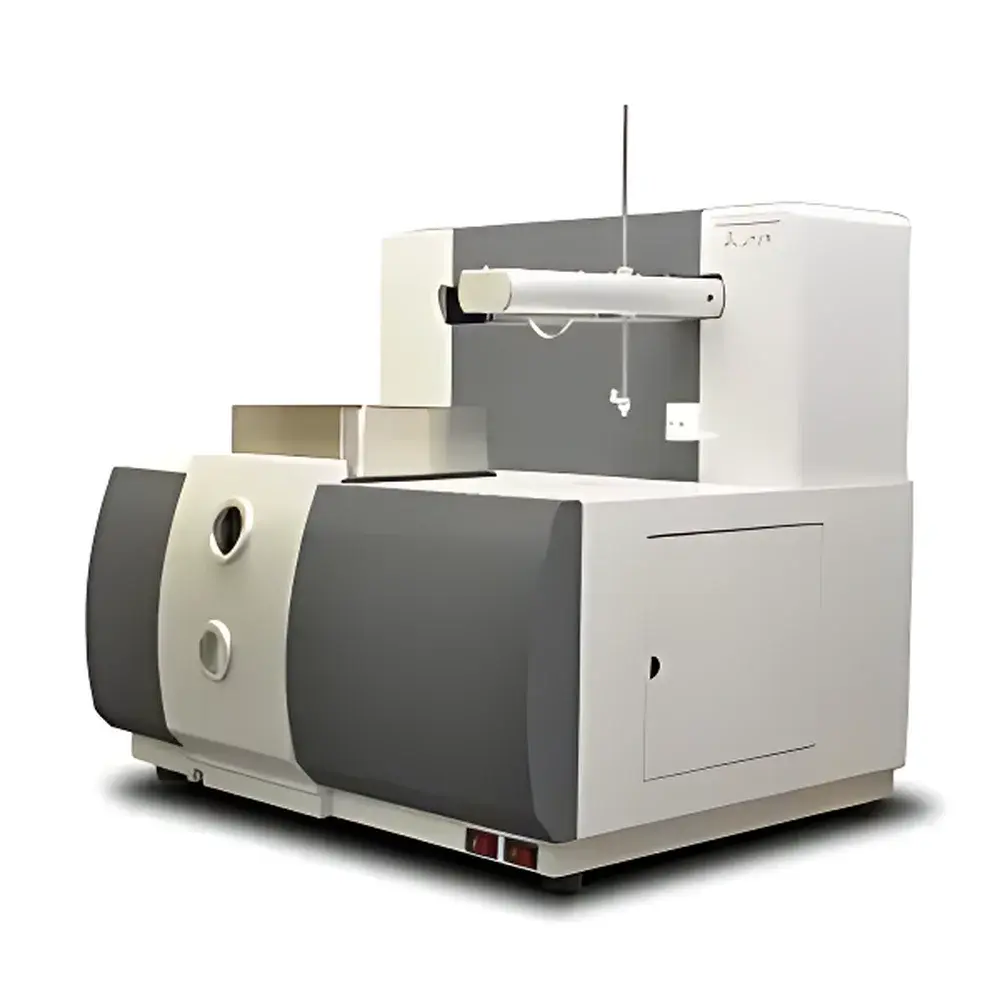
Aurora 1200 Plus Flame and Transverse Heated Graphite Furnace Atomic Absorption Spectrometer
| Brand | Aurora |
|---|---|
| Origin | USA |
| Model | 1200 Plus |
| Instrument Type | Flame and Graphite Furnace AAS |
| Monochromator | Concave Grating |
| Optical System | Double-Beam |
| Detector | Photomultiplier Tube (PMT) |
| Background Correction | Zeeman and D₂ Lamp (1 kHz, Smith-Hieftje mode) |
| Wavelength Range | 185–900 nm |
| Atomizer Temperature Range (GFAAS) | Room Temperature to 3000 °C (programmable) |
| Heating Rate (GFAAS) | Up to 3800 K/s |
| Auto-sampler | Optional XYZ Robotic Sampler with On-line Pre-concentration (up to 100×) |
| Lamp Mount | 6-position Rotating Lamp Tower (4 standard + 2 high-intensity lamp power supplies) |
| Software Compliance | FDA 21 CFR Part 11–ready audit trail, electronic signature support, GLP/GMP data integrity features |
Overview
The Aurora 1200 Plus is a dual-mode atomic absorption spectrometer engineered for trace elemental analysis across demanding laboratory environments. It integrates flame atomic absorption spectroscopy (FAAS) and transverse-heated graphite furnace atomic absorption spectroscopy (TH-GFAAS) into a single, unified platform—enabling seamless switching between high-throughput routine analysis and ultra-trace quantification down to sub-pg/mL levels. The instrument employs a Czerny-Turner (C-T) optical configuration with a concave holographic grating monochromator, delivering consistent spectral resolution across the full operational range of 185–900 nm. Its double-beam optical design compensates for source drift and lamp intensity fluctuations in real time, ensuring long-term baseline stability and measurement reproducibility. Background correction is implemented via two complementary methods: high-speed (1 kHz) deuterium-lamp correction with Smith-Hieftje modulation for broad-band interference, and precision Zeeman-effect correction for structured background arising from molecular absorption or scattering—particularly critical in complex matrices such as biological digests or environmental slurries.
Key Features
- Transverse-heated graphite furnace with integrated thermocouple stack temperature monitoring and programmable ramping up to 3000 °C; heating rates exceed 3800 K/s for rapid thermal stabilization and minimized analyte loss.
- Patented all-reflective optical path minimizes chromatic aberration and maintains peak resolution across UV–VIS–NIR wavelengths without refractive element degradation.
- 6-position rotating hollow cathode lamp turret with automatic lamp selection, positional calibration, and dual power supply architecture—supporting both standard and high-intensity lamps for optimal signal-to-noise in volatile or refractory elements.
- Modular XYZ robotic autosampler compatible with standard 12 × 75 mm or 16 × 100 mm tubes; enables on-line pre-concentration (up to 100×), matrix-matched calibration, and automated dilution protocols.
- Real-time furnace visualization system with integrated CCD imaging—provides direct observation of sample deposition, drying, pyrolysis, and atomization stages for method development and troubleshooting.
- Flame system equipped with corrosion-resistant nebulizer and PTFE-coated spray chamber—compatible with acidic, alkaline, and organic solvent-based samples without performance compromise.
Sample Compatibility & Compliance
The Aurora 1200 Plus accommodates liquid samples across diverse physicochemical profiles—including aqueous standards, acid-digested environmental solids, enzymatically hydrolyzed biological tissues, and petroleum distillates. Its flame and graphite furnace modules comply with internationally recognized analytical standards including ASTM D1688 (copper in fuel oils), ISO 11885 (water quality—determination of metals), USP and (elemental impurities in pharmaceuticals), and EPA Methods 200.7, 200.9, and 7000B. All hardware and firmware components meet IEC 61326-1 electromagnetic compatibility requirements. Software architecture supports full 21 CFR Part 11 compliance, featuring role-based access control, electronic signatures, immutable audit trails, and secure data archiving—validated for use in GLP and GMP-regulated laboratories.
Software & Data Management
Control and data acquisition are managed through Aurora AA Pro™—a Windows-native application built on a modular, event-driven framework. The interface utilizes intuitive toolbar navigation and context-sensitive parameter wizards, reducing operator training time without sacrificing analytical flexibility. Quantitative workflows support multi-point calibration (linear, quadratic, cubic), bracketed standards, and internal standardization. Peak integration offers configurable options: peak height, peak area, or derivative-based detection—each with adjustable baseline algorithms and noise filtering. All raw spectra, method files, and result sets are stored in a relational SQLite database with timestamped metadata. Export formats include CSV, PDF reports, and native Excel (.xlsx) with embedded formatting and statistical summaries (RSD%, recovery %, LOD/LOQ calculations). Data export and report generation are fully scriptable via COM automation for LIMS integration.
Applications
The Aurora 1200 Plus serves as a primary elemental analyzer in environmental monitoring labs performing heavy metal screening in soil leachates and wastewater effluents; clinical and toxicology units quantifying Pb, Cd, As, and Hg in whole blood and urine; food safety programs verifying nutrient fortification (e.g., Fe, Zn, Cu) and contaminant limits (e.g., Ni in infant formula); and metallurgical QA/QC departments validating alloy composition and surface contamination in aerospace-grade alloys. Its hydride/vapor generation module interfaces directly with external HG-AAS systems, extending detection capability for As, Se, Sb, Bi, Te, and Sn at sub-ng/L levels—making it suitable for regulatory testing under EU Directive 2023/2002 and China’s GB 5009.11–2014.
FAQ
What atomization modes does the Aurora 1200 Plus support?
It operates in both flame (FAAS) and transverse-heated graphite furnace (TH-GFAAS) modes, with software-controlled automatic switching between them.
Is the instrument compliant with FDA 21 CFR Part 11?
Yes—the AA Pro™ software includes electronic signature validation, audit trail logging, user access tiers, and data integrity safeguards aligned with Part 11 requirements.
Can the system perform on-line sample pre-concentration?
Yes—when equipped with the optional XYZ autosampler, it supports automated, programmable pre-concentration up to 100-fold prior to GFAAS injection.
What background correction methods are available?
Dual-mode correction: Zeeman-effect (for structured background) and high-frequency (1 kHz) deuterium-lamp Smith-Hieftje correction (for broadband absorption).
Does the software support multi-element sequential analysis?
No—AAS is inherently single-element per lamp; however, the 6-lamp turret allows rapid sequential analysis of up to six elements within one run using pre-configured method sequences.




