
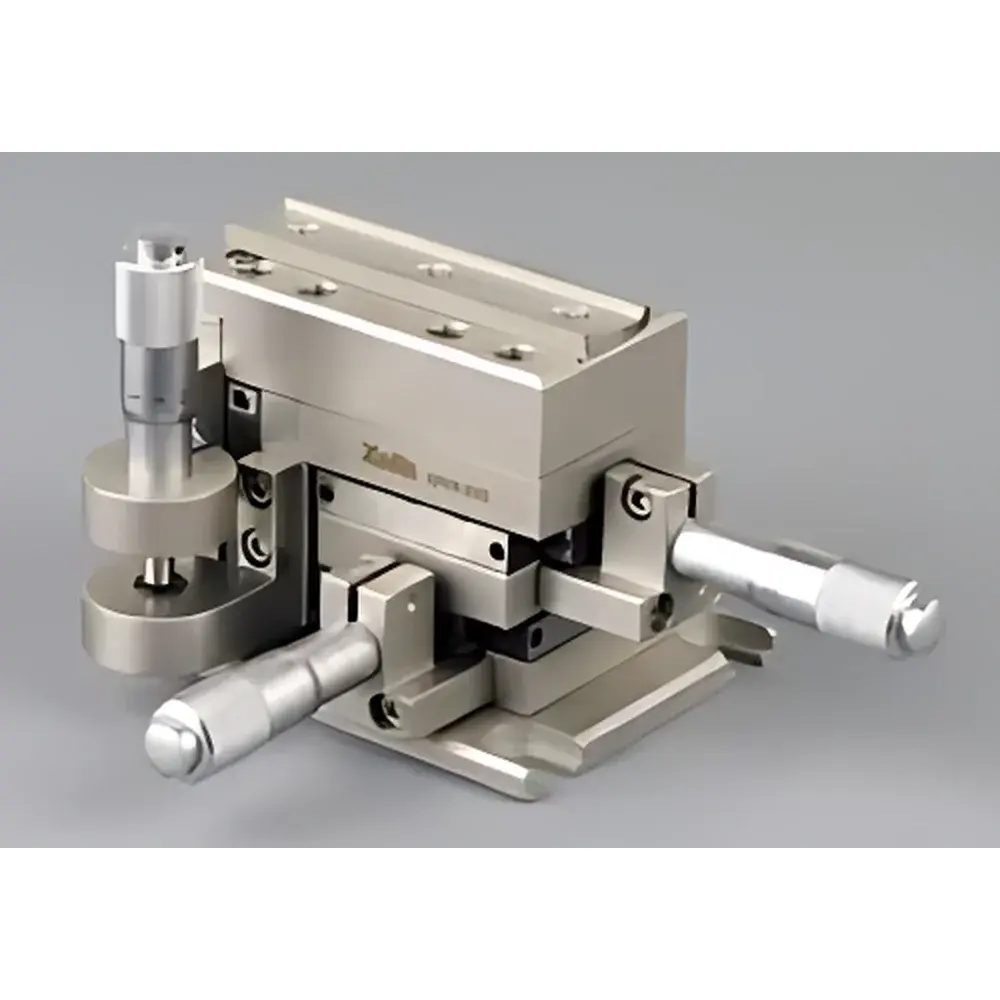
APFP-XYZ Three-Axis Fiber Positioning Mount
| Brand | ZOLIX |
|---|---|
| Origin | Beijing, China |
| Manufacturer Type | Direct Manufacturer |
| Country of Origin | China |
| Model | APFP-XYZ |
| Pricing | Upon Request |
| Translation Range (X) | 12 mm |
| Translation Range (Y) | 12 mm |
| Translation Range (Z) | 6 mm |
| Tilt Error (Pitch/Yaw) | < 100 µrad |
| Load Capacity | 2.3 kg |
| Optical Axis Height | 79 mm |
Overview
The APFP-XYZ Three-Axis Fiber Positioning Mount is a precision mechanical stage engineered for high-stability alignment of single-mode and multimode optical fibers in free-space coupling, fiber-to-fiber interconnection, and fiber-to-device integration applications. Designed using a kinematic, over-constrained dovetail slide architecture, it enables independent, orthogonal translation along the X, Y, and Z axes with sub-microradian angular stability—critical for maintaining mode field overlap and minimizing insertion loss in demanding photonic assembly workflows. Unlike generic translation stages, the APFP-XYZ integrates a dedicated fiber-mounting interface compatible with standard SM/PM fiber ferrules (e.g., FC/PC, FC/APC) and modular optical carriers, ensuring repeatable positioning without introducing parasitic tilt or lateral shear during adjustment. Its rigid aluminum alloy body and hardened stainless steel lead screws provide long-term dimensional stability under laboratory thermal gradients and mechanical vibration typical in optics cleanrooms and R&D environments.
Key Features
- Three independent linear axes (X, Y, Z) with calibrated micrometer drives offering 12 mm travel in X and Y, and 6 mm in Z—each with engraved scale divisions and lockable knurled knobs for coarse and fine positioning.
- Dovetail mounting platform on top surface accepts standard optical carrier plates (e.g., Ø1″, Ø25 mm), lens mounts, and custom fiber adapters; dual-threaded M4 and M6 tapped holes enable secure fastening of auxiliary fixtures.
- Angular stability characterized by < 100 µrad total tilt (pitch + yaw) across full travel range—verified via autocollimator measurement per ISO 10110-7—ensuring minimal beam deviation during iterative alignment procedures.
- Rated static load capacity of 2.3 kg distributed evenly across the mounting surface; optimized moment arm design prevents sagging or hysteresis when supporting fiber collimators, isolators, or compact interferometric modules.
- Optical axis height fixed at 79 mm above base mounting surface—compatible with industry-standard optical tables (e.g., Thorlabs, Newport) and facilitates co-alignment with other components in multi-stage optical benches.
- Left-hand variant (APFP-XYZL) available for mirrored optical layouts requiring reversed actuation directionality—identical metrological performance and mechanical interface.
Sample Compatibility & Compliance
The APFP-XYZ is mechanically agnostic to fiber type or connectorization, supporting SMF-28, PM1550, HI1060, and specialty fibers mounted in ceramic or metal ferrules. It complies with mechanical interface standards defined in ISO 10110-1 (optical element drawing notation) and adheres to RoHS 2011/65/EU material restrictions. While not an electronic instrument, its construction supports GLP-aligned lab documentation protocols: each unit carries a unique serial number laser-etched on the base plate, enabling traceable calibration history and asset management in regulated photonics manufacturing facilities.
Software & Data Management
As a manually operated mechanical stage, the APFP-XYZ does not incorporate embedded electronics, firmware, or software drivers. However, it is fully compatible with third-party motorized upgrade kits (e.g., ZOLIX’s APFP-XYZ-M series with stepper motor integration), which support ASCII command sets over RS-232/USB and are programmable via Python, LabVIEW, or MATLAB APIs. When used in automated systems, position logs, actuation timestamps, and environmental metadata can be recorded in accordance with FDA 21 CFR Part 11 requirements using validated data acquisition platforms.
Applications
- Precision alignment of fiber pigtails to laser diodes, photodetectors, and modulators during hybrid photonic packaging.
- Active/passive alignment in fiber-optic sensor head assembly (e.g., Fabry–Pérot, FBG, and interferometric configurations).
- Beam steering and collimation optimization in free-space quantum optics experiments involving entangled photon sources.
- Calibration setup for optical power meters and spectral analyzers where fiber input repeatability directly impacts measurement uncertainty budgets.
- Integration into automated wafer-level testing stations for silicon photonics PICs, where XYZ repeatability ≤ ±0.5 µm is required between probe cycles.
FAQ
Is the APFP-XYZ compatible with vacuum environments?
No—the stage uses lubricated brass-on-steel leadscrews and elastomeric knob seals not rated for UHV or HV conditions. For vacuum-compatible alternatives, consult ZOLIX’s APFP-V series with dry-film lubrication and vented housing.
Can I mount a fiber collimator directly onto the dovetail platform?
Yes—standard Ø25 mm fiber collimators with M4 or M6 base threads mount securely; ensure center-of-mass remains within the 2.3 kg load limit and centered over the platform’s structural ribs.
What is the typical positional repeatability after multiple adjustment cycles?
Under controlled temperature (±0.5°C) and using recommended torque (0.15 N·m) on locking knobs, repeatability is ≤ ±1.2 µm in X/Y and ≤ ±0.8 µm in Z, verified per ISO 230-2 Annex B test procedures.
Does ZOLIX provide calibration certificates with this product?
Standard delivery includes a factory verification report listing measured travel ranges, tilt error, and load test results. NIST-traceable calibration certificates are available as an optional service upon order.
How do I distinguish between APFP-XYZ and APFP-XYZL models during installation?
The left-hand variant (APFP-XYZL) features counter-clockwise-increase labeling on all three micrometer dials and reversed dovetail orientation—confirm orientation by checking the “L” engraving adjacent to the Z-axis knob.




