
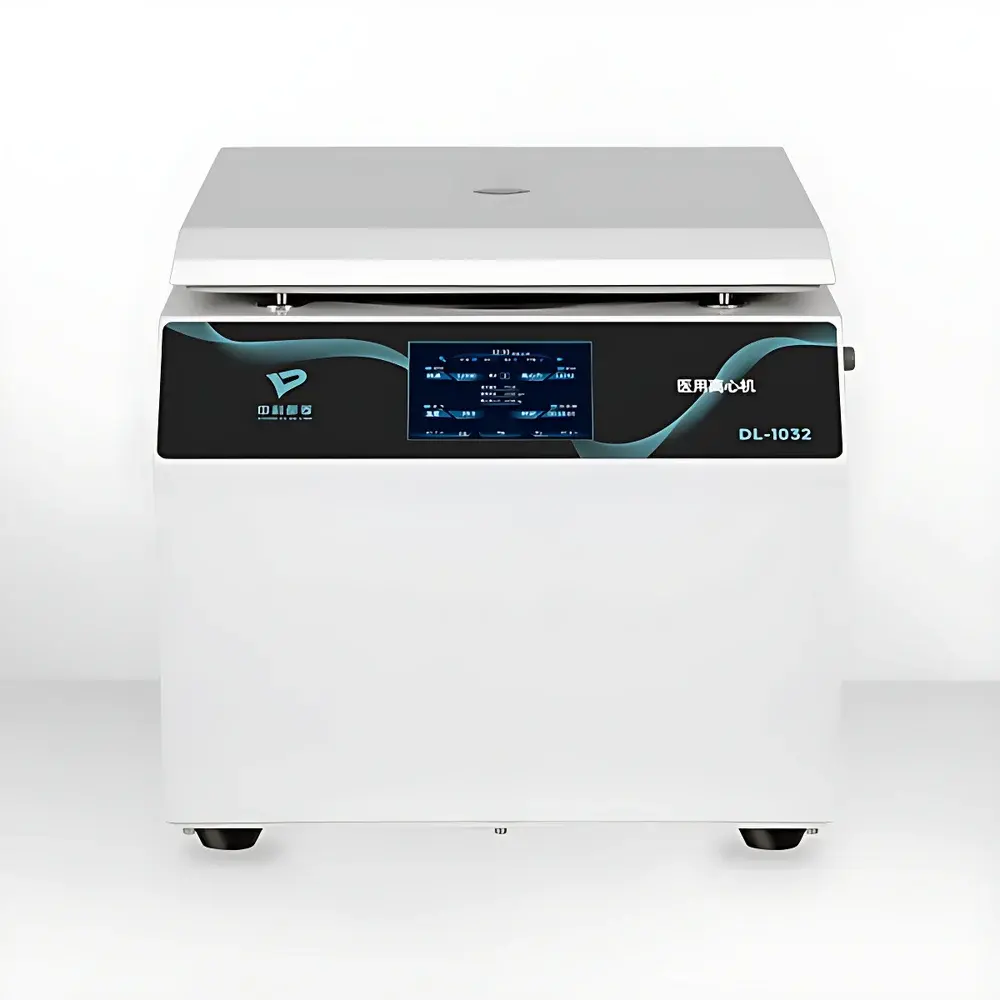
Duling DL-1032 Benchtop Low-Speed Centrifuge
| Brand | Duling |
|---|---|
| Origin | Anhui, China |
| Manufacturer Type | Authorized Distributor |
| Product Category | Domestic |
| Model | DL-1032 |
| Instrument Type | Benchtop Centrifuge |
| Speed Range | 0–6000 rpm |
| Max RCF | 5037 × g |
| Max Capacity | 5 × 96 mL (horizontal rotor) |
| Dimensions (L×W×H) | 515 × 425 × 420 mm |
| Drive System | Maintenance-Free AC Variable-Frequency Motor |
| Control Interface | Microprocessor-Based Touch Panel with Dual LED Display (RPM & RCF) |
| Safety Features | Dual Interlocked Lid Lock, Automatic Imbalance Detection & Audio Alert, Instant Short-Spin Mode, At-Set-RPM Timing Function |
| Construction | Dual-Layer Steel Housing with Corrosion-Resistant Coating on Centrifuge Chamber |
| Compliance | Designed for GLP-compliant laboratories |
Overview
The Duling DL-1032 is a microprocessor-controlled benchtop low-speed centrifuge engineered for routine separation tasks in clinical diagnostics, life science research, and quality control laboratories. It operates on the principle of sedimentation under controlled gravitational force (RCF), enabling efficient pelleting of cells, bacteria, subcellular organelles, and particulate matter from liquid suspensions. With a maximum rotational speed of 6000 rpm and an RCF ceiling of 5037 × g, the DL-1032 delivers consistent, reproducible separations without inducing excessive shear stress—critical for preserving sample integrity in sensitive applications such as blood fractionation, microbial harvesting, and foodborne pathogen isolation. Its AC variable-frequency motor eliminates carbon brushes, ensuring long-term torque stability, minimal thermal drift, and silent operation (<55 dB(A) at full load), making it suitable for shared lab environments including teaching facilities and QA/QC labs where acoustic comfort and reliability are essential.
Key Features
- Maintenance-free AC variable-frequency motor with precise speed regulation (±10 rpm accuracy across full range)
- Dual-parameter LED display showing real-time RPM and RCF values simultaneously
- Touch-sensitive control panel with dedicated RCF setting key and intuitive parameter navigation
- Dual interlocked lid safety system: automatic mechanical lock engagement upon rotor acceleration and fail-safe electronic release only after complete deceleration
- Intelligent imbalance detection algorithm that halts operation within 0.8 seconds upon detecting >3 mm radial displacement or mass asymmetry exceeding 5 g per bucket
- At-set-rpm timing function: initiates countdown only when target speed is reached, eliminating timing errors due to ramp-up lag
- Short-spin (pulse) mode for rapid, transient centrifugation without full program setup
- Corrosion-resistant epoxy-coated centrifuge chamber compatible with common disinfectants (e.g., 70% ethanol, 0.5% sodium hypochlorite) and mild acidic/basic reagents
- Automatic rotor recognition via embedded RFID tag (compatible with standard horizontal rotors for 15 mL, 50 mL, and 96-well plate carriers)
Sample Compatibility & Compliance
The DL-1032 accommodates a broad spectrum of primary sample formats—including conical tubes (15 mL, 50 mL), microcentrifuge tubes (1.5–2.0 mL), and standard 96-well plates—via interchangeable horizontal rotors. Its 5 × 96 mL capacity configuration supports high-throughput serum/plasma separation in clinical testing workflows. The instrument complies with IEC 61010-1:2010 safety standards for laboratory electrical equipment and meets electromagnetic compatibility requirements per EN 61326-1. While not certified for Class II biological safety containment, its sealed rotor design and corrosion-resistant chamber align with biosafety level 1 (BSL-1) and BSL-2 operational protocols when used with appropriate secondary containment. Data logging capabilities support traceability for ISO/IEC 17025-accredited testing laboratories and CLIA-regulated clinical labs.
Software & Data Management
The DL-1032 operates autonomously without external software but supports manual parameter archiving through built-in non-volatile memory (retains up to 99 user-defined protocols). Each protocol stores rotor type, speed, RCF, time, acceleration/deceleration profiles, and start timestamp. Optional RS-232 serial interface enables connection to LIMS or ELN systems for automated run log export (ASCII-delimited format), supporting FDA 21 CFR Part 11–aligned audit trails when paired with validated third-party middleware. All parameter changes during non-programmed operation are logged with timestamps, satisfying internal GLP documentation requirements for method deviation tracking.
Applications
- Clinical diagnostics: Serum, plasma, and urine sediment preparation for urinalysis and immunoassays
- Microbiology: Harvesting bacterial cultures (E. coli, S. aureus, B. subtilis) and yeast (S. cerevisiae) prior to DNA extraction or staining
- Food & agriculture testing: Separation of fat globules in milk homogenates, detection of adulterants in honey, and pathogen enrichment from produce wash water
- Environmental monitoring: Concentration of algae, protozoa, and suspended solids from wastewater or surface water samples
- Academic teaching: Demonstrating sedimentation kinetics, density gradient principles, and centrifugal force calculations in undergraduate biophysics and biochemistry labs
- Veterinary & aquaculture labs: Processing whole blood from avian, porcine, and piscine species for hematocrit determination and pathogen screening
FAQ
What rotor configurations are supported by the DL-1032?
The instrument accepts standard horizontal rotors rated for ≤6000 rpm and ≤5037 × g, including carriers for 5 × 96 mL bottles, 12 × 15 mL tubes, 8 × 50 mL tubes, and 2 × 96-well microplates.
Does the DL-1032 support temperature control?
No. The DL-1032 is a non-refrigerated model designed for ambient-temperature separations. For temperature-sensitive samples, users should pre-chill samples and rotors prior to loading.
Can I modify parameters mid-run?
Yes—during non-programmed operation, speed, time, and RCF can be adjusted in real time without stopping the rotor, provided the new settings remain within mechanical and safety limits.
Is rotor calibration required before first use?
No factory calibration is needed; however, users must verify rotor identification and confirm maximum load symmetry before initial operation. A balance verification procedure is included in the operator manual.
How does the imbalance protection system respond during operation?
Upon detecting mechanical imbalance exceeding preset thresholds, the unit triggers an audible alarm, displays “UNBAL” on the LED screen, and initiates immediate deceleration using regenerative braking—without requiring manual intervention.



