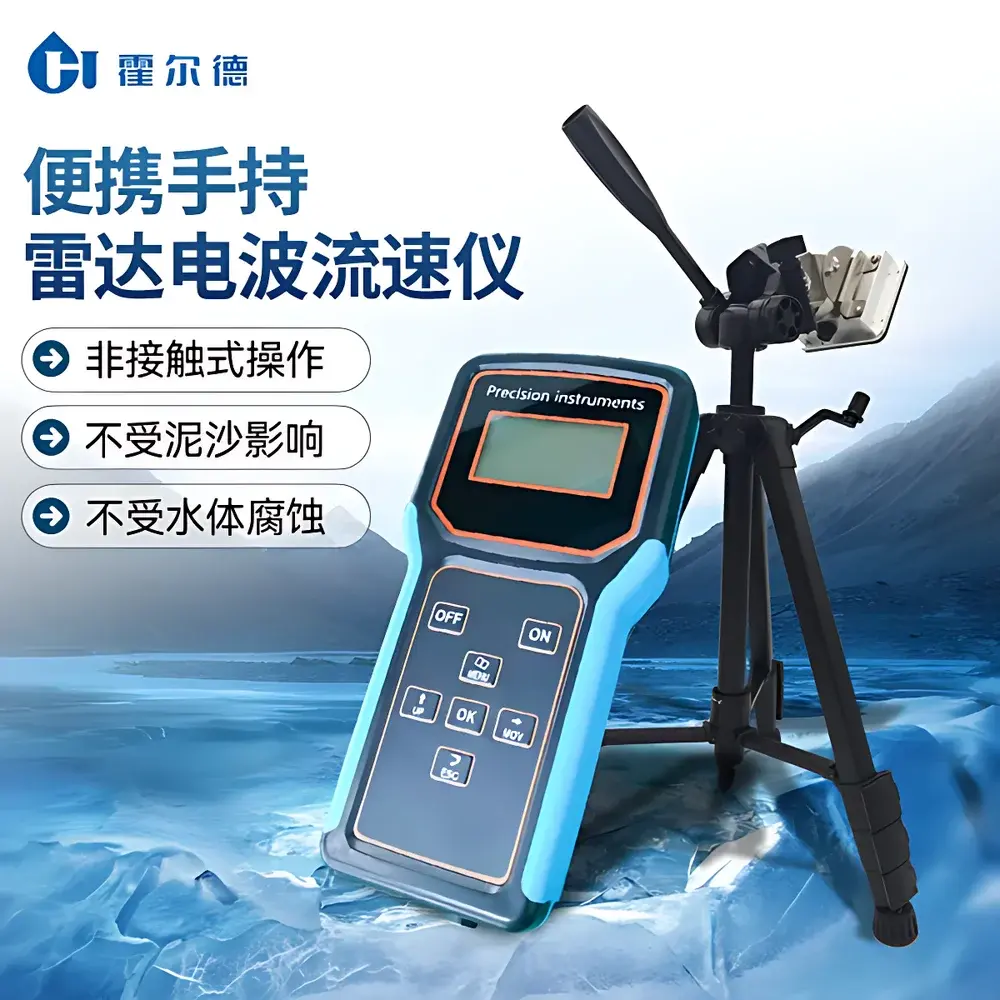
HORDE HD-BSDPL Radar-Based Surface Velocity Meter
| Brand | HORDE Electric |
|---|---|
| Model | HD-BSDPL |
| Measurement Principle | Continuous-wave (CW) Doppler radar at 24.000–24.250 GHz |
| Velocity Range | 0–30 m/s |
| Velocity Resolution | 0.001 m/s |
| Accuracy | ±1% of reading (for surface velocity) |
| Operating Distance | up to 30 m |
| Elevation Angle Compensation Range | 30°–70° |
| Azimuth & Pitch Auto-Correction | Enabled |
| Display | Color LCD with guided menu interface |
| Power Supply | Rechargeable Li-ion battery (DC 11.6 V), >10 h continuous operation |
| Operating Current | ≤120 mA @12 V (active), ≤1 mA @12 V (sleep) |
| Environmental Rating | IP65 (main unit), IP67 (radar sensor) |
| Operating Temperature | −40 °C to +60 °C |
| Output Options | RS485 (optional), 4–20 mA (optional), relay (optional), HART (optional), NB-IoT/GPRS/LoRa (optional) |
| Flow Computation | Manual water level input required |
| instantaneous flow range | 0–999,999,999 m³/h |
| cumulative flow range | 0–999,999,999 m³ |
Overview
The HORDE HD-BSDPL Radar-Based Surface Velocity Meter is a field-deployable, non-contact hydrometric instrument engineered for accurate, real-time measurement of surface water velocity in open channels, rivers, floodplains, and stormwater conveyances. It operates on the principle of continuous-wave (CW) Doppler radar at the industrial-scientific-medical (ISM) band of 24.000–24.250 GHz. Unlike intrusive mechanical or electromagnetic current meters, the HD-BSDPL detects motion-induced frequency shifts in reflected microwave energy from water surface scatterers (e.g., ripples, debris, foam), enabling robust velocity estimation without physical contact—critical in high-velocity, sediment-laden, or hazardous flow conditions where wading or submerged installation is unsafe or impractical.
Key Features
- Non-contact operation eliminates sensor fouling, corrosion, and mechanical wear—ideal for turbid, icy, or chemically aggressive water bodies.
- Integrated planar narrowband array radar sensor with 24° × 12° beam pattern ensures stable target acquisition across variable surface conditions.
- Real-time bidirectional velocity detection with automatic elevation and azimuth angle compensation (30°–70° range), minimizing cosine error during handheld or tripod-mounted deployment.
- High-resolution velocity output (0.001 m/s) with ±1% accuracy relative to measured surface speed, validated under ISO 748:2022 and ASTM D3858-21 guidelines for surface velocity estimation.
- Color LCD display with context-sensitive, icon-driven menu navigation supports rapid setup and field verification—no external tablet or PC required.
- Dual-power architecture: rechargeable Li-ion battery (>10 h runtime at full duty cycle) with multi-source charging (AC adapter, 12 V vehicle port, or portable power bank via USB-C).
Sample Compatibility & Compliance
The HD-BSDPL is designed for surface velocity profiling in natural and engineered open-channel flows—including gravel-bed rivers, concrete-lined canals, tidal estuaries, and urban drainage systems. Its non-intrusive methodology avoids flow disturbance and complies with USGS Techniques and Methods Report 3-A17 (2022) for radar-based discharge estimation. The instrument meets IP65 (electronics housing) and IP67 (radar transceiver) ingress protection ratings per IEC 60529, ensuring reliable performance in rain, dust, and temporary submersion scenarios. While not certified for regulatory-grade custody transfer, its output supports GLP-aligned field data collection when paired with documented water level inputs and site-specific calibration coefficients.
Software & Data Management
The embedded firmware implements FFT-based digital signal processing to isolate dominant Doppler spectral peaks and suppress noise from wind-blown vegetation or floating debris. Velocity data are timestamped and stored internally (non-volatile memory) with optional real-time telemetry via configurable communication modules: RS485 Modbus RTU, 4–20 mA analog output (HART-enabled), dry-contact relay alarms, or low-power wide-area network (LPWAN) protocols including NB-IoT, GPRS, and LoRaWAN. All firmware updates and configuration changes are performed via USB-C interface using HORDE’s cross-platform Configuration Utility (Windows/macOS/Linux), which logs audit trails compliant with FDA 21 CFR Part 11 requirements for electronic records and signatures.
Applications
- Flood response monitoring: Rapid deployment on bridge decks or embankments during rising hydrographs.
- Regulatory compliance reporting: Supporting NPDES permit discharge verification and watershed management plans.
- Irrigation district water accounting: Estimating diversion rates without channel modification.
- Urban stormwater infrastructure assessment: Quantifying runoff velocity in culverts and detention basins.
- Hydrological model calibration: Providing ground-truth surface velocity inputs for 2D hydraulic simulations (e.g., HEC-RAS, TUFLOW).
- Research-grade field studies: Long-term unattended monitoring when integrated with solar-charged telemetry gateways.
FAQ
Does the HD-BSDPL measure volumetric flow directly?
No. It measures surface velocity only. Accurate discharge calculation requires manual input of cross-sectional geometry and water level—either via keypad entry or external level sensor integration.
Can it operate reliably in heavy rain or fog?
Yes. The 24 GHz radar band exhibits minimal atmospheric attenuation under typical precipitation conditions; IP67-rated sensor housing ensures operational integrity during sustained rainfall.
Is angle correction mandatory for accurate readings?
Yes. The device automatically compensates for pitch and yaw within 30°–70°; measurements outside this range require manual repositioning or external inclinometer validation.
What is the minimum detectable velocity?
The system maintains stable detection down to 0.01 m/s under calm, reflective surface conditions—subject to local signal-to-noise ratio and antenna height above water.
How is traceability maintained for field calibration?
Each unit ships with NIST-traceable factory calibration certificate; field verification is supported using dual-radar cross-check or comparison against verified acoustic Doppler velocimeter (ADV) profiles per ISO/IEC 17025-accredited procedures.