
Bandpass Filter – Imported Optical Component for Precision Spectral Selection
| Origin | USA |
|---|---|
| Manufacturer Type | Authorized Distributor |
| Import Status | Imported |
| Model Range | Customizable Standard & OEM Models |
| Pricing | Available Upon Request |
Overview
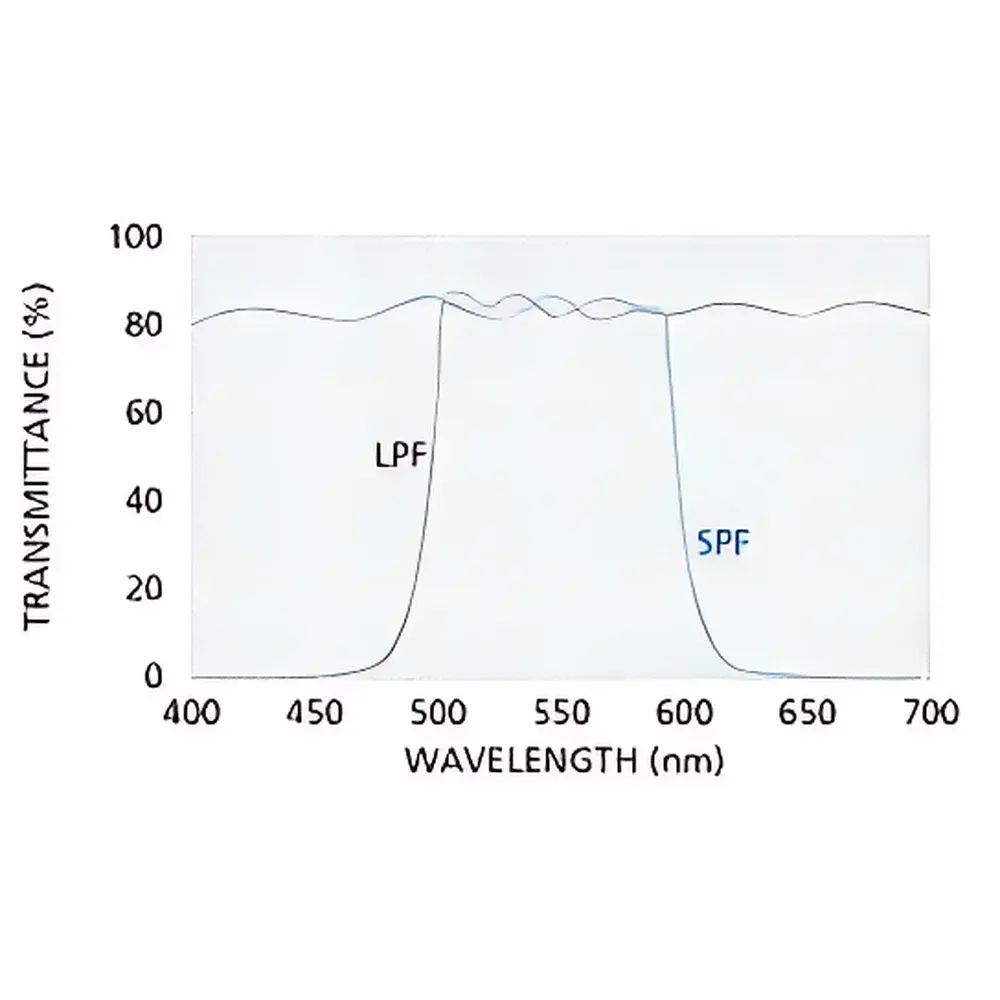
Bandpass filters are passive optical components engineered to transmit a specific, contiguous wavelength range—defined by a center wavelength (CWL) and full width at half maximum (FWHM)—while rejecting radiation outside this band. Unlike longpass or shortpass filters, which exhibit monotonic transmission edges, bandpass filters rely on interference-based thin-film multilayer coatings deposited on high-quality fused silica or BK7 substrates. This design enables precise spectral isolation critical in fluorescence microscopy, Raman spectroscopy, laser line cleanup, environmental remote sensing, and optical communications. The imported bandpass filters referenced herein are manufactured in the United States under ISO 9001-certified cleanroom conditions, with spectral performance validated per ISO 10110-7 and MIL-C-48497A specifications. Each filter undergoes spectral verification using calibrated double-monochromator spectrophotometers traceable to NIST standards.
Key Features
- High optical density (OD ≥ 6) in blocking regions across UV-VIS-NIR (200–1100 nm), minimizing out-of-band leakage
- Center wavelength tolerance of ±1.5 nm (standard); optional ±0.5 nm for metrology-grade applications
- FWHM options spanning 1 nm (narrowband laser rejection) to 80 nm (broadband photometric bands)
- Substrate materials include UV-grade fused silica (for <350 nm transmission), BK7 (VIS-optimized), and CaF₂ (deep-UV capable)
- AR-coated back surfaces reduce ghost reflections and improve system throughput
- Hard-coated dielectric stacks resistant to humidity, abrasion, and cleaning solvents per MIL-F-48616
Sample Compatibility & Compliance
These bandpass filters integrate seamlessly into standard optical mounts (e.g., SM1-threaded lens tubes, cage systems, filter wheels) and are compatible with collimated or convergent beams up to f/2. They comply with RoHS 2015/863/EU and REACH SVHC regulations. For regulated environments—including clinical diagnostics instrumentation and pharmaceutical analytical systems—the filters support documentation packages aligned with FDA 21 CFR Part 11 requirements when integrated into validated instrument platforms. Spectral certification reports (including measured transmission curves, CWL, FWHM, and blocking OD values) accompany every shipment and are archived for GLP/GMP audit readiness.
Software & Data Management
While inherently passive, these filters are fully supported within common optical design and simulation workflows. Transmission data is provided in standardized ASCII format (.txt) compliant with Zemax OpticStudio, CODE V, and FRED import protocols. Users may load spectral files directly into radiometric modeling tools (e.g., LightTools, ASAP) for stray light analysis or signal-to-noise ratio estimation. For inventory and configuration management, each filter batch includes a unique serial number linked to its certified spectral report; integration with enterprise asset management (EAM) or LIMS systems is enabled via CSV export functionality.
Applications
- Fluorescence lifetime imaging (FLIM): isolating emission bands from multi-label assays while suppressing excitation bleed-through
- Raman spectroscopy: rejecting Rayleigh scatter and selecting Stokes/anti-Stokes peaks with <0.1 cm⁻¹ resolution equivalence
- Laser safety interlocks: attenuating specific laser lines (e.g., 532 nm, 1064 nm) in Class IV laser enclosures per IEC 60825-1
- Astronomical instrumentation: defining photometric bands (e.g., Sloan ugriz, Johnson UBV) in focal plane arrays
- Environmental monitoring: enabling selective detection of gas absorption features (e.g., CH₄ at 1650 nm, CO₂ at 2000 nm) in open-path FTIR systems
FAQ
What does “imported” signify for these bandpass filters?
It indicates final manufacturing, coating, and spectral validation occur in the United States, with full traceability to domestic production facilities and NIST-traceable calibration infrastructure.
Can custom center wavelengths be specified?
Yes—custom CWLs between 250 nm and 12 µm are available with lead times commensurate with coating run scheduling; minimum order quantities apply for non-standard designs.
Do these filters support high-power laser applications?
Standard versions are rated for continuous-wave irradiance up to 500 W/cm² at 1064 nm; high-damage-threshold variants (LDT > 5 J/cm², 10 ns pulse) are available upon request.
Is angle-of-incidence sensitivity documented?
Yes—angular tuning shift (ΔCWL vs. AOI) is characterized for 0° to 15° incidence and included in the spectral report; all standard filters are optimized for near-normal incidence operation.
How are spectral tolerances verified?
Each filter undergoes point-by-point scanning on a PerkinElmer Lambda 1050+ spectrophotometer with 0.05 nm resolution, with raw data and statistical summaries archived for 10 years per internal QA policy.





