
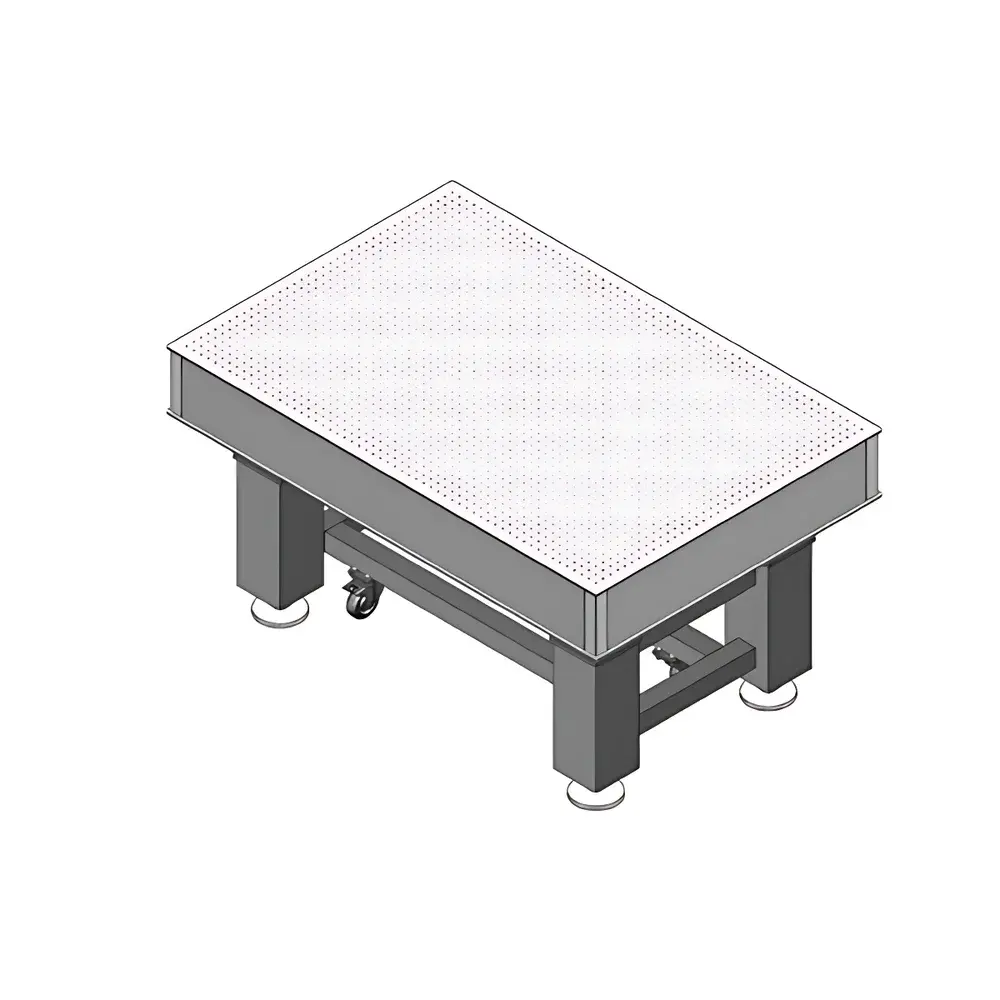
ZOLIX DRR Series Precision Dual-Frequency Damped Optical Vibration Isolation Platform
| Brand | ZOLIX |
|---|---|
| Origin | Beijing, China |
| Manufacturer Type | Direct Manufacturer |
| Product Category | Domestic (China-Made) |
| Model | DRR |
| Price | USD 3,950 (FOB Beijing) |
Overview
The ZOLIX DRR Series Precision Dual-Frequency Damped Optical Vibration Isolation Platform is an engineered solution for high-stability optical experimentation in research laboratories, metrology facilities, and advanced teaching environments. Designed around a proprietary P-type dual-frequency damping isolation system, the platform addresses two critical vibration regimes simultaneously: low-frequency ground-borne disturbances (typically below 15 Hz) and mid-frequency structural resonances. This dual-band attenuation architecture leverages coupled mechanical impedance matching—achieved through integrated viscoelastic damping elements at both the support-leg interface and base mounting level—to suppress transmissibility across a broader spectral range than conventional single-stage isolators. The platform’s fundamental resonance frequency is maintained below 6–15 Hz under typical operational loads (50–200 kg/m²), ensuring effective isolation for sensitive interferometric setups, laser cavity alignment, quantum optics experiments, and nanoscale imaging systems requiring sub-micron positional stability.
Key Features
- P-type dual-frequency damped isolation system: Combines tuned mass-like behavior at low frequencies with broadband viscous dissipation at higher frequencies, delivering consistent transmissibility reduction across 1–100 Hz.
- Monolithic welded steel support frame: Four-point (or six-point for platforms ≥3 m) rigid structure with integrated leveling screws (±10 to +15 mm adjustment per leg) and heavy-duty locking casters for repositioning without disassembly.
- Three-layer sandwich honeycomb tabletop: Fabricated via full-penetration welding—not adhesive bonding—eliminating delamination, creep, or long-term stiffness degradation. Internal stiffening uses orthogonal steel webbing for optimal rigidity-to-mass ratio.
- SUS410 ferromagnetic stainless steel top surface (4–6 mm thick): Provides magnetic compatibility for optical mounts and translation stages while maintaining corrosion resistance in controlled lab environments.
- Precision-ground flatness: 0.02–0.05 mm deviation over any 600 mm × 600 mm area—exceeding ISO 10360-2 geometric tolerance benchmarks for optical work surfaces.
- Standardized M6 threaded array: 25 mm × 25 mm pitch grid across entire surface, compatible with Thorlabs, Newport, and Standa mounting hardware without adapters.
Sample Compatibility & Compliance
The DRR platform accommodates optical components ranging from compact diode lasers and fiber couplers to large-aperture interferometers and multi-axis nanopositioning systems. Its load capacity scales with tabletop thickness: 120 kg/m² (100 mm), 140 kg/m² (200 mm), and 167 kg/m² (300 mm). Structural integrity complies with ISO 140-6 (vibration testing of equipment) and meets static deflection requirements outlined in ANSI/EIA-748-A for laboratory-grade optical supports. While not certified to ISO 14644 cleanroom standards, its black aluminum-plastic side cladding and electrostatically sprayed carbon-steel base minimize particulate shedding. All welds conform to AWS D1.1 structural steel code; surface finishes adhere to ASTM B117 salt-spray test protocols for corrosion resistance verification.
Software & Data Management
The DRR platform is a passive mechanical system and does not incorporate embedded electronics, firmware, or software interfaces. However, it is fully compatible with third-party vibration monitoring systems—including Brüel & Kjær Type 4382 accelerometers and PCB Piezotronics ICP® sensors—for real-time transmissibility mapping and modal analysis. Calibration reports (flatness verification, resonance frequency sweep data, and load-deflection curves) are provided upon request and archived per GLP-compliant documentation practices. For FDA-regulated applications involving optical instrumentation used in analytical method validation (e.g., USP spectrophotometer qualification), the platform’s mechanical traceability—via serial-numbered weld tags and material certification (MTR) for SUS410 and structural steel—supports audit readiness under 21 CFR Part 11 when paired with validated measurement workflows.
Applications
- Laser interferometry and gravitational wave detector prototype alignment
- Confocal and super-resolution microscopy stage stabilization
- Ultrafast laser pulse compression and CPA beamline configuration
- Quantum optics experiments requiring phase coherence over >1 s integration times
- Optical coherence tomography (OCT) system development and calibration
- Undergraduate and graduate optics laboratories where repeatability, safety, and service life are prioritized over ultra-low-cost alternatives
FAQ
What is the difference between the DRR and conventional air-damped optical tables?
The DRR employs a passive, maintenance-free dual-frequency mechanical damping system rather than pneumatic components—eliminating dependency on compressed air, pressure regulators, or leveling valves. It offers superior low-frequency suppression (<10 Hz) compared to standard elastomeric isolators, without the footprint or infrastructure demands of active systems.
Can the DRR platform be anchored to the floor for enhanced stability?
Yes. Optional floor-mounting kits (sold separately) include seismic-rated anchor bolts and reinforced base plates, enabling permanent installation while preserving the ±15 mm height adjustment range.
Is SUS410 top surface compatible with vacuum-compatible optical mounts?
SUS410 is not UHV-rated due to its higher outgassing rate versus 316L stainless steel; however, it is suitable for high-vacuum (10⁻⁶ mbar) applications when properly passivated and baked. For UHV use, ZOLIX offers a custom 316L top-surface option.
How is flatness verified during manufacturing?
Each tabletop undergoes coordinate measuring machine (CMM) verification using ISO 10360-2 traceable probes; results are recorded in a certificate of conformance shipped with the unit.
Does ZOLIX provide installation and commissioning support?
Yes. On-site technical assistance—including laser-leveling, resonance characterization, and integration with existing optical benches—is available globally through authorized ZOLIX application engineers.





