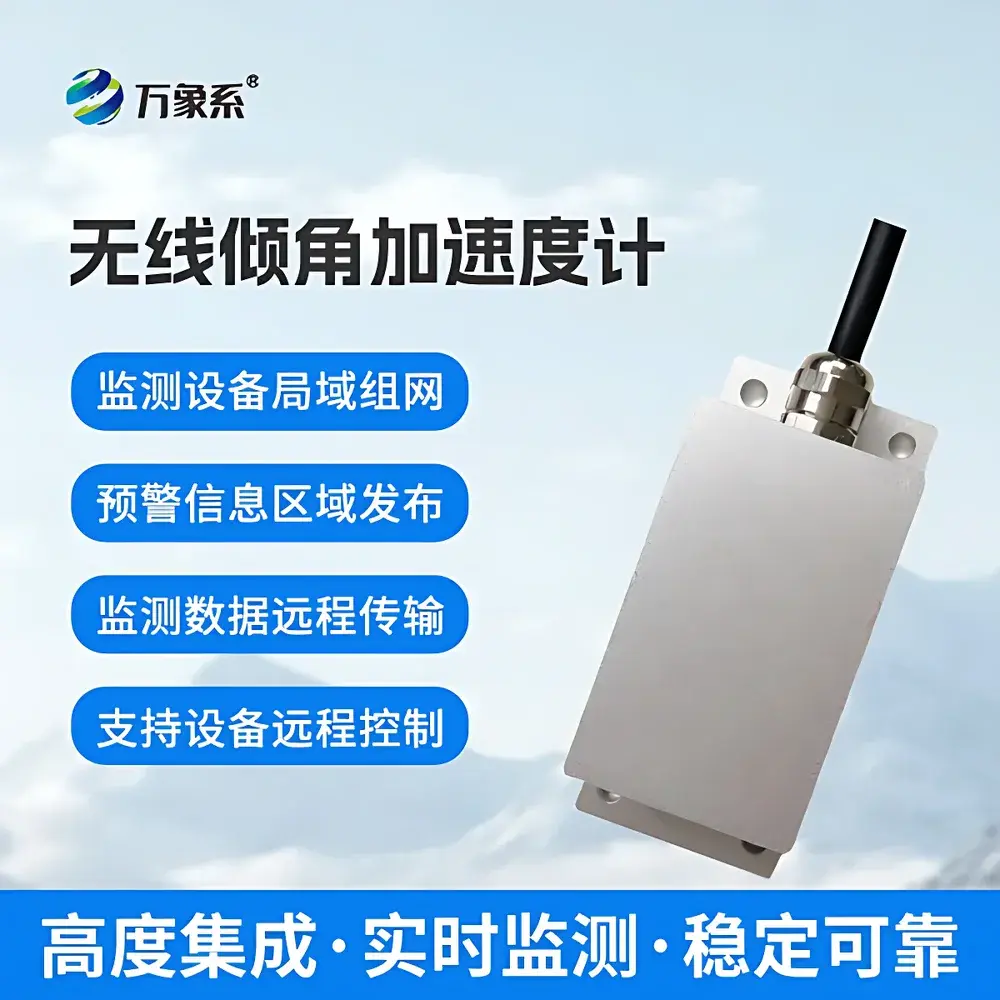
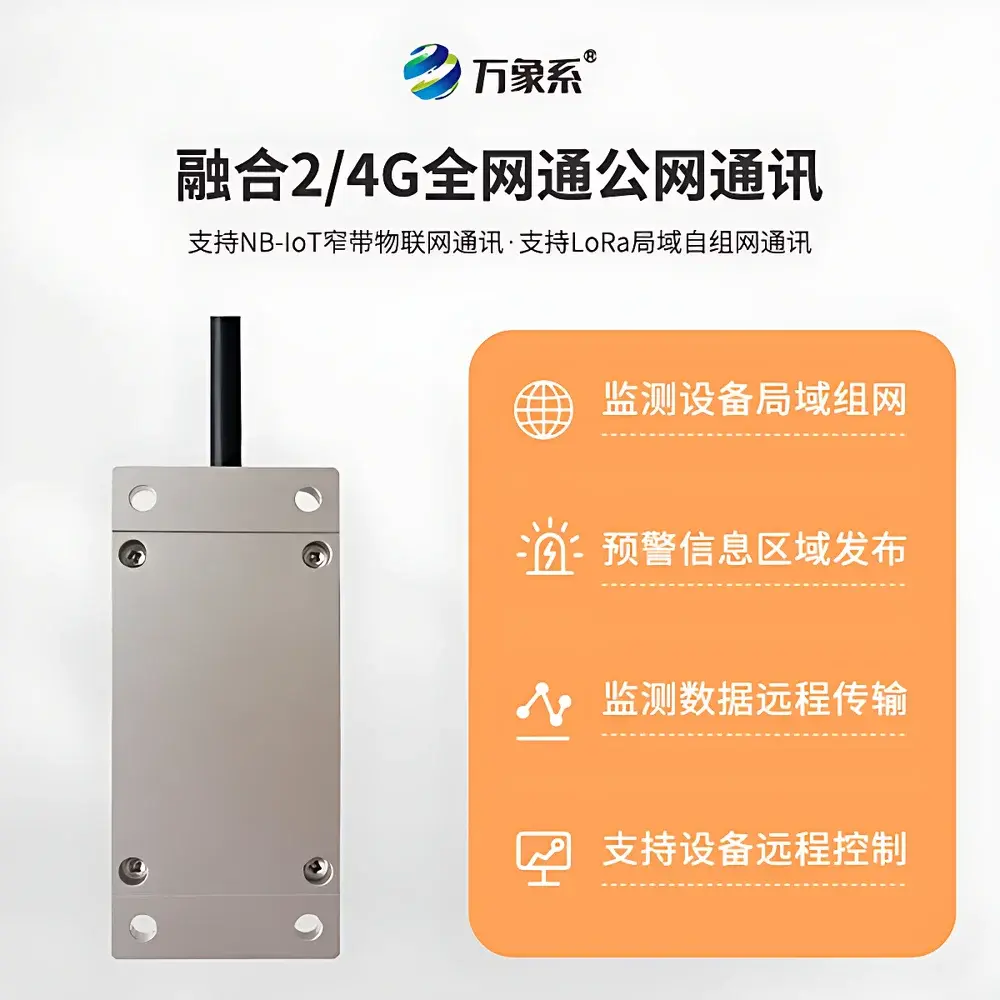
WX-QJ2 Dual-Axis Inclinometer
| Brand | Vientiane Environment |
|---|---|
| Origin | Shandong, China |
| Manufacturer Type | OEM/ODM Producer |
| Country of Origin | China |
| Model | WX-QJ2 |
| Price | USD 450 (FOB) |
| Measurement Range | ±90° (X- and Y-axis) |
| Accuracy Options | ±0.001° / ±0.005° / ±0.01° |
| Operating Voltage | 3.7–4.2 V DC |
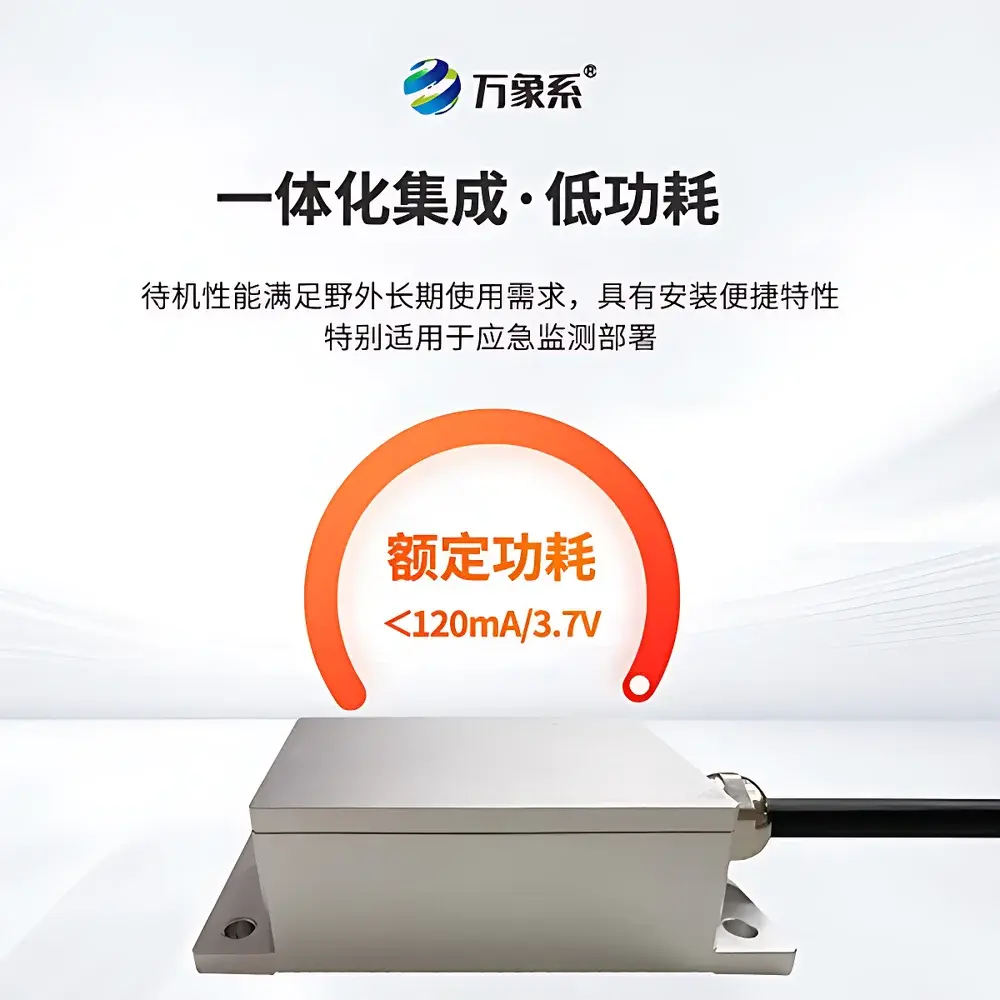
| Typical Current Draw | <120 mA @ 3.7 V |
| Operating Temperature | −40 °C to +85 °C |
| Operating Humidity | ≤95% RH (non-condensing) |
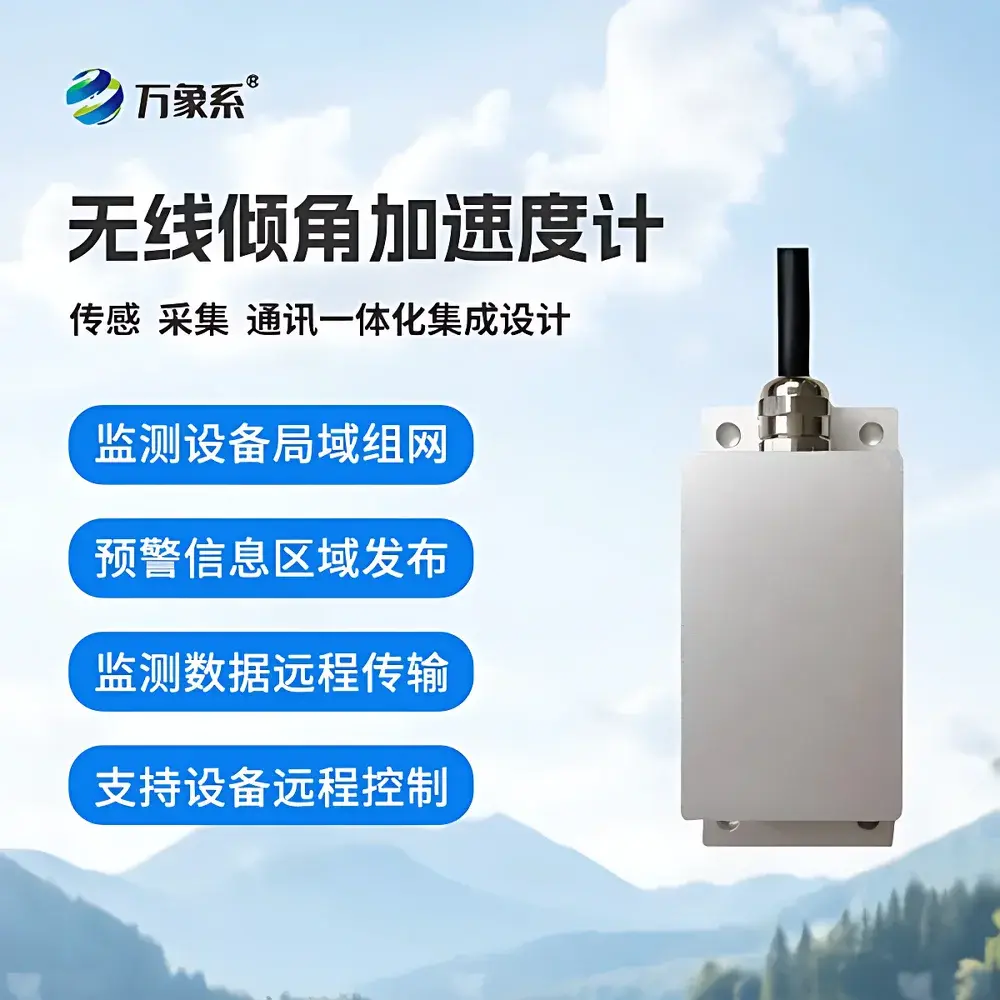
| Communication Protocols | 2G/4G GPRS, NB-IoT, LoRaWAN |
| Sampling Rate | Configurable from 1 Hz to 50 Hz (high-frequency mode) or 0.00014 Hz to 1 sample/hour (low-frequency mode, interval 1–7200 s) |
| Data Upload Modes | Scheduled transmission + event-triggered upload (e.g., tilt threshold exceedance) |
| Remote Configuration Support | Yes |
Overview
The WX-QJ2 Dual-Axis Inclinometer is an industrial-grade MEMS-based angular displacement sensor engineered for continuous, long-term structural inclination monitoring in civil infrastructure applications. It operates on the principle of capacitive micro-electromechanical sensing, where dual orthogonal proof masses detect gravitational vector components along the X- and Y-axes with high linearity and thermal stability. Unlike single-axis solutions, the WX-QJ2 provides simultaneous, synchronized measurement of pitch and roll angles—critical for assessing asymmetric deformation in tall or asymmetric structures such as wind turbine towers, telecom masts, historic building façades, and bridge piers. Its compact, hermetically sealed housing meets IP67 ingress protection requirements, enabling reliable deployment in outdoor, unsheltered environments subject to rain, dust, freeze-thaw cycles, and wide ambient temperature swings.
Key Features
- True dual-axis measurement with independent, factory-calibrated sensitivity and zero-offset compensation for each axis
- Selectable accuracy grades: ±0.001° (high-precision variant), ±0.005° (standard metrological grade), or ±0.01° (cost-optimized operational grade)
- Wide dynamic range: full-scale output across ±90° per axis with monotonic response and <0.05% non-linearity (typ.)
- Low-power architecture optimized for battery-operated remote installations; supports 3–10 year operation on a single 10,000 mAh Li-SOCl₂ cell under typical 1-min sampling + daily upload duty cycle
- Multi-protocol wireless connectivity: firmware-upgradable support for LTE-M, NB-IoT (Cat-NB1/NB2), LoRaWAN Class A/C, and legacy 2G/GPRS—enabling flexible integration into existing LPWAN or cellular telemetry infrastructures
- Configurable event-trigger logic: user-defined tilt thresholds (e.g., >0.1° deviation from baseline), rate-of-change alarms (>0.05°/min), and hysteresis filtering to suppress false positives from transient vibration
Sample Compatibility & Compliance
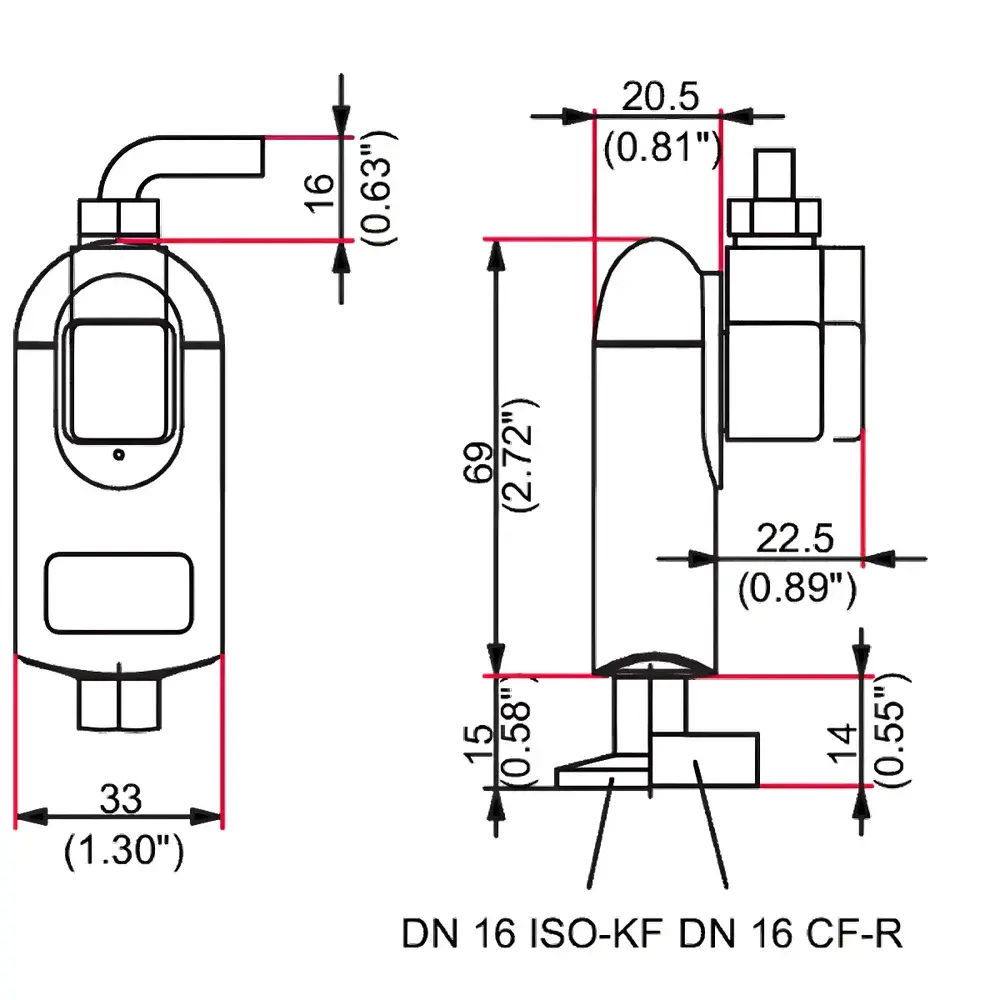
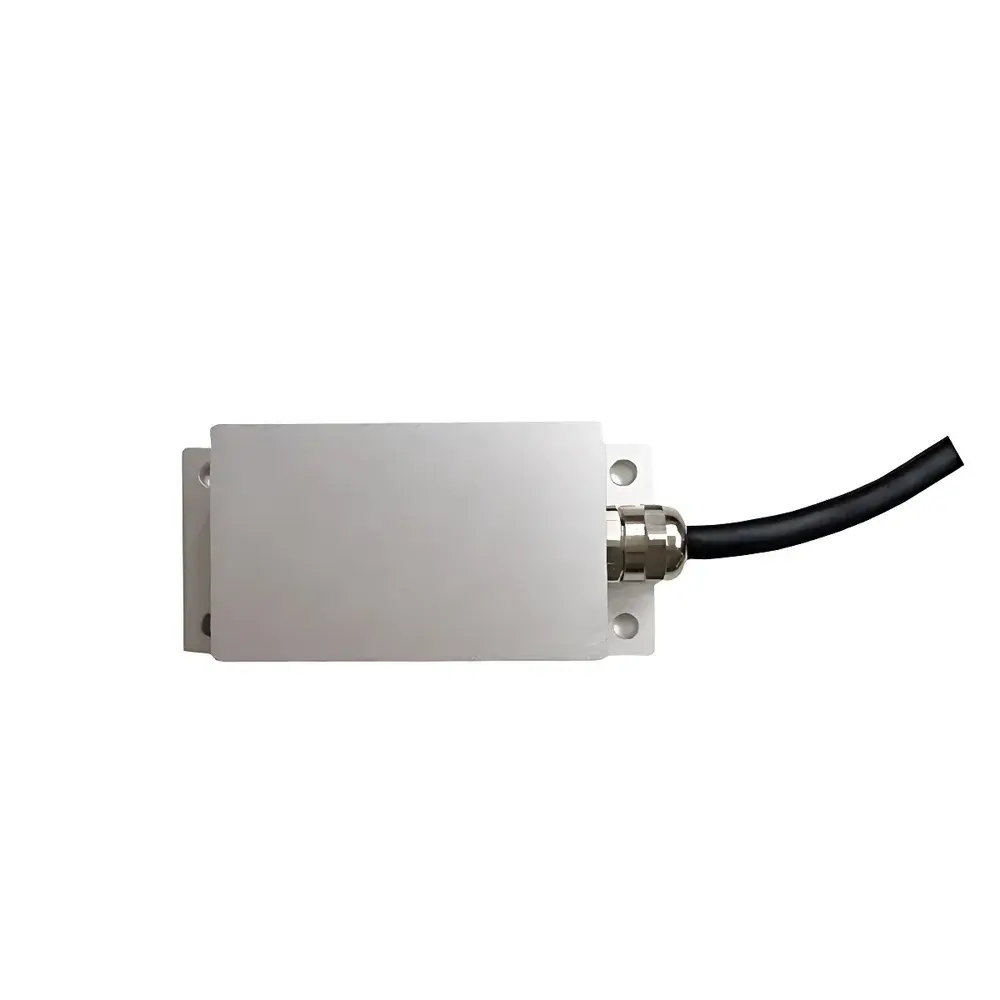
The WX-QJ2 is designed for direct mounting onto concrete, steel, or composite substrates using M4 stainless-steel fasteners and optional thermal-isolation pads. Its mechanical footprint (62 × 42 × 22 mm) and low mass (<120 g) minimize inertial loading effects during seismic or wind-induced motion. The device complies with IEC 60068-2 environmental stress testing standards (including shock, vibration, and damp heat), and its electromagnetic compatibility conforms to EN 61000-6-2 (immunity) and EN 61000-6-4 (emissions). While not certified for SIL or ASIL functional safety levels, its design adheres to principles outlined in ISO 13849-1 for reliability-critical instrumentation. Data integrity protocols align with GLP-aligned field data collection practices, supporting audit-ready timestamping and CRC-16 frame validation.
Software & Data Management
Vientiane Environment provides the open-API “IncliCloud” platform for centralized device provisioning, over-the-air (OTA) firmware updates, and time-series visualization. Raw angle outputs are transmitted in IEEE 754-compliant binary format (32-bit float per axis), with optional JSON wrapper for MQTT/HTTP(S) ingestion. The platform supports role-based access control (RBAC), automated baseline drift correction via periodic self-leveling routines (if installed on stable reference points), and export to CSV, NetCDF, or OPC UA for integration with SCADA, BMS, or structural health monitoring (SHM) systems. All communication sessions employ TLS 1.2+ encryption, and local edge storage (up to 32,768 samples) ensures data continuity during network outages.
Applications
- Continuous tilt surveillance of aging masonry structures and heritage buildings under urban subsidence or soil creep conditions
- Dynamic monitoring of wind turbine tower deflection under operational loads and extreme wind events (IEC 61400-22 compliant post-installation verification)
- Settlement tracking of bridge abutments and pier foundations during construction and service life
- Real-time alignment verification of precision machinery bases (e.g., CNC gantries, coordinate measuring machines) during facility commissioning
- Geotechnical early-warning for landslide-prone slopes via distributed inclinometer arrays coupled with pore-water pressure sensors
FAQ
What calibration documentation is provided with the WX-QJ2?
Each unit ships with a traceable calibration certificate (NIST-traceable reference standard), listing axis-specific zero bias, scale factor, cross-axis sensitivity, and temperature coefficient data across −20 °C to +60 °C.
Can the WX-QJ2 operate autonomously without cloud connectivity?
Yes—the device supports fully offline operation with local logging, configurable alarm thresholds, and scheduled internal data dumps via RS-485 or USB-C for manual retrieval.
Is third-party software integration supported?
Yes—RESTful API endpoints, Modbus RTU/TCP register maps, and pre-built drivers for LabVIEW, MATLAB, and Python (via PySerial/Requests) are publicly documented in the Developer Portal.
How is long-term zero drift managed in field deployments?
The firmware includes adaptive baseline learning algorithms that identify stable rest periods (detected via acceleration magnitude and variance thresholds) to recalibrate zero offset without requiring physical intervention.
Does the device meet explosion-proof or hazardous-area certification requirements?
No—the WX-QJ2 is rated for general industrial use (non-hazardous locations); ATEX or IECEx variants are not currently available but may be developed upon request for volume OEM projects.