
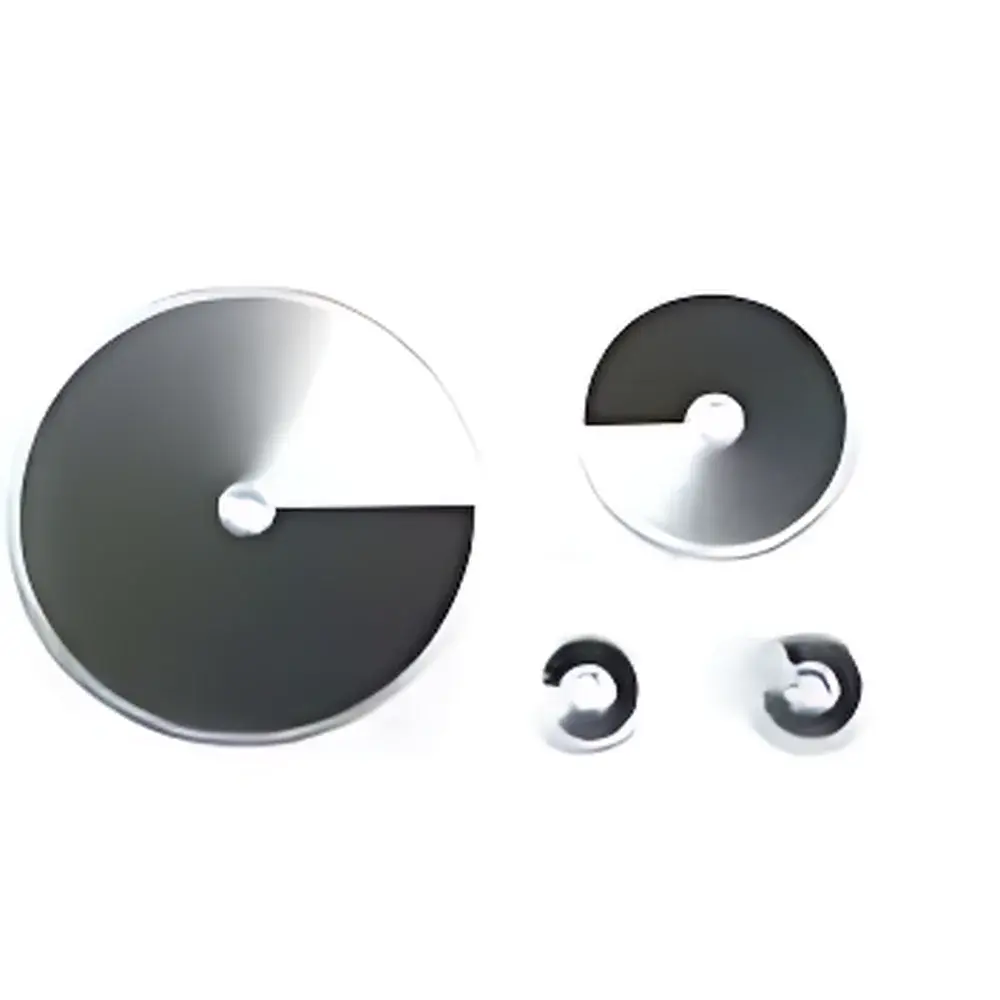
ZOLIX NDFI/NDFL/NDFC Series Neutral Density Filters
| Brand | ZOLIX |
|---|---|
| Origin | Beijing, China |
| Manufacturer Type | OEM/ODM Manufacturer |
| Product Type | Fixed, Linear Variable, and Circular Variable Neutral Density Filters |
| Optical Density (OD) Range | 0.0–4.0 |
| Substrate Material | Optical Glass (BK7, Fused Silica options available) |
| Surface Quality | 60-40 scratch-dig |
| Parallelism | <1 arcmin |
| Clear Aperture | ≥90% of nominal diameter/length |
| Coating | Metallic (absorptive) or Dielectric (reflective) |
| Transmission Uniformity | ±3% across clear aperture (fixed OD) |
| Wavelength Range | 400–1100 nm (optimized for 400–700 nm visible band) |
| Standard Dimensions | Ø10–Ø100 mm (circular), 3–100 mm width × 10–150 mm length (linear), 50×50 mm to 50×50 mm (square fixed) |
Overview
ZOLIX NDFI, NDFL, and NDFC Series Neutral Density (ND) Filters are precision optical components engineered for controlled attenuation of light intensity without spectral distortion. Based on well-established principles of either broadband absorption (metal-dielectric thin-film stacks) or reflective attenuation (dielectric interference coatings), these filters maintain neutral spectral transmittance across the visible and near-infrared spectrum (400–1100 nm), with optimal performance validated in the 400–700 nm range. Unlike colored glass or dichroic filters, ZOLIX ND filters deliver spectrally flat attenuation—critical for quantitative photometry, laser power management, camera exposure calibration, and optical system alignment where wavelength-dependent bias must be eliminated. The series comprises three distinct architectures: fixed-density (NDFI), linear variable-density (NDFL), and circular variable-density (NDFC) configurations—each fabricated using metrology-grade substrate polishing, vacuum deposition, and in-process spectral verification per ISO 9022-3 and ISO 10110-7 standards.
Key Features
- Three architecture classes: Fixed OD (NDFI), linear gradient OD (NDFL), and radial/circular gradient OD (NDFC)—enabling flexible integration into static, scanning, or beam-centering applications.
- Optical density range from OD 0.0 to OD 4.0 (i.e., 100% to 0.01% transmission), with tight tolerances: ±0.05 OD for fixed filters; ±5% relative gradient linearity for NDFL; ±0.05 OD radial step accuracy for NDFC.
- Dual material and coating platforms: Absorptive (metallic alloy on BK7 or fused silica) for high damage threshold (>500 MW/cm² pulsed, >5 kW/cm² CW at 1064 nm) and reflective (multi-layer dielectric) for minimal thermal lensing and polarization insensitivity.
- Substrate compliance: All BK7 variants meet MIL-O-13830A surface quality (60-40 scratch-dig); fused silica options available for UV-enhanced or low-thermal-expansion requirements.
- Mechanical stability: Thickness tolerance ±0.1 mm; parallelism <1 arcmin; wedge <3 arcsec; clear aperture ≥90% of nominal dimension—ensuring compatibility with standard kinematic mounts and lens tubes (e.g., Thorlabs SM1/SM2, Newport 60 mm cage systems).
- Traceable calibration: Each production lot undergoes spectral transmittance mapping via calibrated UV-VIS-NIR spectrophotometer (PerkinElmer Lambda 1050+), with full spectral reports provided upon request per ISO/IEC 17025 guidelines.
Sample Compatibility & Compliance
ZOLIX ND filters are compatible with collimated and convergent beams up to f/2, supporting both free-space and fiber-coupled optical paths. Fixed-density variants (NDFI) are routinely deployed in laser safety interlocks, photodetector linearity validation, and radiometric reference chains compliant with NIST-traceable workflows. Linear variable filters (NDFL) serve as continuous exposure control elements in automated slit-scanning spectrometers and beam profiling systems requiring real-time intensity normalization. Circular variable filters (NDFC) enable center-of-mass beam diagnostics and adaptive focus alignment in confocal microscopy and ultrafast pulse characterization setups. All filters conform to ISO 10110-7 (optical component surface imperfections), ISO 9022-3 (environmental resistance), and RoHS 2015/863/EU directives. Reflective-type filters comply with EN 61228 (laser product safety) when integrated into Class 3B/4 laser enclosures.
Software & Data Management
While inherently passive components, ZOLIX ND filters integrate seamlessly into automated optical test benches via programmable filter wheels (e.g., Sutter Lambda 10-B, Thorlabs FW102C) and LabVIEW- or Python-controlled motion stages. Spectral transmittance data (CSV/TXT format) is supplied with each batch for import into optical design software including Zemax OpticStudio, CODE V, and FRED. For GMP/GLP environments, full traceability documentation—including substrate lot numbers, coating run IDs, spectral scan timestamps, and operator signatures—is archived for ≥15 years. Optional IQ/OQ/PQ validation packages support FDA 21 CFR Part 11-compliant deployment in regulated pharmaceutical or medical device R&D labs.
Applications
- Laser power stabilization and attenuation in Ti:sapphire, Nd:YAG, and diode-pumped solid-state laser systems.
- Dynamic range extension in scientific CMOS and EMCCD imaging—particularly in fluorescence lifetime imaging (FLIM) and single-molecule tracking.
- Reference-grade calibration of photodiodes, integrating spheres, and spectroradiometers per CIE S 026/E:2015 and ASTM E308.
- Beam homogenization and spatial intensity modulation in structured illumination microscopy (SIM) and digital holographic interferometry.
- Real-time exposure compensation in hyperspectral push-broom scanners and aerial photogrammetry payloads.
- Neutral attenuation in optical coherence tomography (OCT) reference arms to balance sample and reference path intensities.
FAQ
What is the damage threshold for ZOLIX absorptive ND filters under CW 532 nm illumination?
Typical LIDT is 5 kW/cm² for 10 s exposure on BK7-based NDFI filters with metallic coating; fused silica substrates increase this to >10 kW/cm². Exact values depend on beam diameter, spot uniformity, and cooling conditions—test reports available per IEC 60825-1 Annex D.
Can NDFL linear variable filters be used in convergent beams?
Yes, but with caution: gradient fidelity degrades beyond f/4 due to non-normal incidence effects. We recommend collimated use or ray-tracing validation in Zemax for f/2–f/3 applications.
Do ZOLIX ND filters exhibit polarization dependence?
Absorptive (NDFI/NDFL/NDFC) types show <0.5% polarization sensitivity across 400–1100 nm. Reflective variants exhibit ≤2% extinction ratio variation—measured and reported per ISO 15362.
Is custom OD profile design supported?
Yes. ZOLIX offers bespoke gradient profiles (e.g., Gaussian, logarithmic, segmented linear) and non-standard dimensions (up to Ø150 mm or 200×200 mm square) under NDA, with lead times starting at 6 weeks.
Are spectral transmittance certificates provided with every order?
Batch-level spectral reports are standard. Individual-filter certification (with serial-numbered scans) is available as a value-added service—required for ISO/IEC 17025-accredited calibration labs.




