
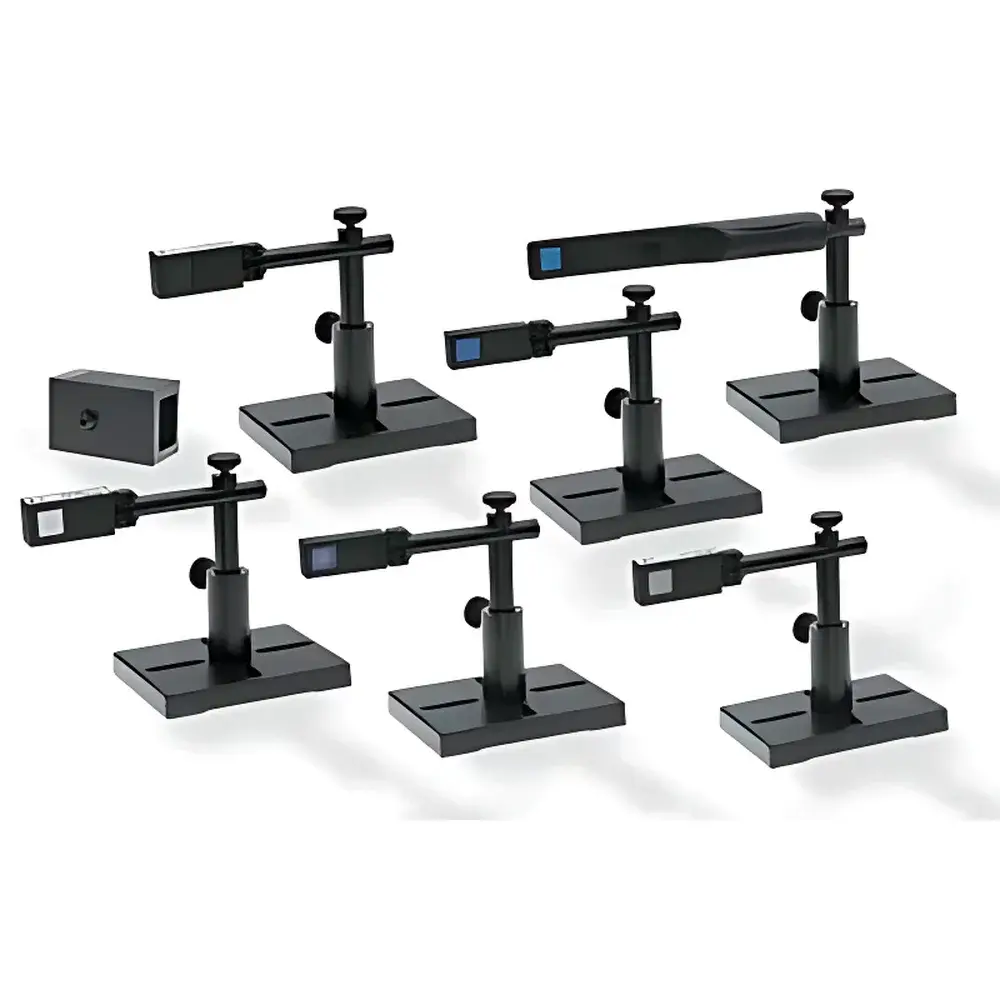
Ophir PD300 Series Photodiode Laser Power Sensor Heads
| Origin | Israel |
|---|---|
| Manufacturer Type | Authorized Distributor |
| Origin Category | Imported |
| Model | PD300 |
| Pricing | Available Upon Request |
Overview
The Ophir PD300 Series comprises a family of high-precision, calibrated photodiode-based laser power sensor heads engineered for low-to-medium power optical radiation measurement across ultraviolet, visible, and near-infrared spectral bands. These sensors operate on the principle of photovoltaic conversion, where incident photons generate a proportional photocurrent that is linearly related to irradiance over a wide dynamic range. Unlike thermal detectors, photodiode sensors deliver nanosecond-level response times, exceptional sensitivity down to 10 pW, and high signal-to-noise ratios—making them ideal for characterizing continuous-wave (CW) and quasi-CW lasers in R&D, production QC, and calibration laboratories. The PD300 platform supports interchangeable configurations optimized for specific wavelength regimes (UV, VIS-NIR, IR), beam geometries (collimated or divergent), and application constraints (e.g., background light rejection, human-eye photopic response, or ultra-low noise operation).
Key Features
- Photodiode detection technology with 10 pW minimum detectable power (PD300-UV-193 variant) and up to 3 W full-scale range
- Wavelength coverage spanning 193 nm (excimer UV) to 1800 nm (SWIR), with model-specific calibration traceable to NIST standards
- Active ambient light compensation circuitry (standard on PD300, PD300-1W, PD300-3W) enabling stable measurements under typical lab lighting conditions
- Multiple aperture options: standard 10 × 10 mm active area for broad-beam applications; Φ5 mm for focused or fiber-coupled beams; compact 2.4 × 2.8 mm for photometric Lux measurement (PD300-CIE)
- Optimized variants include low-noise IR models (PD300-IRG), flat-spectral-response units (PD300-BB), and excimer-calibrated probes (PD300-UV-193 at 193 nm)
- Integrated thermistor for real-time temperature compensation, ensuring measurement stability across ambient fluctuations (±0.02 %/°C typical drift coefficient)
Sample Compatibility & Compliance
The PD300 series is compatible with a wide range of laser sources including HeNe (632.8 nm), diode lasers (405–1550 nm), DPSS lasers (532 nm, 1064 nm), HeCd (325 nm, 442 nm), and pulsed UV systems (e.g., ArF excimer at 193 nm). All models comply with ISO/IEC 17025-accredited calibration practices and are supplied with individual calibration certificates specifying wavelength-dependent responsivity (A/W), linearity deviation (< ±0.5 %), and spectral uniformity (±1.5 % across active area). For regulated environments, the sensors support integration into GLP/GMP workflows when paired with Ophir StarLite or Vega meters equipped with audit-trail-enabled firmware compliant with FDA 21 CFR Part 11 requirements.
Software & Data Management
PD300 sensors interface seamlessly with Ophir’s proprietary StarLab software (Windows/macOS) and LabVIEW-compatible drivers (NI-VISA, .NET SDK). Real-time data acquisition supports sampling rates up to 40 kHz, configurable averaging modes (RMS, peak-hold, burst capture), and automatic unit conversion (W, mW, µW, dBm, Lux). Measurement logs are exportable in CSV, XML, or PDF formats with embedded metadata—including timestamp, sensor ID, calibration expiration date, and environmental temperature. Firmware updates and recalibration scheduling are managed via the Ophir Calibration Portal, which maintains full traceability to national metrology institutes.
Applications
- Laser diode characterization during wafer-level testing and module burn-in
- Optical alignment verification in confocal microscopy and optical coherence tomography (OCT) systems
- UV curing process monitoring in semiconductor lithography and additive manufacturing
- Photobiomodulation (PBM) dose validation in preclinical research
- Calibration transfer between primary standards (e.g., cryogenic radiometers) and field-deployable instruments
- Beam profiling auxiliary measurement for M² and divergence analysis
FAQ
What is the difference between PD300-UV and PD300-UV-193?
PD300-UV offers extended UV coverage from 200–1100 nm with low-noise electronics; PD300-UV-193 adds NIST-traceable calibration at 193 nm and enhanced quartz window transmission for ArF excimer applications.
Can PD300 sensors measure pulsed lasers?
Yes—provided pulse repetition frequency exceeds 10 Hz and average power remains within specified range; for short-pulse (<10 ns) or high-peak-power applications, thermal sensors (e.g., 3A-P, 10A-P) are recommended.
Is background light compensation automatic or user-configurable?
Fully automatic: the built-in reference photodiode continuously samples ambient illumination and subtracts its contribution from the main signal path in real time.
How often does the PD300 require recalibration?
Annual recalibration is recommended for ISO/IEC 17025 compliance; intervals may be extended to 24 months under controlled lab conditions with documented stability monitoring.
Are fiber-optic adapters available for PD300 series?
Yes—Ophir offers SMA905, FC/PC, and ST-compatible adapters (e.g., FVA-1, FVA-2) with calibrated coupling efficiency correction factors included in StarLab software.
Related Products






