
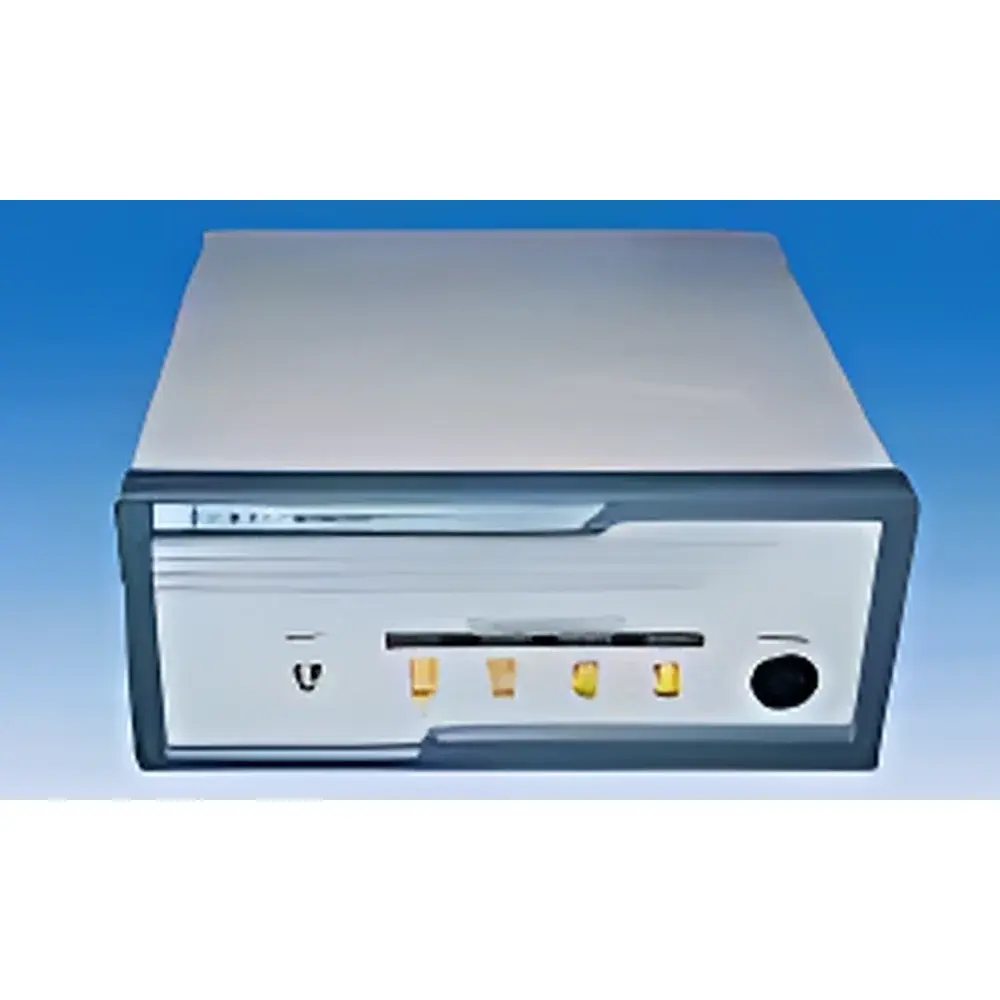
ZOLIX DCS200PC Single-Photon Counter
| Brand | ZOLIX |
|---|---|
| Model | DCS200PC |
| Counting Rate | 100 Mcps |
| Analog Input Channels | 4 (0–10 V, 16-bit A/D, 1 MS/s per channel) |
| Analog Output Channels | 2 (0–10 V) |
| Interface | USB 2.0 |
| Certification | CE |
| Power Supply | DC 24 V, 0.3 A |
| Dimensions | 240 × 240 × 120 mm |
| Weight | 3.3 kg |
Overview
The ZOLIX DCS200PC Single-Photon Counter is a high-performance, time-resolved photon detection system engineered for quantitative optical measurements at the quantum limit. It operates on the principle of discrete photoelectron pulse discrimination in photomultiplier tube (PMT) or hybrid photodetector outputs under ultra-low-light conditions. When incident photons strike the photocathode, each photon—subject to the detector’s quantum efficiency—may trigger a single photoelectron cascade. This cascade generates a measurable voltage pulse across a load resistor; the DCS200PC employs precision amplitude discrimination and digital pulse counting logic to isolate true photon events from thermal noise, afterpulsing, and electronic baseline fluctuations. Unlike analog integration methods, this photon-counting architecture delivers shot-noise-limited sensitivity, enabling reliable detection of non-overlapping photon pulses with sub-nanosecond temporal resolution. The system is optimized for applications requiring statistical fidelity in low-photon-flux regimes—including fluorescence lifetime imaging (FLIM), time-correlated single-photon counting (TCSPC), quantum optics experiments, and ultra-weak chemiluminescence assays.
Key Features
- Maximum sustained photon counting rate of 100 million counts per second (Mcps), supporting high-throughput time-resolved measurements without significant dead-time distortion.
- Four synchronized analog input channels with 16-bit resolution and up to 1 MS/s sampling rate per channel—enabling parallel acquisition of auxiliary signals (e.g., laser sync, delay generator triggers, or reference photodiode outputs) alongside photon timing data.
- Two independent analog output channels (0–10 V range) for real-time control loop interfacing, such as feedback-driven stage positioning or intensity stabilization in closed-loop optical setups.
- USB 2.0 interface compliant with standard Windows/Linux device driver frameworks—ensuring plug-and-play compatibility with third-party data acquisition software and custom LabVIEW or Python-based control environments.
- Rugged aluminum chassis (240 × 240 × 120 mm, 3.3 kg) with internal EMI shielding and thermally stable signal conditioning circuitry—designed for long-duration operation in shared laboratory spaces or integrated OEM instrumentation platforms.
- CE-marked for electromagnetic compatibility and safety compliance—meeting essential requirements of Directive 2014/30/EU (EMC) and 2014/35/EU (LVD).
Sample Compatibility & Compliance
The DCS200PC is not a standalone detector but a dedicated photon pulse processing unit intended for use with external photon-sensitive detectors including side-on or head-on PMTs, microchannel plate (MCP) detectors, and silicon photomultipliers (SiPMs). It requires compatible high-voltage power supplies (typically −800 V to −1500 V) and appropriate pulse-shaping amplifiers or constant-fraction discriminators (CFDs) depending on detector rise time and output impedance. The system supports integration into GLP- and GMP-regulated environments when paired with audit-trail-capable acquisition software; while the hardware itself does not implement FDA 21 CFR Part 11 electronic signature functionality, its deterministic digital architecture ensures traceable timestamping and raw pulse logging—foundational for regulatory data integrity. All analog I/O conforms to industrial-standard voltage ranges (0–10 V) and is referenced to a common ground plane to minimize crosstalk in multi-channel optical configurations.
Software & Data Management
The DCS200PC ships with ZOLIX-provided SDKs for C/C++, MATLAB, and Python (via ctypes bindings), allowing full register-level control over threshold settings, gate enable/disable, counter reset modes, and buffer management. Raw photon arrival timestamps (with <1 ns binning resolution) and analog waveform segments are streamed in binary format with embedded metadata (timestamp, channel ID, trigger edge). Data files adhere to HDF5 v1.10+ standards for hierarchical storage and cross-platform portability. Optional TCSPC analysis modules support deconvolution fitting (e.g., iterative reconvolution with instrument response function), lifetime distribution mapping (e.g., multi-exponential decay analysis), and phasor plot generation—compatible with export to Origin, Igor Pro, or open-source tools like Lifetimes.jl. All firmware updates are delivered via signed hex packages validated against SHA-256 checksums.
Applications
- Time-resolved fluorescence spectroscopy and anisotropy decay analysis in biophysical studies of protein folding and membrane dynamics.
- Single-molecule fluorescence resonance energy transfer (smFRET) experiments requiring high temporal fidelity and low dark-count rejection.
- Quantum key distribution (QKD) testbeds where precise photon arrival statistics and synchronization jitter (<50 ps RMS) are critical.
- Calibration of radiometric standards using NIST-traceable attenuated laser sources and cryogenic radiometers.
- Development and validation of scintillation detectors for nuclear medicine and particle physics instrumentation.
FAQ
What is the minimum detectable pulse width supported by the DCS200PC?
The system accepts input pulses with full-width at half-maximum (FWHM) ≥ 2 ns, assuming proper impedance matching and termination. Pulse width is not internally measured; discrimination relies on amplitude and timing relative to programmable thresholds.
Can the DCS200PC operate in gated counting mode?
Yes—it supports external TTL gating with user-defined start/stop windows down to 10 ns resolution, enabling background suppression in pulsed excitation experiments.
Is firmware upgrade capability available in the field?
Yes—firmware updates are performed via USB using ZOLIX-signed binaries and require no hardware modification or service intervention.
Does the device support NIM or LEMO input standards?
Input connectors are SMA female; users must provide appropriate passive or active adapters for NIM (+1 V) or LEMO (−1.2 V) logic levels, with attention to impedance matching and DC coupling configuration.
How is timing jitter characterized for the DCS200PC?
Typical timing jitter (rms) is ≤ 35 ps for pulses >50 mV into 50 Ω, measured against a calibrated RF signal generator and referenced to the internal 100 MHz clock source.





