
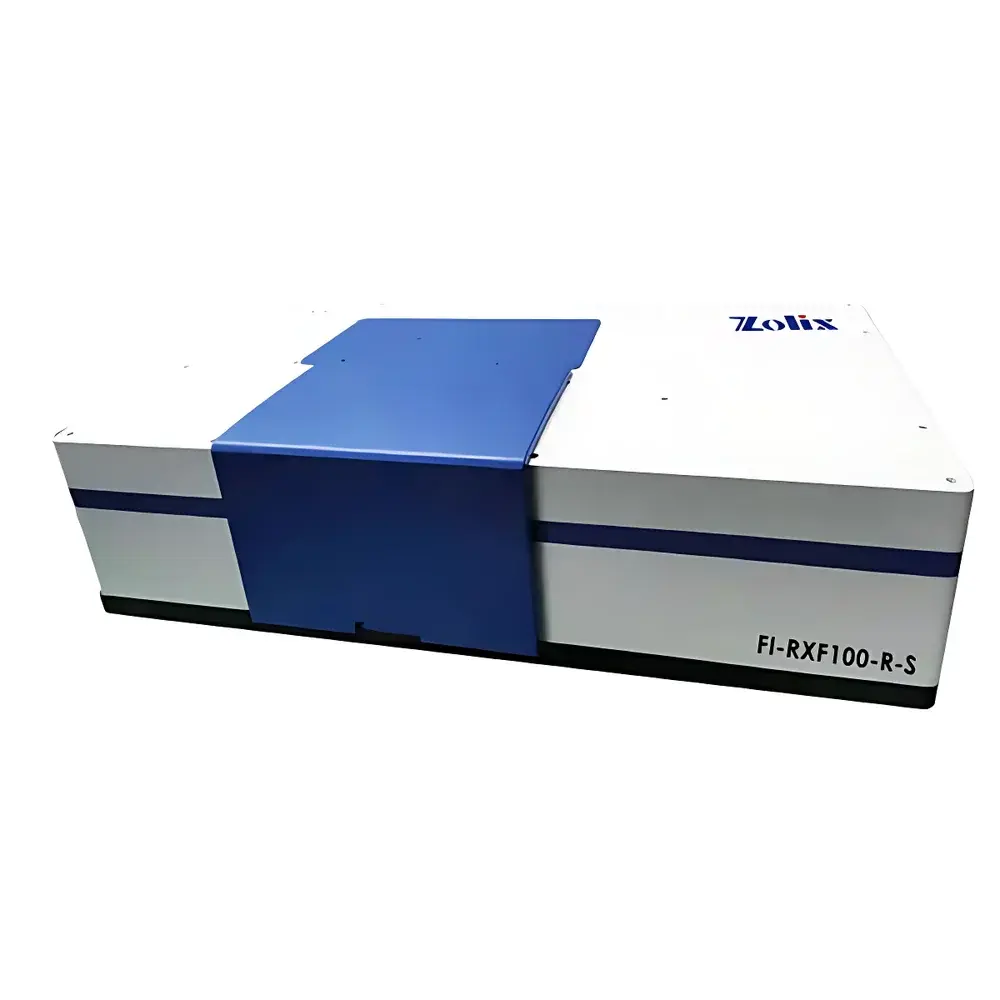
ZOLIX FI-RXF100-R Fourier Transform Infrared (FTIR) Spectrometer
| Brand | ZOLIX |
|---|---|
| Origin | Beijing, China |
| Manufacturer Type | Direct Manufacturer |
| Instrument Type | Laboratory Benchtop FTIR Spectrometer |
| Spectral Resolution | < 0.4 cm⁻¹ |
| Wavenumber Accuracy | < 0.005 cm⁻¹ |
| Spectral Range | 8000–350 cm⁻¹ (standard), optional 5000–500 cm⁻¹ |
| Interferometer | Cube-corner Retroreflector Michelson Interferometer |
| Beam Splitter | Hygroscopic-resistant ZnSe |
| Detector Options | High-sensitivity DLaTGS, TE-cooled MCT, or Liquid-nitrogen-cooled MCT |
| Laser Source | Solid-state HeNe laser (10+ year lifetime) |
| Optical Mirrors | Gold-coated (reflectivity >98% above 2 µm, +5% vs aluminum) |
| Dimensions (L×W×H) | 685 × 415 × 223 mm |
| Weight | 25 kg |
| Sample Compartment | Large-volume, modular, fully accessible for in situ accessories |
Overview
The ZOLIX FI-RXF100-R is a high-performance, laboratory-grade Fourier Transform Infrared (FTIR) spectrometer engineered for precision molecular characterization across solid, liquid, gas, and in situ catalytic systems. Based on the Michelson interferometer architecture with cube-corner retroreflector optics, it delivers exceptional optical path stability, long-term wavenumber reproducibility, and robust immunity to mechanical vibration and thermal drift. Its core measurement principle relies on interferometric encoding of infrared radiation—where broadband IR light from a high-stability ceramic source is split, recombined after variable path difference, and detected as an interferogram; subsequent Fourier transformation yields high-fidelity absorbance or transmittance spectra. Designed for research-grade applications demanding trace-level sensitivity and quantitative reliability, the FI-RXF100-R supports full compliance with ASTM E1421, ISO 17025 calibration traceability frameworks, and GLP-aligned spectral acquisition workflows.
Key Features
- Hermetically sealed optical bench with anti-humidity ZnSe beam splitter and windows—eliminates desiccant maintenance and prevents spectral artifacts from moisture absorption.
- Large-volume sample compartment (≥12 L usable volume) accommodates standard transmission cells, ATR accessories, integrating spheres, and custom in situ reactors—including high-temperature/pressure diffuse reflectance cells with dual BaF₂ windows and sapphire observation port.
- Externally adjustable precision aperture with mechanical gain staging—enables real-time optimization of signal-to-noise ratio (SNR) without software intervention, critical for low-light or highly scattering samples.
- Gold-coated optical mirrors throughout the beam path—providing >98% reflectivity in mid- to far-IR regions and superior oxidation resistance versus aluminum coatings, ensuring long-term radiometric stability.
- Modular detector compatibility: Standard DLaTGS for routine analysis; TE-cooled MCT for rapid-scanning kinetics; liquid-nitrogen-cooled MCT for highest sensitivity in low-concentration gas-phase or surface adsorption studies.
- Integrated solid-state HeNe laser reference (10+ year operational lifetime) ensures sub-pixel interferogram sampling accuracy and eliminates alignment drift over extended acquisition periods.
Sample Compatibility & Compliance
The FI-RXF100-R supports universal IR measurement modalities: transmission (KBr pellets, thin films, sealed liquid cells), attenuated total reflection (ATR) using diamond, ZnSe, or Ge crystals, diffuse reflectance (DRIFTS), and specular reflection (with fixed- or variable-angle accessories). Its large chamber enables seamless integration of in situ/operando accessories—including temperature-controlled DRIFTS cells (RT to 800 °C), stainless-steel gas cells (path lengths: 1.5–500 cm), and corrosion-resistant flow reactors compatible with H₂S, NH₃, Cl₂, or HF environments. All hardware and firmware are designed to support audit-ready data integrity: spectral metadata (date/time, operator ID, instrument parameters) is embedded in each FID and processed spectrum; raw interferograms are retained by default; optional 21 CFR Part 11-compliant software modules provide electronic signatures, role-based access control, and immutable audit trails.
Software & Data Management
The instrument operates with ZOLIX’s proprietary SpectraPro™ acquisition and processing suite—built on a deterministic real-time kernel for jitter-free interferogram digitization at up to 100 kHz sampling rates. Key capabilities include automated background subtraction (N₂ purge or evacuated path), real-time spectral ratioing (e.g., time-resolved adsorption kinetics), multi-point baseline correction, and peak deconvolution using constrained Voigt fitting. Processed spectra export in ASTM E131-compliant JCAMP-DX format; raw interferograms are stored in IEEE 754-compliant binary format. The software architecture supports batch processing of hundreds of spectra, scripting via Python API (PySpectra SDK), and direct integration with LIMS platforms through HL7 and ASTM E2500-07 interfaces. All spectral libraries (polymer, pharmaceutical, catalyst, gas-phase) are NIST-traceable and version-controlled.
Applications
The FI-RXF100-R is extensively deployed in heterogeneous catalysis research, where its in situ DRIFTS capability enables quantitative monitoring of surface adsorbates (e.g., CO, NO, pyridine, NH₃) under controlled temperature, pressure, and gas composition. It supports kinetic modeling of adsorption/desorption isotherms (Langmuir–Freundlich), acid–base site quantification via probe molecule titration, and mechanistic elucidation of reaction intermediates during CO₂ hydrogenation or selective catalytic reduction (SCR). Beyond catalysis, it serves in polymer degradation analysis (oxidation index, crystallinity), pharmaceutical polymorph identification (USP ), semiconductor thin-film thickness profiling (via interference fringe analysis), and environmental gas monitoring (ppb-level VOC detection using multipass cells). Its modular design allows adaptation to hyphenated techniques—including FTIR–GC coupling and simultaneous IR–Raman operando cells.
FAQ
What spectral resolution and wavenumber accuracy does the FI-RXF100-R achieve?
It delivers spectral resolution better than 0.4 cm⁻¹ and wavenumber accuracy better than 0.005 cm⁻¹, verified against NIST-traceable polystyrene film standards per ASTM E1421.
Can the instrument be used for high-temperature in situ DRIFTS experiments?
Yes—the optional stainless-steel DRIFTS reactor supports continuous operation from ambient to 800 °C, with integrated K-type thermocouples, water-cooled flanges, and vacuum-compatible sealing (down to 10⁻⁶ torr).
Is the system compliant with regulatory data integrity requirements?
When configured with SpectraPro™ GxP Edition, it meets FDA 21 CFR Part 11, EU Annex 11, and ISO/IEC 17025 requirements for electronic records and signatures.
Which detector options are available for low-concentration gas-phase analysis?
For maximum sensitivity in trace gas detection, the liquid-nitrogen-cooled MCT detector is recommended—offering noise-equivalent power (NEP) < 1×10⁻¹⁰ W/Hz½ in the 4000–600 cm⁻¹ range.
Does the system support third-party accessory integration?
Yes—standard 50.8-mm optical rails, SMA905 fiber ports, and programmable TTL I/O enable plug-and-play interfacing with commercial gas dosing systems, mass spectrometers, and electrochemical cells.





