
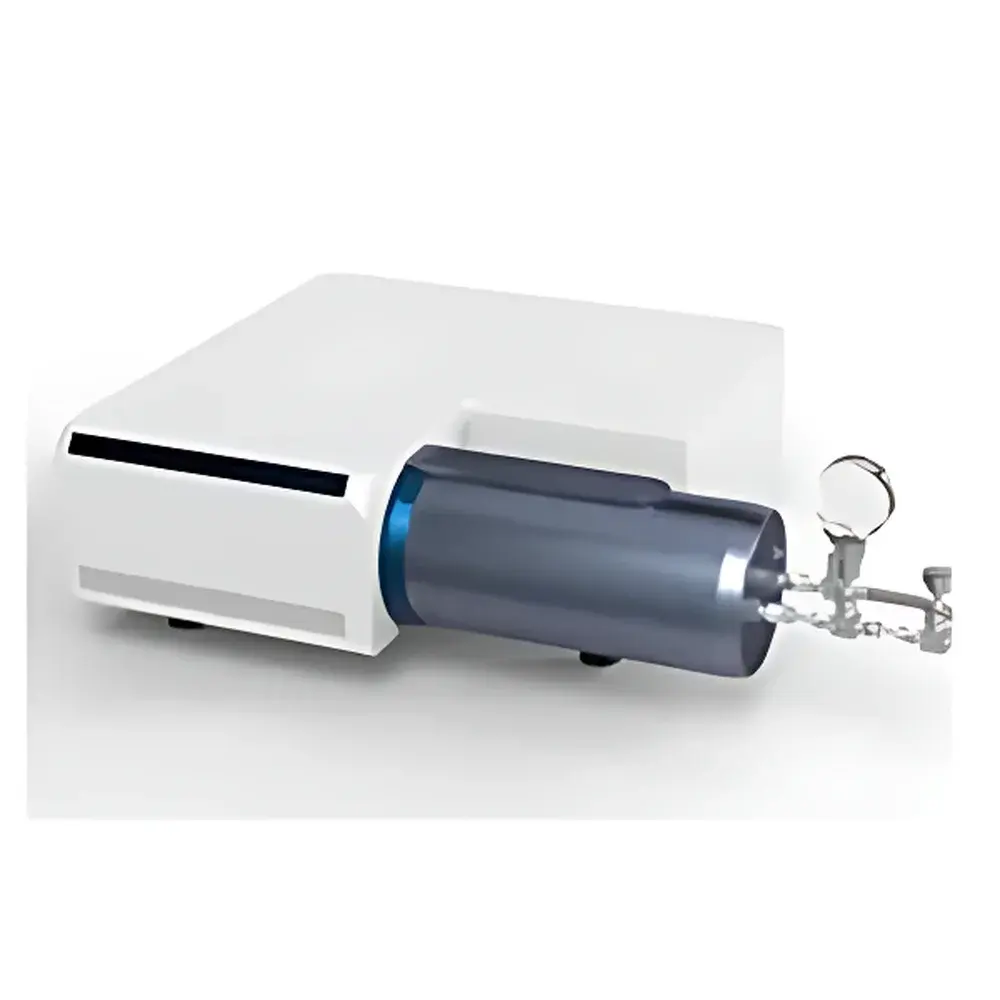
ZOLIX Gas Raman Analyzer
| Brand | ZOLIX |
|---|---|
| Model | Gas Raman Analyzer |
| Origin | Beijing, China |
| Manufacturer | ZOLIX Optics Co., Ltd. |
| Type | Raman Spectroscopy-Based Gas Analyzer |
| Laser Excitation | 532 nm (0–1.5 W, power stability <3% RMS) |
| Optical Architecture | High-throughput transmissive imaging spectrometer with deep-cooled high-sensitivity CCD/CMOS detector |
| Enhanced Optical Path | Optimized Raman collection geometry with gas cell integration |
| Detection Modes | Static gas cell, high-pressure folded-path cell, integrating sphere, photonic crystal fiber (PCF) gas cell |
| Compliance | Designed for GLP/GMP-aligned operation |
Overview
The ZOLIX Gas Raman Analyzer is a purpose-built, benchtop Raman spectroscopy system engineered for selective, quantitative, and real-time analysis of gaseous species in industrial and laboratory environments. Unlike absorption-based techniques—such as Fourier-transform infrared (FTIR) or tunable diode laser absorption spectroscopy (TDLAS)—this instrument leverages the intrinsic vibrational Raman scattering phenomenon, enabling direct detection of homonuclear diatomic molecules (e.g., N₂, O₂, H₂) that are IR-inactive. The system operates on the principle of inelastic photon scattering: monochromatic 532 nm laser light interacts with molecular bonds, generating Stokes-shifted photons whose spectral positions correspond to unique rotational-vibrational energy transitions. These “molecular fingerprints” allow unambiguous identification and concentration quantification without chemical derivatization or separation steps.
Key Features
- 532 nm solid-state laser source with adjustable output (0–1.5 W) and RMS power stability better than 3%, ensuring signal reproducibility across extended acquisition periods.
- High-throughput transmissive imaging spectrometer optimized for Raman shift coverage from 100 cm⁻¹ to 3500 cm⁻¹ at ≤4 cm⁻¹ spectral resolution (FWHM), supporting multi-component gas mixture deconvolution.
- Deep-cooled scientific-grade CCD or back-illuminated CMOS detector (−60 °C operating temperature), delivering low dark current and high quantum efficiency in the visible-NIR range.
- Modular gas cell interface accommodating multiple configurations: standard static cell, high-pressure folded-path cell (up to 10 atm), integrating sphere (for heterogeneous phase compatibility), and photonic crystal fiber (PCF) gas cell for ultrafast in-situ response (sub-second duty cycle).
- No consumables, no carrier gases, no chromatographic columns—enabling continuous unattended operation with minimal maintenance overhead.
- Immunity to water vapor interference: Raman cross-sections of H₂O are orders of magnitude lower than those of target analytes such as CH₄, CO₂, or C₂H₆ under typical process conditions, eliminating calibration drift due to ambient humidity.
Sample Compatibility & Compliance
The analyzer supports direct analysis of undiluted, pressurized, or ambient-pressure gas streams—including corrosive, explosive, or moisture-laden matrices—without pre-treatment. It complies with fundamental spectroscopic measurement standards referenced in ASTM E1840 (Standard Guide for Raman Shift Standards), ISO 8573-1 (compressed air purity classes), and IEC 60079-0 (explosion protection for instrumentation used in hazardous areas—when configured with appropriate enclosures). System firmware and embedded acquisition software support electronic record integrity per FDA 21 CFR Part 11, including role-based user authentication, time-stamped audit trails, and immutable raw data storage.
Software & Data Management
Acquisition and analysis are performed via ZOLIX’s proprietary RamanSuite™ software, a Windows-based platform featuring spectral preprocessing (cosmic ray removal, baseline correction, fluorescence subtraction), multivariate curve resolution (MCR), and partial least squares (PLS) regression models calibrated against NIST-traceable gas standards. All spectra are stored in HDF5 format with embedded metadata (laser power, integration time, temperature, pressure, cell path length). Export options include CSV, ASCII, and JCAMP-DX for third-party chemometric tools. Remote monitoring and scheduled automated measurements are supported via TCP/IP interface and RESTful API.
Applications
- Transformer oil-gas dissolved gas analysis (DGA) for early detection of insulation aging and thermal faults in power substations.
- Real-time hydrocarbon profiling during petroleum well logging—simultaneous quantification of CH₄, C₂H₆, C₃H₈, CO₂, and H₂S in drill-cuttings headspace.
- In situ monitoring of off-gas composition in lithium-ion battery formation and aging tests, tracking CO, CO₂, H₂, and electrolyte decomposition volatiles.
- Continuous emission monitoring (CEM) of refinery flare stacks and catalytic cracker effluents for regulatory reporting (EPA Method 320 compliance support).
- Process gas analysis in blast furnace top-gas recycling loops, measuring CO, CO₂, N₂, H₂, and CH₄ for energy recovery optimization.
FAQ
Does the system require calibration with certified gas standards?
Yes—quantitative analysis requires initial PLS or MCR model development using traceable gas mixtures. Once validated, field recalibration intervals are typically 3–6 months depending on operational severity.
Can it distinguish structural isomers (e.g., n-butane vs. isobutane)?
Yes—the Raman shifts of C–C skeletal vibrations and methyl group deformations differ measurably between isomers, enabling discrimination when spectral resolution and signal-to-noise ratio permit.
Is vacuum or purge gas required for optical path integrity?
No—optical train is sealed and purged internally during manufacturing. Ambient air operation is fully supported; optional nitrogen purge can be added for UV-sensitive applications.
What is the typical limit of detection (LOD) for methane in atmospheric pressure air?
Under standard configuration (100 s integration, 1 atm, 10 cm path), LOD is ~5 ppmv for CH₄. With high-pressure folded-cell option (10 atm), LOD improves to sub-ppmv levels.
Is photonic crystal fiber (PCF) cell compatible with high-temperature sampling?
Standard PCF cells operate up to 80 °C; custom high-temp variants with metal-jacketed fused silica PCF are available upon request, rated to 200 °C.
Related Products




