
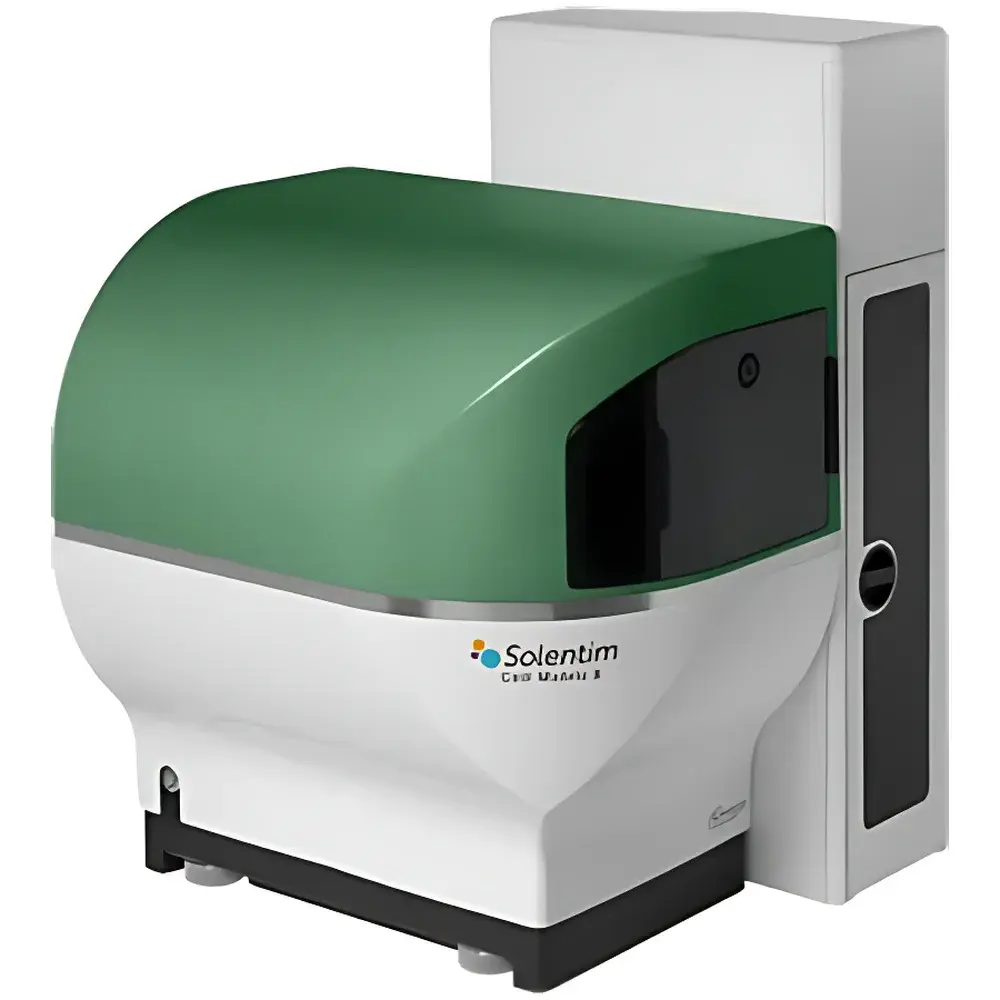
Solentim Cell Metric® X High-Contrast Clonal Imaging System
| Brand | Solentim |
|---|---|
| Origin | United Kingdom |
| Manufacturer | Solentim Ltd. |
| Model | Cell Metric® X |
| Type | Automated High-Content Clonal Imaging and Verification System |
| Compliance | Designed for GLP/GMP-aligned workflows, supports 21 CFR Part 11–compliant audit trails via STUDIUS platform |
| Automation Interface | Compatible with third-party robotic arms (e.g., Hamilton, Tecan) via standard API and physical stacker interface (10-plate capacity) |
Overview
The Solentim Cell Metric® X is an automated, high-contrast clonal imaging system engineered for early-stage monoclonal antibody (mAb) and recombinant protein development in biopharmaceutical R&D and cell line development (CLD) laboratories. It operates on the principle of brightfield and phase-contrast digital microscopy combined with AI-driven image segmentation and single-cell tracking—enabling unambiguous Day 0 monoclonality verification without fluorescent labeling or destructive sampling. Unlike conventional colony-picking or endpoint assays, the Cell Metric® X captures time-resolved images of individual wells across multi-well plates (96-, 384-, and 1536-well formats), reconstructing lineage trees to confirm origin from a single progenitor cell. This capability directly addresses ICH Q5D and USP <1043> guidance on clonality assurance and supports regulatory submissions—including IND/IMPD dossiers—by providing objective, traceable, and auditable evidence of monoclonal origin.
Key Features
- Day 0 monoclonality verification: Captures high-resolution, high-contrast images within 2–4 hours post-seeding, enabling definitive identification of single-cell-derived colonies before division.
- AI-powered Automated Clone Confirmation (AEC) module: A validated deep learning algorithm trained on >10,000 manually annotated clonal events; delivers >99.2% precision and >98.7% recall in single-cell detection under standard assay conditions.
- Integrated 10-plate stacker: Supports unattended operation across multiple plates; designed with standardized mechanical footprints and API endpoints for seamless integration into automated CLD workflows (e.g., with Hamilton VANTAGE or Tecan Fluent systems).
- Optimized optical architecture: Dual-path illumination (LED-based brightfield + optimized phase contrast) minimizes halo artifacts and enhances edge definition for low-contrast adherent and suspension-derived clones.
- Regulatory-ready data integrity: All image metadata—including timestamps, focus parameters, environmental logs (ambient temperature/humidity), and user actions—are embedded and cryptographically signed at acquisition.
Sample Compatibility & Compliance
The Cell Metric® X accommodates standard SBS-compliant microplates (including skirted, semi-skirted, and low-profile variants) and supports both adherent (e.g., CHO-K1, HEK293) and suspension-adapted (e.g., CHO-S, Expi293F) cell lines. It has been validated for use with common cloning matrices including methylcellulose, soft agar, and collagen-coated surfaces. The system complies with ISO 13485:2016 quality management requirements for medical device manufacturers and is designed to operate within GLP and GMP environments. When deployed with STUDIUS software configured for 21 CFR Part 11 compliance, it provides electronic signatures, role-based access control, and immutable audit trails—meeting FDA and EMA expectations for clonality documentation in biologics development.
Software & Data Management
STUDIUS is Solentim’s enterprise-grade data management platform, serving as the central hub for image ingestion, analysis, reporting, and long-term archival. It ingests raw TIFF sequences from the Cell Metric® X, applies batch-normalized AEC analysis, and generates standardized PDF reports compliant with internal SOPs and external regulatory templates. STUDIUS supports structured data export (CSV, JSON-LD) for LIMS and ELN integration and includes built-in version control for analysis pipelines. All image datasets are stored with SHA-256 checksums; modifications trigger automatic rehashing and event logging. Optional modules include multi-user review workflows, deviation flagging (e.g., doublets, debris contamination), and statistical process control (SPC) dashboards for clone selection metrics.
Applications
- Monoclonal cell line development: Accelerating selection of high-producing, genetically stable clones for upstream process development.
- Regulatory dossier preparation: Generating auditable clonality evidence for IND, BLA, and MAA submissions per ICH, FDA, and EMA expectations.
- Process characterization studies: Correlating early clonal morphology with productivity, glycosylation profiles, and stability attributes.
- CRISPR/Cas9 and gene editing validation: Confirming monoclonality after single-cell sorting of edited populations.
- Contract development and manufacturing organizations (CDMOs): Enabling standardized, transferable clonality workflows across client projects.
FAQ
What does “Day 0 monoclonality verification” mean in practice?
It refers to imaging and computational confirmation that a visible colony originated from one cell—performed within hours of plating, prior to the first mitotic division. This eliminates reliance on retrospective inference based on colony morphology or growth kinetics.
Can the Cell Metric® X be used with non-standard plate formats or custom substrates?
Yes—through optional calibration protocols and user-defined region-of-interest (ROI) mapping; however, full validation support is provided only for SBS-standard plates and Solentim-qualified matrices.
Is the AEC algorithm qualified for use in GMP environments?
Yes—the AEC module undergoes annual requalification per Solentim’s IQ/OQ/PQ protocol suite and is documented in the system’s Design Qualification (DQ) report, available upon request under NDA.
How is data backup and disaster recovery handled in STUDIUS?
STUDIUS supports configurable replication to on-premise NAS or cloud object storage (AWS S3, Azure Blob); all backups retain cryptographic integrity verification and timestamped version history.
Does the system require routine optical recalibration?
No—optical alignment is factory-set and locked; only periodic verification using Solentim’s NIST-traceable calibration slide is recommended every six months or after transport.





