
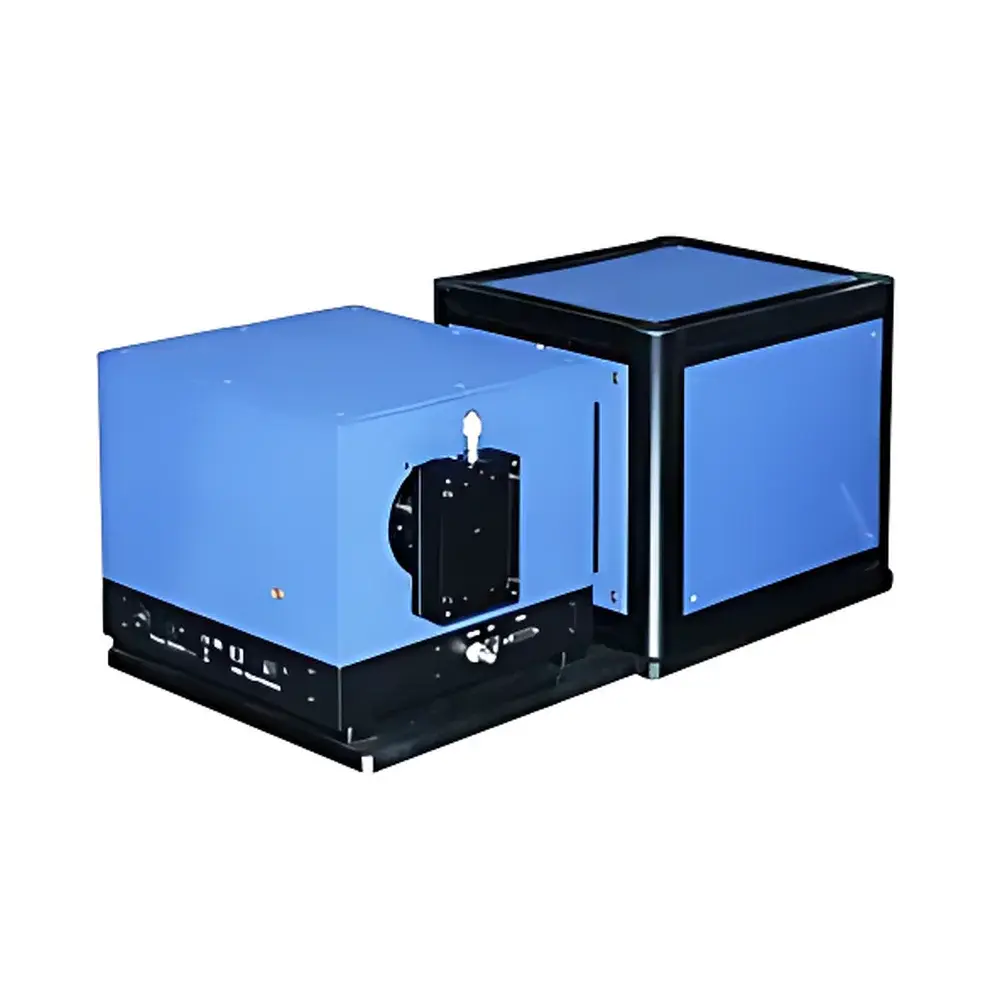
ZOLIX TLSE1805i-X150 Enhanced Tunable Xenon Light Source
| Brand | ZOLIX |
|---|---|
| Origin | Beijing, China |
| Manufacturer Type | OEM Manufacturer |
| Product Origin | Domestic (China) |
| Model | TLSE1805i-X150 |
| Pricing | Upon Request |
| Monochromator | Omni-λ1805i Imaging Spectrograph |
| Light Source | 150 W Imported Xenon Arc Lamp |
| Spectral Range (recommended) | 250–1500 nm |
| Output Bandwidth (recommended) | 2–10 nm |
| Output Bandwidth Tuning Range | 0.3–20 nm |
| Grating #1 | 1200 grooves/mm @ 300 nm |
| Grating #2 | 600 grooves/mm @ 750 nm |
| Filter Transmission Range | 200–1500 nm |
| Output Power (monochromatic) | ≥0.2 mW (@ 500 nm, 5 nm bandwidth, 1200 g/mm grating) |
| Power Stability | < ±0.5% RMS over 1 hour |
Overview
The ZOLIX TLSE1805i-X150 is an engineered tunable monochromatic light source designed for high-fidelity spectral characterization in optical metrology, photoluminescence excitation spectroscopy, quantum efficiency measurement, and photochemical reaction studies. It integrates a stabilized 150 W imported xenon short-arc lamp with the Omni-λ1805i imaging spectrograph — a precision monochromator utilizing aspheric image-corrected optics to minimize astigmatism and optimize spatial recombination of off-axis rays at the focal plane. This optical architecture ensures superior signal throughput and wavelength fidelity compared to conventional Czerny-Turner monochromators, delivering more than 2× higher photon collection efficiency across the UV-VIS-NIR range (250–1500 nm). The system supports both open-beam and fully enclosed configurations, enabling flexible integration into vacuum chambers, cryostats, or custom optical tables while maintaining thermal and mechanical stability under prolonged operation.
Key Features
- High-stability 150 W xenon arc lamp with certified spectral output and long-life imported bulb (rated >1000 h)
- Omni-λ1805i imaging monochromator featuring dual-grating turret (1200 g/mm @ 300 nm and 600 g/mm @ 750 nm) for optimized resolution and throughput trade-offs
- Continuously adjustable entrance/exit slits (0.01–3 mm), enabling precise control of spectral bandwidth from 0.3 nm to 20 nm
- Recommended operational bandwidth of 2–10 nm, balancing spectral purity and irradiance for quantitative excitation applications
- Integrated broadband filter wheel (200–1500 nm transmission range) to suppress higher-order diffraction and stray light
- Optomechanical design compliant with ISO 10110 surface quality standards; all optical mounts are kinematically constrained and vibration-damped
- Optional motorized wavelength scanning and automated grating selection via RS232/USB interface
Sample Compatibility & Compliance
The TLSE1805i-X150 is compatible with standard optical breadboards (M6/M4 tapped holes), fiber-coupled input/output ports (SMA905), and modular sample holders for thin films, powders, liquids, and semiconductor wafers. Its spectral calibration traceability aligns with NIST-traceable reference lamps (e.g., FEL-type tungsten halogen standards), supporting compliance with ISO/IEC 17025 laboratory accreditation requirements. When operated with calibrated photodiodes and spectroradiometers, the system satisfies ASTM E308 (computing colorimetric quantities) and ISO 11664-3 (CIE colorimetry) for radiometric validation. The xenon lamp’s stable UV output enables adherence to IEC 61215 (photovoltaic module testing) and JIS C 8901 (lighting spectral evaluation) protocols.
Software & Data Management
Control is facilitated through ZOLIX’s proprietary LightMaster™ software (Windows 10/11, 64-bit), offering wavelength sweep programming, real-time power monitoring, multi-point intensity logging, and export to CSV/HDF5 formats. The software implements audit-trail functionality per FDA 21 CFR Part 11 requirements — including user authentication, electronic signatures, and immutable timestamped event logs — making it suitable for GLP/GMP-regulated environments. Third-party integration is supported via LabVIEW VIs, Python (PyVISA), and MATLAB instrument control toolboxes. All firmware updates are digitally signed and verified prior to installation.
Applications
- Excitation spectroscopy of quantum dots, perovskites, and organic semiconductors
- External quantum efficiency (EQE) and incident photon-to-current efficiency (IPCE) mapping of photovoltaic devices
- Time-resolved photoluminescence (TRPL) pump-probe experiments requiring narrowband, high-stability excitation
- Calibration of CCD/CMOS sensors, spectroradiometers, and hyperspectral imagers
- Photochemical kinetics studies under controlled monochromatic irradiation (e.g., photocatalysis, ROS generation)
- Reflectance and transmittance measurements of optical coatings and metamaterials
FAQ
What is the typical warm-up time required to achieve spectral stability?
The xenon lamp requires approximately 15 minutes of continuous operation to reach thermal equilibrium; power stability better than ±0.5% RMS is achieved within this period and maintained for ≥1 hour.
Can the system be configured for vacuum-compatible operation?
Yes — the enclosed TLSE1805i-X150A variant features CF-40 flanges and stainless-steel housing options rated for ≤10⁻⁵ mbar base pressure.
Is NIST-traceable spectral irradiance calibration available?
ZOLIX offers optional factory calibration using a NIST-traceable spectroradiometer (Hamamatsu CS-2000), delivered with full uncertainty budget and certificate of calibration.
How is stray light suppressed across the UV-NIR range?
Stray light is minimized through a combination of double-monochromator-grade grating coatings, order-sorting filters (200–1500 nm), and internal baffling aligned to ISO 9022-5 scattering specifications.
What maintenance intervals are recommended for the xenon lamp and optical components?
Lamp replacement is advised after 1000 hours of cumulative operation; mirror reflectivity and grating efficiency should be verified annually using a reference photodiode and spectral scan baseline.





